12 V Refrigerator Runtime from a Portable Power Station
Check a compressor fridge or cooler's exact DC input and measure energy before estimating runtime from a station's 12 V output.
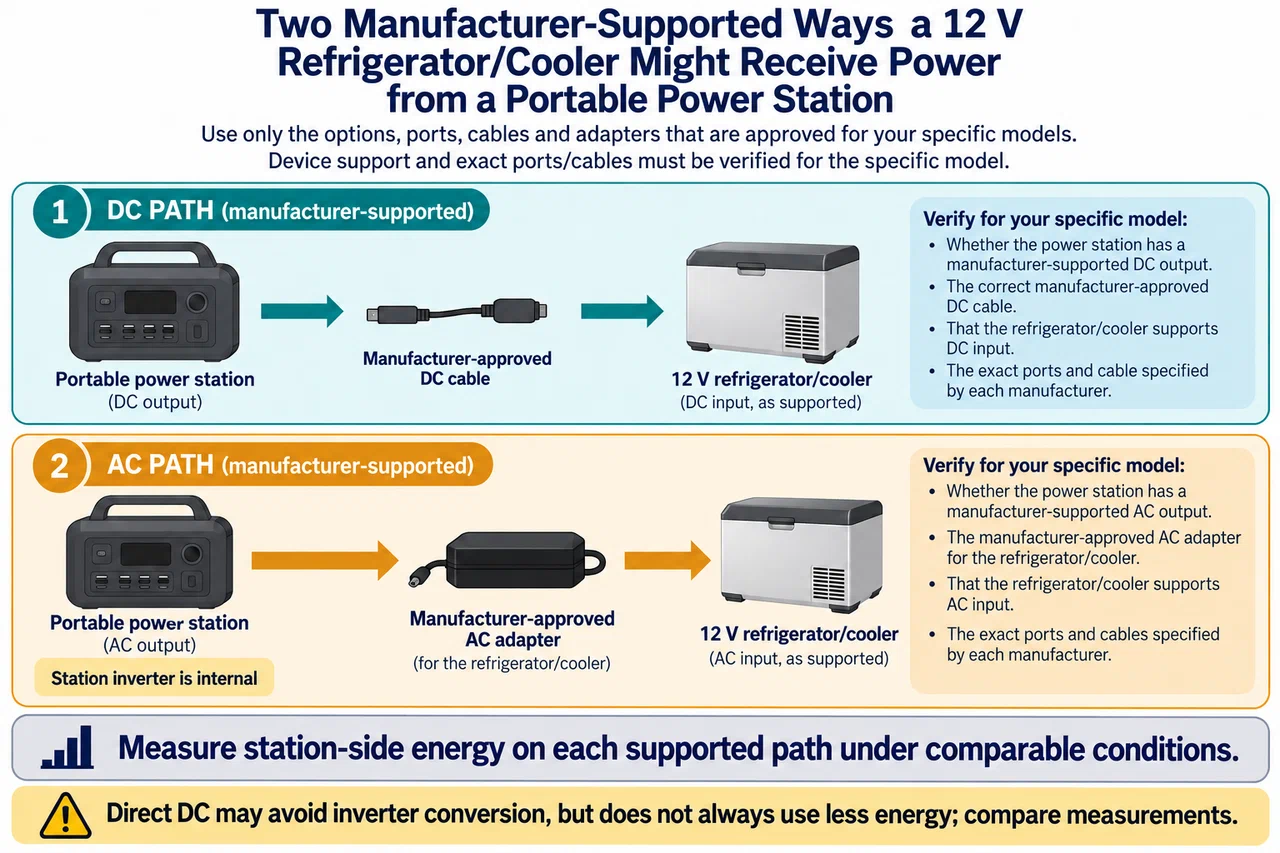
A 12 V compressor refrigerator can avoid the station’s AC inverter, but direct DC is not automatically the better or compatible path. The fridge may require a voltage range, current, connector, polarity, and cable that a station’s outlet does not provide. Start with the exact fridge model and the station manual, then compare measured energy for each supported path.
Identify the fridge’s input
Record the complete model and regional version, the input voltage range, rated or maximum current, connector, polarity, fuse requirements, and low-voltage behavior. “12 V” is not one universal connection standard. Some coolers accept a broad DC range, some require a vehicle-style socket, and others use a named cable or adapter. Do not cut, splice, or adapt a cable based only on a matching plug.
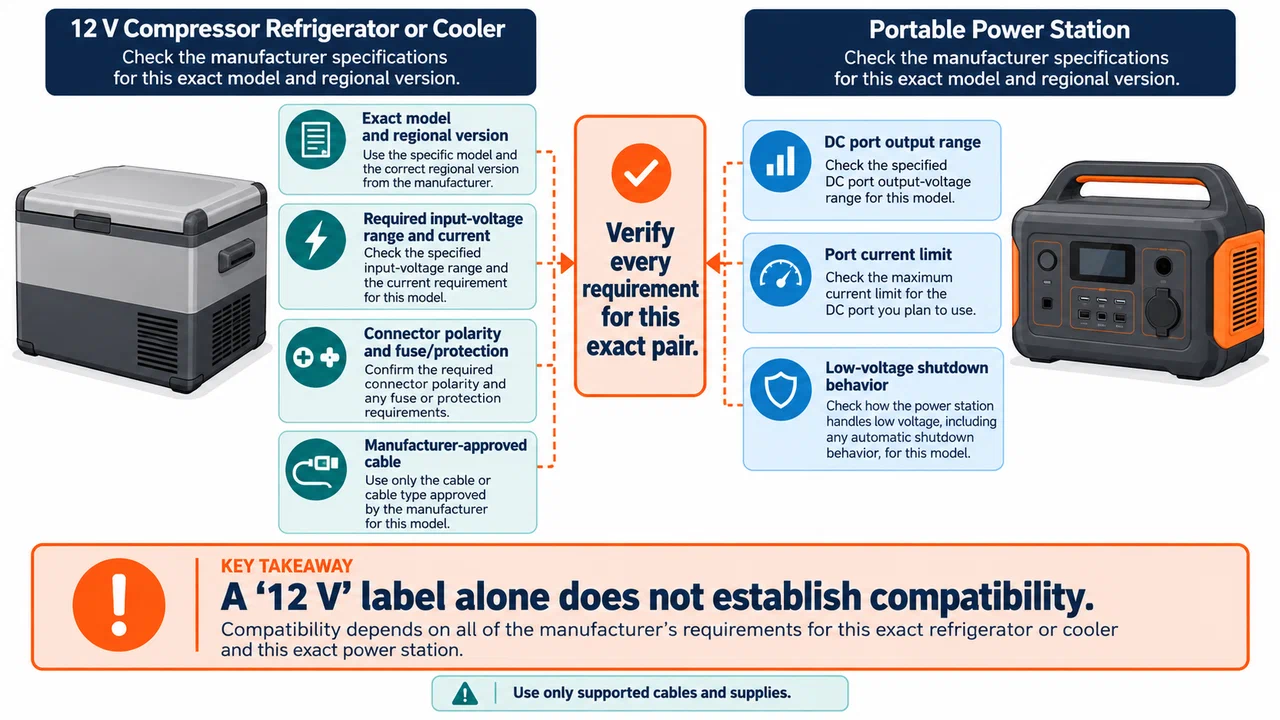
Product labels describe different things. The CFX5 manual lists DC input options of 12 V and 24 V and AC input of 100–240 V, but it does not give rated-current values. Confirm the exact regional unit label and measure energy under the intended settings; do not infer average draw from a voltage range. Whynter’s FM-45G lists up to 4.5 A at 12 V and 2.5 A at 24 V DC, alongside a separate AC maximum. Neither figure says how many amp-hours the compressor will use over a day. A Makita DCW180 cooler/warmer lists separate cooling and heating input figures and accepts a specified battery platform or 12/24 V vehicle input; its modes and power path should not be merged with a refrigerator profile. The manual’s battery operating-time examples also depend on exact ambient and control temperatures; see the DCW180 runtime guide rather than applying them to another cooler or a power station.
Measure cycling energy under realistic conditions
A compressor switches between running and resting. Average energy changes with ambient temperature, the setpoint, ventilation, insulation, food temperature, lid openings, and whether the unit is cooling or freezing. Dometic explains that its CFX3 average consumption depends on ambient and internal temperatures and compressor cycling. If the maker gives a method using amp-hours per hour, use the exact model’s conditions.
A useful field measurement is watt-hours over a complete, representative interval from the station’s DC output. Record voltage and current if the station reports them, temperature, setpoint, and compressor activity. Test long enough to capture several cycles. An instantaneous current reading or the rated maximum is not a daily-energy estimate.
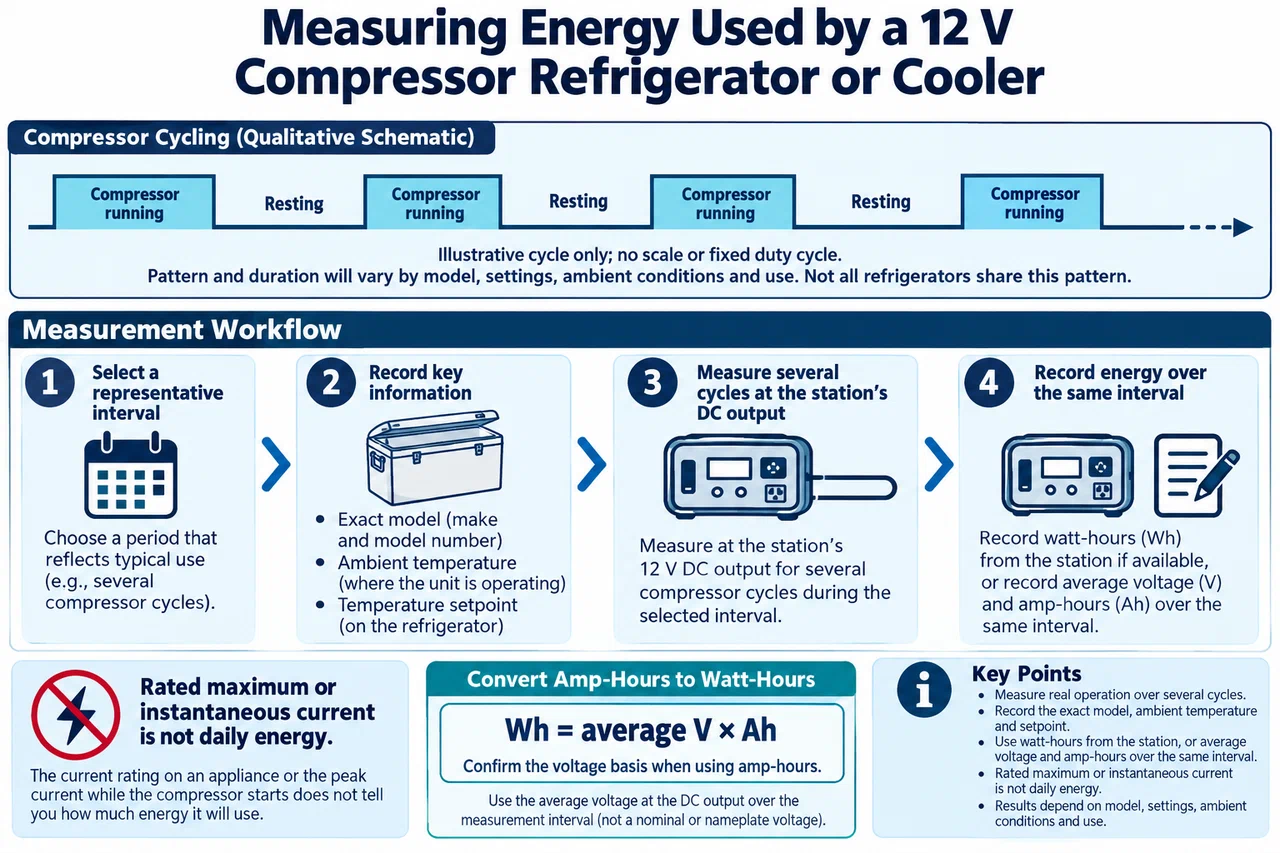
Convert measured DC energy to the units used by the station: Wh = average volts × amp-hours for a measured interval. If the station reports amp-hours, confirm the voltage basis. The runtime estimate is then usable station energy on that DC port divided by measured fridge energy per hour or day. Include reserve and any output shutdown threshold. Do not treat a car-port amp rating as the station’s usable battery capacity.
Compare DC with AC carefully
If the refrigerator has an approved AC supply, compare the two paths with measurements at the station. The DC path may avoid inverter conversion, while the AC path may have a lower or higher total loss depending on the adapters and device. Use only manufacturer-supported cables and supplies. A compatible voltage number alone does not verify connector polarity, overcurrent protection, or stable operation.
A Goal Zero Alta 50 page gives an 8 W average and 192 Wh/day under a stated 2 °C condition, and an 80 W rated input. That European-page example is useful for understanding the difference between average energy and the input ceiling, but it is not an independent test or a promise for another cooler or setpoint. Its accompanying Yeti 1500X example also does not establish compatibility with a different station or regional supply; verify both exact models.
Plan for hot weather and recharge
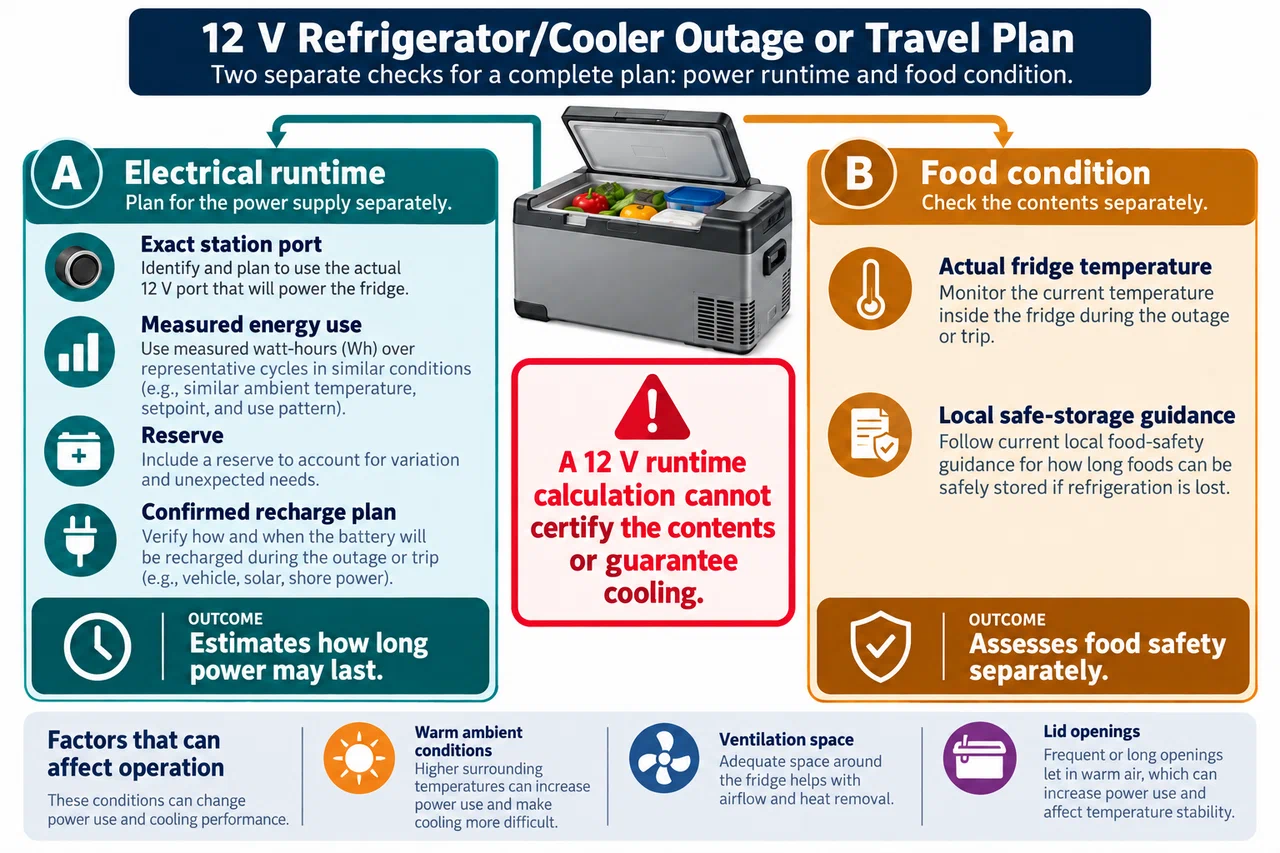
Leave the fridge the ventilation space its manual specifies. Limit warm starts and unnecessary openings, and add the expected recharge interval, solar conditions, or vehicle charging only after checking those input limits. For food, temperature and safe-storage guidance are separate from battery runtime. A 12 V calculation cannot certify the contents or guarantee cooling if the port trips, the battery empties, or the connector disconnects. Test the exact station and fridge together before relying on them for travel or an outage.