How Long a Portable Power Station Can Run a Chest Freezer
Estimate chest-freezer energy from the exact unit and measured cycles; keep electrical runtime separate from closed-door food preservation.
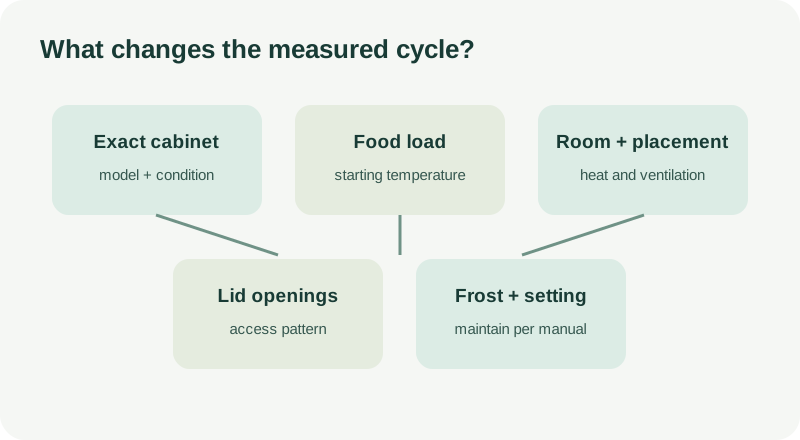
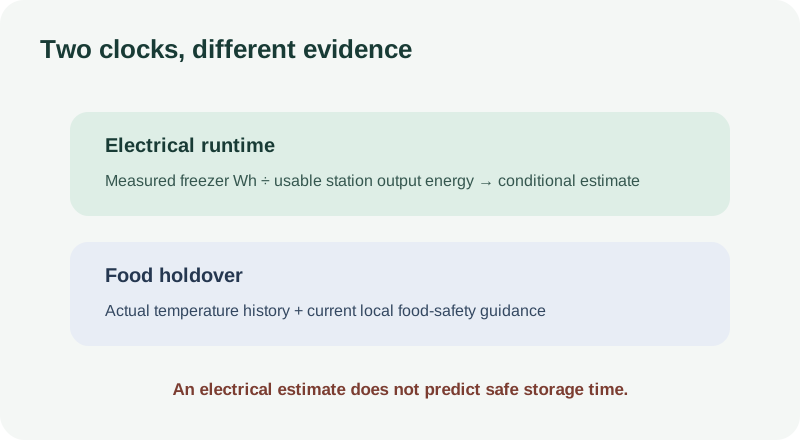
A chest freezer’s electrical runtime depends on its exact model, temperature setting, room conditions, food load, lid openings, frost, and the station’s conversion path. The cabinet’s ability to hold cold after power stops is a separate question. Neither the freezer’s annual energy label nor a generic “hours without power” figure describes how long a particular station can operate it.
Start with the exact unit
Record the complete model and suffix from the freezer label, the rated supply voltage and frequency, current or watts, and instructions for auxiliary power. Confirm that the station has the correct AC voltage and frequency, a grounded outlet as required, and enough continuous output for the running load. Compressor startup must also succeed; the station’s surge rating should be checked for its duration and operating conditions. A listed peak output or “lifting” feature does not by itself establish compatibility.
Annual certification energy can help identify a product class, but it is not a continuous watt rating or an outage measurement. For example, ENERGY STAR’s GE FCM11PH family certificate reports 218 kWh/year, while the GE FCM11PHWW product page reports 250 kWh/year. The available records do not reconcile those two published figures, and the suffix on the appliance must be matched before using either. Do not divide either annual figure into station capacity and call the result runtime; the certification and product-page values do not show present cycling, startup demand, or the specific cabinet’s conditions.
Measure energy through normal cycles
Use a properly rated energy meter or the station’s output-energy display to measure a representative interval with the freezer closed and operating normally. Include several compressor starts and stops. Record ambient temperature, thermostat position, whether the freezer is near full or lightly loaded, and whether frost is due for removal according to the manual. Avoid turning the thermostat colder than needed or placing hot food in the cabinet just to produce a test. If the intended outage room is much warmer, take a separate measurement under safe, realistic conditions.
Convert the measured Wh to an average only over the same time interval. If the station reports Wh at its outlet, use that result with the selected outlet’s usable energy. Otherwise account for the distinction between battery-side energy and AC energy available to the appliance. Divide usable station output energy by measured freezer energy per hour or per day, then keep a reserve for changing conditions, station shutdown behavior, and recharge uncertainty. Record the estimate as a range when two realistic tests differ; do not create false precision from one short meter reading.
Midea’s manual for the MRC050S0AWW family advises a cool location away from direct sun or heat, notes that large food loads reduce cooling efficiency and hot food makes the compressor run longer, and recommends limiting openings. It also instructs a 3–5 minute wait before restarting after loss of power. Those are use instructions for the named family, not freezer electrical specifications or a guaranteed cooling recovery result. Follow the manual for the exact cabinet and do not interpret its post-disconnection cooldown wording as a food-safe holdover interval.
Keep holdover and food guidance separate
A runtime estimate ends when the station can no longer deliver power or the freezer stops operating. It does not predict how quickly food warms. Cabinet insulation, starting temperature, room temperature, load, lid opening, seals, and time without power all matter. Keep the lid closed and use a suitable thermometer or other applicable monitoring. After an outage, follow current local food-safety guidance for the actual duration and temperature history; this page does not supply a safe-storage time.
For a different cabinet and defrost arrangement, see the upright-freezer runtime guide. Use the runtime calculator with measured energy and review continuous output and startup surge before using the result.