Upright Freezer Runtime from a Portable Power Station
Measure a specific upright freezer's cycling energy and verify startup and supply limits instead of converting annual energy or a closed-door preservation claim into runtime.
An upright freezer is a cycling compressor load. A power station may have ample advertised watt-hours and still fail to start its compressor, while a freezer’s annual energy figure cannot predict how much it will use during a particular outage. Identify the exact unit, confirm output compatibility, and measure representative energy before estimating hours or days.
Identify the configuration
Record the full model suffix, whether the unit is convertible, voltage and frequency, defrost type, control settings, and the rating-plate current. Upright cabinets may lose cold differently from chest models when opened; fan-assisted or automatic-defrost designs also have operating phases a simple running-watts reading will miss.
Whynter’s UDF-0831SS is an 8.3 cubic-foot upright that can operate as a refrigerator or freezer. The product page lists 130 W and 2 A, while the manual has a separate 10 A electrical requirement. The available evidence does not explain how those labels relate to compressor startup, so preserve the discrepancy and use the exact unit’s rating plate and manufacturer guidance. The manual’s “up to 24 hours” closed-door storage statement is not a power-station runtime or a universal food-safety guarantee.
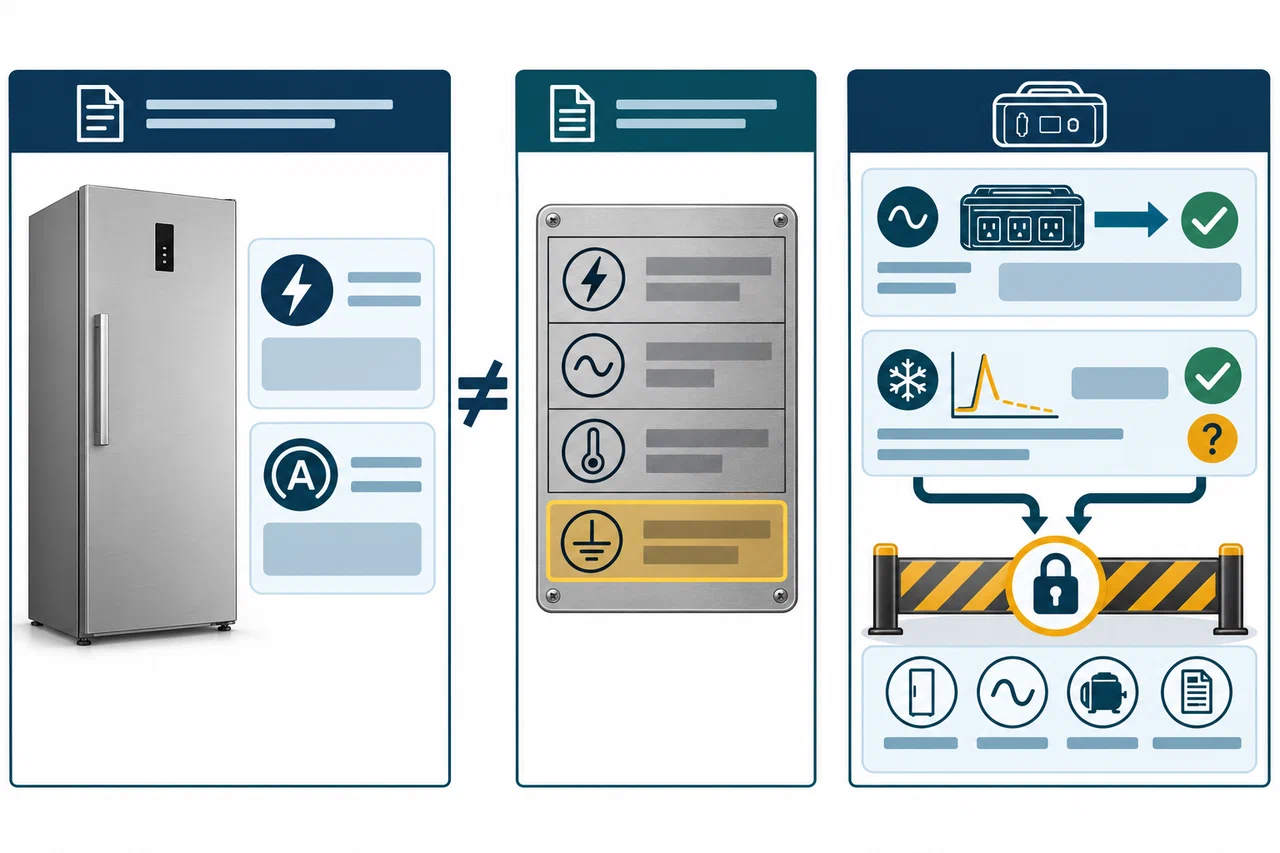
Measure a representative cycle
With a suitable plug-in energy meter, record Wh over enough time to include compressor starts, stable cooling, off cycles, and automatic defrost where applicable. Keep the normal setpoint, room temperature, food load, and door-opening pattern. If a station-side measurement is available, it captures inverter losses that a wall measurement misses. Do not test by opening the appliance or making exposed electrical connections.
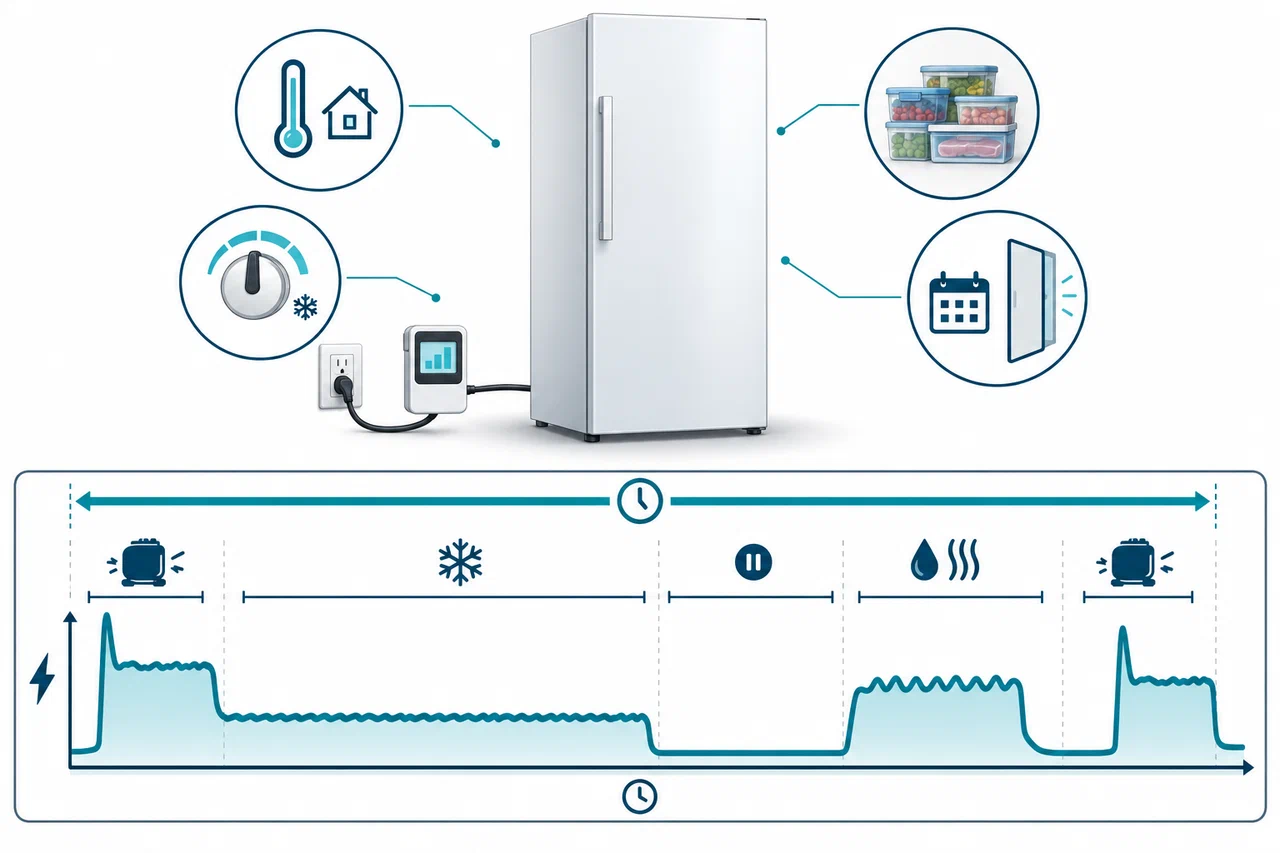
Use measured energy per day rather than a single watts value. If the station provides usable AC energy for this load, estimate days as usable station Wh divided by freezer Wh/day. If you measured at the wall, account for conversion losses where known and present uncertainty where they are not. Reserve capacity for hotter conditions, starts, other loads, battery temperature, and time to recharge.
Check the station before choosing a duration
Confirm matching voltage and frequency, continuous output, and compressor startup capability against the freezer manufacturer’s requirements or an appropriate measured peak. A universal two-times or three-times multiplier cannot establish compatibility. Include simultaneous loads such as the refrigerator, pump, or network equipment.
Check for station AC shutoff behavior at low output and follow the exact station manual. A named station may have settings that affect continuity, but these are model-specific and do not replace an alarm or temperature check. Do not depend on a feature until the freezer and station have been tested together.
Food preservation has a different clock
USDA FSIS gives approximate closed-door guidance of about 48 hours for a full freezer and 24 hours for a half-full freezer during a power outage. Those benchmarks concern food temperature retention, not compressor runtime. Actual safety depends on temperature, how often the door is opened, fill level, food type, and conditions. Follow current local advice and do not use a battery estimate to decide that food is safe.
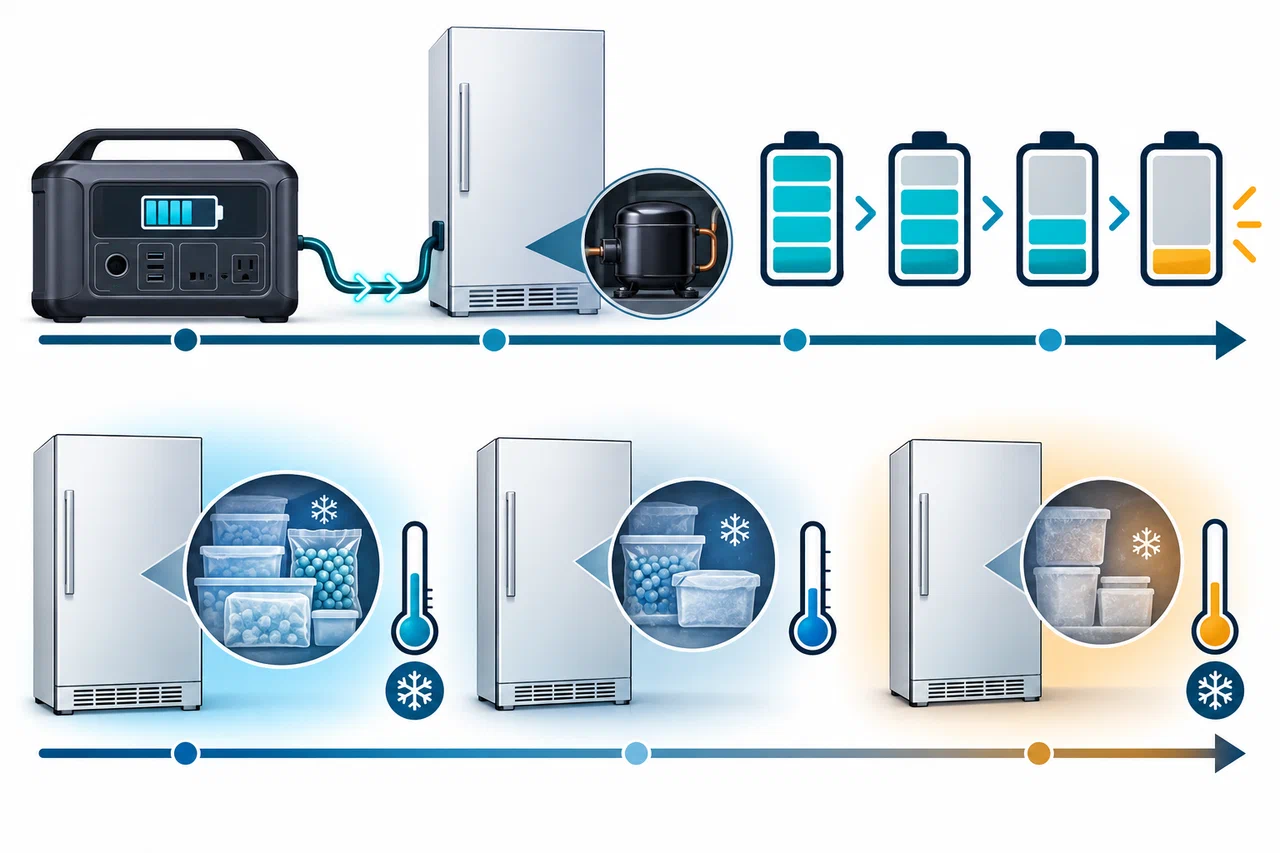
Plan how you will monitor temperatures, reduce door openings, recharge, and move or discard food if the plan fails. For a convertible or upright model, test the actual appliance before the outage; do not substitute chest-freezer behavior or a generic annual kWh label.