How Long a Portable Power Station Can Run a Refrigerator
Measure a household refrigerator through compressor cycles and check station output before estimating outage runtime.
A household refrigerator does not draw its compressor rating continuously: a 100 W label does not mean a 100 W draw around the clock. It cycles, and energy use varies with the exact unit, room temperature, setpoint, contents, door openings, defrost, and seal condition. Start with measured representative use, then check whether the station can start and continuously support the appliance. Battery capacity alone answers neither question.
Measure a representative interval
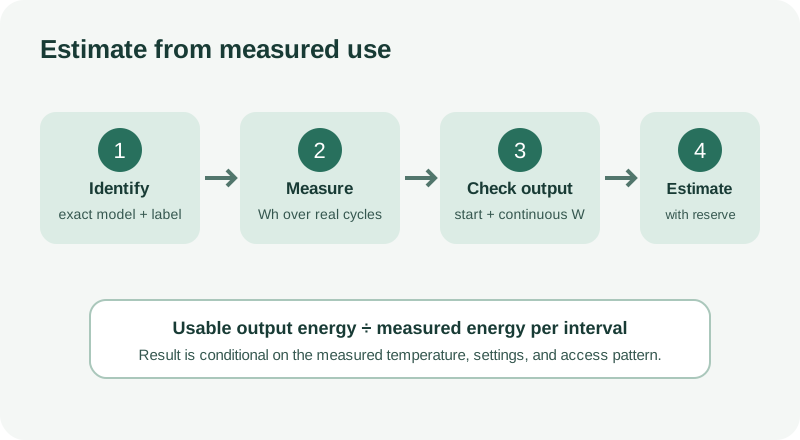
Use a plug-in energy meter rated for the refrigerator’s voltage, frequency, grounding, and current, or a station display that reports output energy. Measure at the AC supply for a complete interval long enough to include several compressor cycles and the ordinary door use you expect. Record room temperature, refrigerator setting, whether food is being loaded, and whether an automatic defrost occurs. A short watt reading can show one operating state; it cannot establish the daily average of a cycling appliance.
If conditions during an outage will be warmer or involve frequent access, make a second measurement that represents that use. Do not deliberately warm food or disable a thermostat to create a test. For a station-side estimate, use energy delivered at the same path you plan to use, because AC conversion and the refrigerator’s starting behavior affect the result. A daily Wh measurement is more useful than multiplying the nameplate maximum by 24 hours.
Check starting and output limits separately
Read the refrigerator label and manual for voltage, frequency, rated current or watts, plug and grounding, and any manufacturer instructions about backup supplies. Compare those facts with the station’s continuous AC output, outlet limits, waveform guidance, and surge specification. A surge headline may use a short duration or a special mode; do not assume it guarantees a compressor start. Test the exact pair before depending on it. Keep other loads unplugged during the initial check so a shared output limit does not obscure the result.
As one model-specific warning, the EcoFlow DELTA 2 V1.0 manual says normal-mode power fluctuations can shut down AC output when a refrigerator is connected. For a refrigerator storing medicine, vaccines, or other valuable items, it recommends the app’s “Always on” setting. That statement concerns that station model and manual revision; it does not promise uninterrupted power or prescribe household food storage. Dometic’s CFX3 guidance also distinguishes average consumption from rated current. These are different product families, so use them to understand the questions to ask, not as a wattage profile for an unrelated household refrigerator.
Estimate energy, not a guaranteed number of days
For a first pass, divide the station’s usable energy on the selected output by measured refrigerator energy per hour or per day. For example, if a measurement shows 1.2 kWh over a day and the station can actually deliver 1.5 kWh through the chosen output, the arithmetic is about 1.25 days before reserve, changing conditions, conversion loss not represented by the measurement, and shutdown behavior. This is a calculation example, not a prediction for a particular refrigerator. Use the energy delivered at the station output where possible, and retain a reserve rather than planning to drain the battery completely.
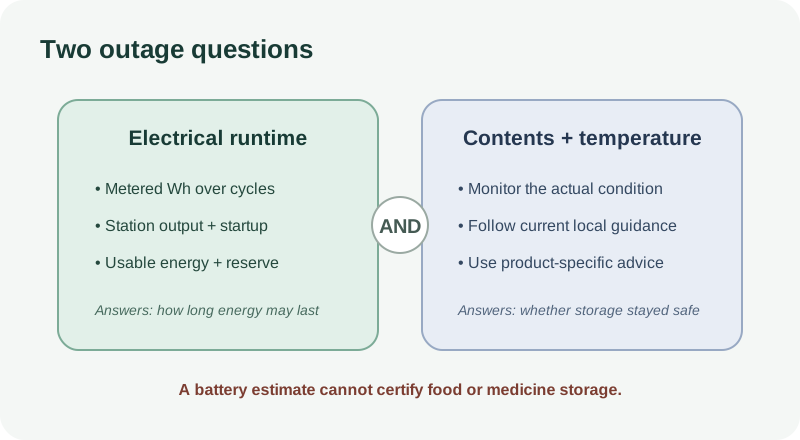
The result describes electrical energy under the measured conditions. It is not a temperature guarantee. Check the appliance’s own instructions, keep doors closed when possible, and follow current local food-safety guidance after an outage. Medicine or other temperature-sensitive products require their own product labeling and qualified storage plan. Battery runtime and safe storage are separate decisions.
For an appliance designed for a 12 V path, see the 12 V refrigerator runtime guide; its direct-DC connector and voltage checks do not apply automatically to an AC household refrigerator. Use the runtime calculator only after measuring the load, and review continuous output and startup surge before relying on the station.