Check Power Station Continuous Output and Appliance Startup Surge
Confirm voltage, port, sustained power, and startup compatibility before estimating how long a station can run an appliance.
Runtime is useful only after the station can supply the appliance. A station may have enough watt-hours for a long estimate but still shut down because a port, voltage, continuous output, or brief starting demand is incompatible. Treat output compatibility as a gate before calculating duration.
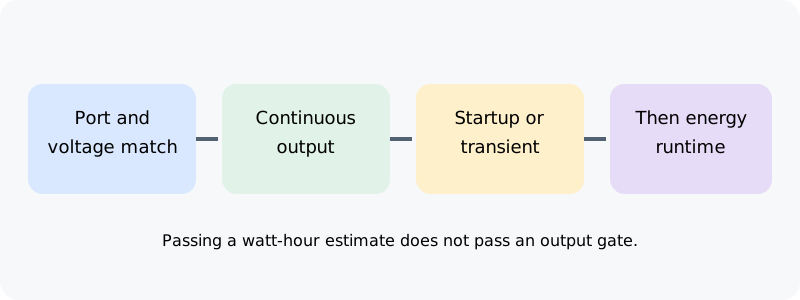
Check the exact port and supply
Read the station and appliance manuals for the exact model and regional variant. Match output voltage and frequency where relevant, AC waveform or DC characteristics, connector, polarity, and supported port. Check whether the desired port can be used in the selected mode and whether its limit is shared with other ports.
Next compare the appliance’s operating demand with the station’s continuous rating. Use real watts for an AC load when available. A product listing may show a maximum output that applies only to a particular port or mode. Do not add ratings from separate outlets unless the manual says they can operate simultaneously at those values.
Then consider starting or transient demand. Motors, compressors, pumps, and some power supplies can draw more at startup than during steady operation, but the amount and duration depend on the appliance and its operating conditions. A device label, meter reading, or common multiplier may not capture that brief event. Use the appliance manufacturer’s instructions and a meter suitable for the transient if a measured value is needed.
Treat ratings as model-specific
The BLUETTI AC180P manual lists 1,800 W rated AC output and a 2,700 W surge value for that station. Those are output limits for the identified model, not a promise that every appliance rated below 1,800 W will start or run on it. Its manual also describes Power Lifting as a specific mode for certain resistive loads; that feature should not be treated as an increase to ordinary output for motors, compressors, or electronics.
A surge rating is meaningful only with its duration, waveform, port, and mode understood. If a manual gives a short peak without stating a useful duration or the appliance has a demanding start, uncertainty remains. A station’s protection can react differently from a household circuit breaker. Do not repeatedly force a shutdown or use an overload test on a load where interruption could create a hazard.
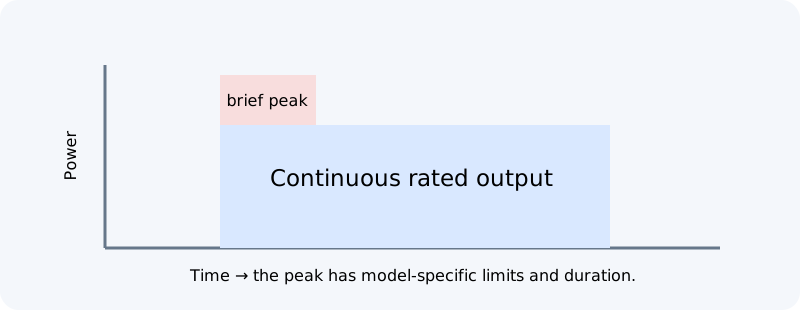
Separate the power gate from the energy estimate
Once the port, continuous load, and likely start have been checked, estimate duration with a suitable Wh and average-W pair. A stable 100 W device and a cycling 100 W device can have different energy use over an hour, even though both may show the same instantaneous value. Conversely, a low average load may still have a startup peak that exceeds the station’s capability.
For several appliances, check the sum of simultaneous operating watts and likely concurrent starts, then compare that with the exact outlet and shared-port limits. Keep that check separate from the total Wh budget. A station may pass one gate and fail the other.
If reliable startup data is unavailable, say so. A successful run with one station, one temperature, or one appliance sample does not guarantee performance under different conditions. Do not present a power-station runtime calculation as proof of electrical installation safety or medical-device suitability. For continuity claims, see UPS/EPS outage continuity.