Measure Appliance Power Draw to Estimate Power Station Runtime
Choose a measurement that matches the appliance’s behavior, record a representative interval, and keep startup demand separate from average energy.
A useful runtime input describes the appliance in the way it will actually be used. One nameplate wattage may be a maximum, a heating element’s active setting, or a brief operating point. It may not represent a compressor cycle, a variable-speed motor, or standby. Decide whether you need steady watts, average watts, watt-hours over a period, or a separate startup measurement before choosing a meter.
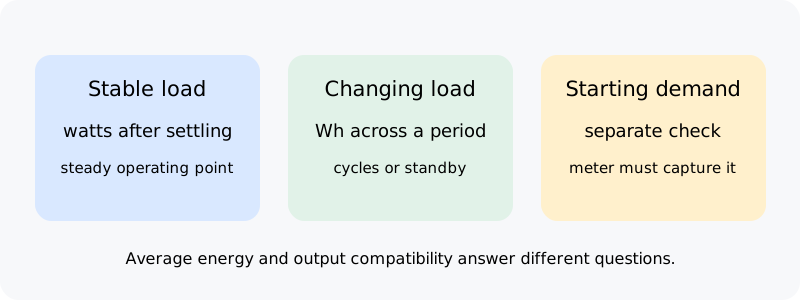
Match the tool to the question
For an ordinary plug-in AC appliance, a consumer plug-in energy meter can record voltage, watts, and accumulated Wh at the receptacle. Confirm that its voltage, current, power range, plug type, and instructions fit the appliance. For a low-power or fluctuating load, look for accumulated energy or a time series rather than relying on a single live display. For a hard-wired or unusually high-power appliance, use manufacturer data or a qualified electrician; do not open equipment or improvise probe connections.
Real power in watts is the useful rate for estimating energy from an AC device. Volts multiplied by amps may describe apparent power in volt-amperes and can overstate real watts for some motors or nonlinear loads. Use a meter that reports real power or Wh when that distinction matters. An RMS current reading alone is not a runtime value, and it does not justify applying a correction to a separate Wh reading.
A plug-in meter is not automatically a surge analyzer. It may sample too slowly or have a range unsuitable for a brief motor start. Check the meter’s stated method and limits. If startup compatibility is important and no appropriate measurement is available, use the appliance and station manuals and preserve the uncertainty.
Record a representative interval
For a stable load, let the reading settle and note watts, settings, elapsed time, and output mode. For a changing load, measure accumulated energy across a complete, representative period, then calculate:
Average watts = energy measured in Wh ÷ elapsed time in hours.
If a refrigerator uses 0.72 kWh in 24 hours under the observed conditions, that is 30 W average for that day. It does not mean the compressor continuously draws 30 W. A different room temperature, thermostat setting, door use, defrost event, or ice maker activity can change the result. Repeat the observation across more than one relevant cycle when a single interval may be atypical.
DOE/FEMP’s public guidance on standby measurements distinguishes stable from fluctuating low-power readings: a stable reading can be averaged under its described method, while a fluctuating result calls for energy measured over time and divided by duration. That is a standby-method boundary, not a universal runtime test window for active appliances. Standards can have more specific scopes and procedures than a public summary; do not claim standards conformity from a home meter reading.
Keep standby, active use, and starts separate
Measure the mode that matters. A networked device may draw different power when idle, asleep, or active. A refrigerator’s full-day energy can include compressor cycles and defrost behavior. A washer label or appliance cycle may specify a defined program. Record which mode and schedule you observed, and do not combine unlike intervals into one unexplained average.
If a station estimate needs both energy and startup compatibility, keep the results in separate fields. Average Wh helps estimate duration. Peak or starting demand helps check whether the station can provide output without shutting down. A start test on one station cannot establish compatibility with other models or conditions.
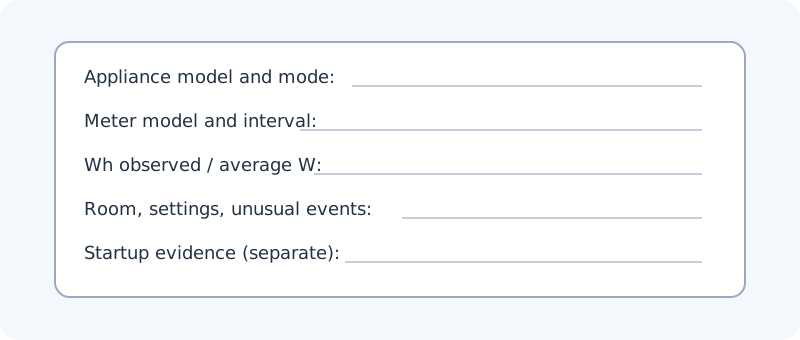
Use safe, dry, undamaged equipment and follow the meter and appliance instructions. Do not interrupt a medically important or temperature-critical load just to obtain a reading. For a safe low-consequence device, record the appliance model, mode, time, ambient conditions if relevant, meter model, start and end readings, and any unusual events. That record makes the estimate reproducible and tells you when it should be measured again.