Use Appliance Energy Labels to Estimate Power Station Runtime
Translate annual or cycle-based label energy into a carefully scoped average, then verify the exact appliance’s actual demand and startup behavior.
An energy label can help compare products or supply a standardized energy figure, but the figure usually describes a defined test or use schedule. It is not automatically the appliance’s instantaneous wattage, startup draw, or energy use during an outage. Treat the label as a clue about average energy, check what period and conditions it represents, then measure the exact appliance when the estimate depends on actual use.
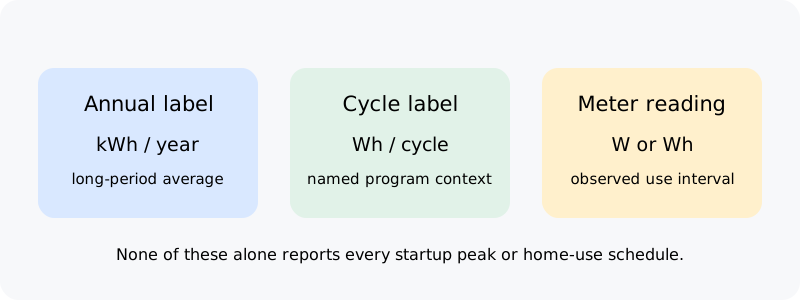
Identify the label and its basis
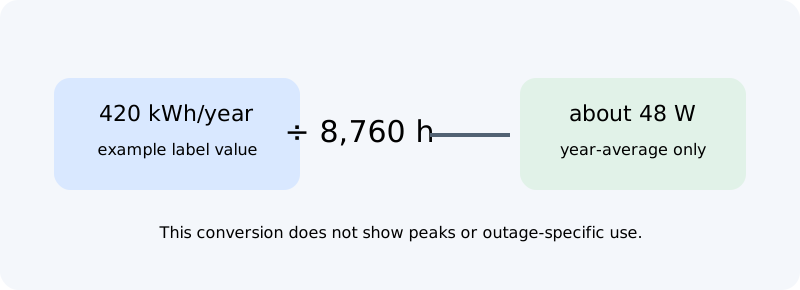
In the United States, an EnergyGuide label commonly reports estimated annual energy use in kWh and lets shoppers compare similar products. It also provides an estimated operating cost under stated assumptions. Divide the annual kWh by 8,760 hours to get a mathematical year-round average in watts. For example, 420 kWh per year divided by 8,760 hours is about 48 W. That average does not show when a compressor, heater, or motor starts, and it may not represent a different climate, control setting, or schedule.
Canada’s EnerGuide label also identifies product energy use and places a model within a comparison scale. Match the exact model and product class. The comparison group and label presentation are part of the meaning; do not assume another country’s scale or a different model is directly comparable.
In Great Britain and Northern Ireland, use the label and product information fiche that apply to the product and market. The relevant fields vary by product. Some labels report annual use; some appliances such as washing machines use energy per set of cycles with other program information. Check the actual label and current market documentation instead of converting a number from a different region or cycle.
Convert only what the label supports
For an annual energy figure, a simple arithmetic conversion is:
Average watts over the year = annual kWh × 1,000 ÷ 8,760.
This gives a long-period average, not a continuous draw. For a cycle-based figure, divide the stated Wh per cycle by the cycle duration only if that duration and the same program are known. The answer is the average during that test cycle; it does not reveal short peaks or how often the appliance will run in your home.
Look up the exact model rather than selecting a “similar” product when runtime matters. Refrigerator energy depends on configuration and features such as size, defrost type, and ice making. A DOE test condition is not a suggested household temperature correction. Use the label’s test context to understand comparisons, not to adjust a portable-station calculation with an unsupported multiplier.
Follow up with a measurement
Use the label to narrow an estimate or compare models, then measure energy at the appliance outlet over a representative period if actual runtime is important. Include normal settings and relevant cycles. If the appliance is intermittent, a full day or multiple cycles may be more useful than a short sample. Record the meter, interval, environment, and any unusual use so the measurement has context.
Keep three questions separate: how much energy is used over a period, how much power is needed while operating, and whether the station can supply startup demand. A label may help with the first question, but it does not usually answer the latter two. See measuring appliance power draw and cycling appliance duty cycle for ways to collect those inputs.
A label-based calculation is most useful when its assumptions remain visible. State the exact model, market, label period, arithmetic conversion, and why the test schedule may differ from the expected use. If the appliance has no matching label or its use pattern is unusual, leave the input as unknown and measure it instead of inventing a typical household value.