Calculate Portable Power Station Runtime from Watt-Hours and Watts
Turn a station’s usable watt-hours and an appliance’s average watts into a bounded runtime estimate, while keeping model-specific losses visible.
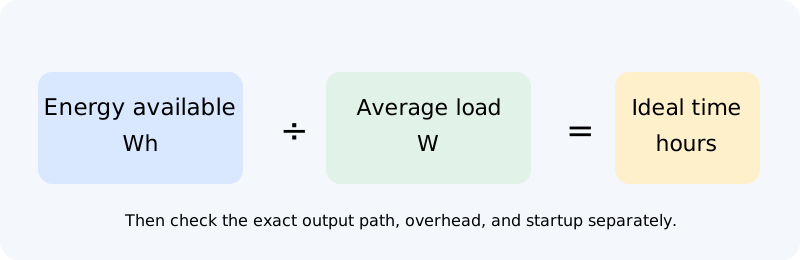
A watt-hour (Wh) is an amount of energy. A watt (W) is a rate of using energy. Dividing energy by a steady rate gives time:
Runtime in hours ≈ energy available to the load path (Wh) ÷ average load power (W).
For example, 600 Wh available to a steady 60 W load gives an ideal estimate of 10 hours. It is a starting point, not a promise. The calculation only works when both inputs describe the same path and operating period. A station’s printed capacity may describe battery energy, while a device-side meter records energy after one or more conversion stages.
Choose the energy basis first
Find the exact station model and read how its manual describes capacity and runtime. Check whether a published usable-energy figure already accounts for depth of discharge or conversion efficiency. If the manual provides a runtime equation, follow its definitions. Do not apply a second efficiency or reserve reduction to a usable-energy number that already includes it.
If only nominal battery capacity is available, treat it as an upper-bound input. The energy that reaches a particular AC or DC output can be lower because of the chosen path, operating limits, and the station’s own consumption. A manual may give a model-specific depth-of-discharge value, conversion efficiency, or idle-use term. Keep each value attached to that model, output, and mode; there is no single percentage that applies to every station.
The AC180P manual lists 1,440 Wh, 90% depth of discharge, inverter efficiency above 85%, and about 15 W AC self-consumption. Its example gives roughly 20 hours for a 40 W refrigerator: 1,440 Wh × 90% × 85% ÷ (40 W + 15 W). BLUETTI’s current U.S. product page says the formula is unsuitable for compressor loads such as refrigerators and air conditioners. The sources conflict; do not use the printed result for compressor runtime. Measure representative-cycle energy and check the exact station’s output and startup limits.
Use an appliance value that represents its use
A nameplate maximum, a momentary peak, and an average operating load answer different questions. For a stable device, a suitable power reading may be enough for a first estimate. For a device that cycles, changes speed, or spends time in standby, measure energy over a representative period and divide by the elapsed hours to find average watts. A label’s annual or cycle energy can help describe energy use, but its test schedule may not match the hours when a station is needed.
For a measured interval, use the device-side energy directly when possible. If it used 180 Wh in six hours, its average over that interval was 30 W. That average is useful for an energy estimate, but it does not tell you whether the station can start the device. Check starting demand and the station’s continuous output separately before relying on the duration.
Show the assumptions
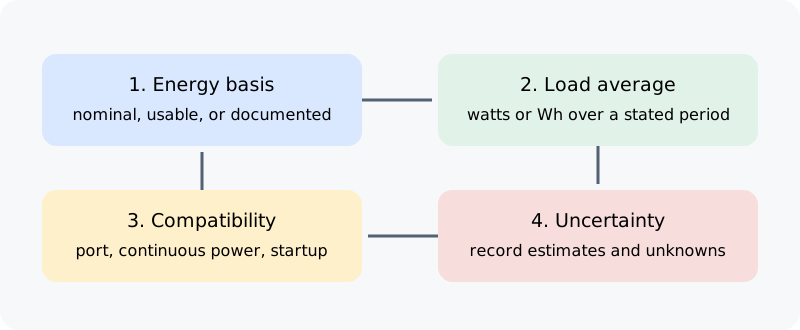
Write down the station model and output, the energy figure and its source, the load value and measurement period, and any model-specific adjustment. Mark each input as documented, measured, estimated, or unknown. If a value is unknown, show a range or a clearly labeled ideal case instead of hiding uncertainty inside a precise-looking decimal.
For a quick calculation, divide usable watt-hours by average watts. For a more detailed estimate, follow the exact model manual and subtract only documented station consumption that is not already included in the energy figure. Keep the arithmetic transparent so a later measurement can replace an estimate without changing the whole method.
Where this estimate stops
A duration calculation does not establish that the appliance is compatible with the port, that a motor will start, that an output will stay enabled at low load, or that a critical device has a safe backup plan. It also does not predict solar input or charging while supplying a load. Those are separate checks. See real-world losses, measuring appliance demand, and continuous output and startup demand.
Use the number as a planning estimate and compare it with a controlled, representative run only when that is safe for the equipment and the load. Record the actual model, setting, ambient conditions, and output port. If the result differs, revise the inputs you can observe; do not turn one test into a universal correction for other stations or appliances.