Why Real-World Power Station Runtime Is Lower Than the Label
Separate usable battery energy, output conversion, station consumption, and operating conditions instead of applying an unsupported universal factor.
A station’s Wh rating describes stored energy on a stated basis. It does not mean every watt-hour will reach every connected device. Runtime depends on the output path, the load, the station’s own use, and its operating limits. Separate these effects so an estimate can be checked and improved instead of hiding them in a single “real-world” percentage.
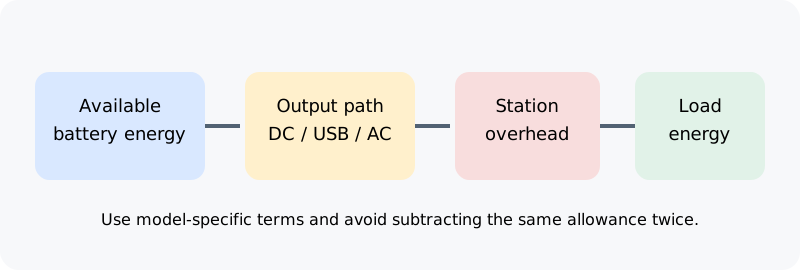
Keep the energy boundaries distinct
Start with the exact model manual. Determine whether the rated value is nominal battery capacity, a usable figure, or an output-specific runtime estimate. Then identify the path: a DC output, USB output, or AC inverter may have different conversion stages and limits. A device-side meter measures after the path; a battery estimate may be upstream of it.
A useful accounting form is:
Energy reaching the load ≈ battery energy available − path conversion loss − station consumption − energy held back by the model’s operating limits.
This is a way to organize evidence, not a universal station formula. If a manufacturer’s usable-energy figure already includes a conversion or depth-of-discharge allowance, do not subtract it again. If its runtime formula includes idle consumption, do not add a second idle term. Keep every input on the same side of the boundary and over the same period.
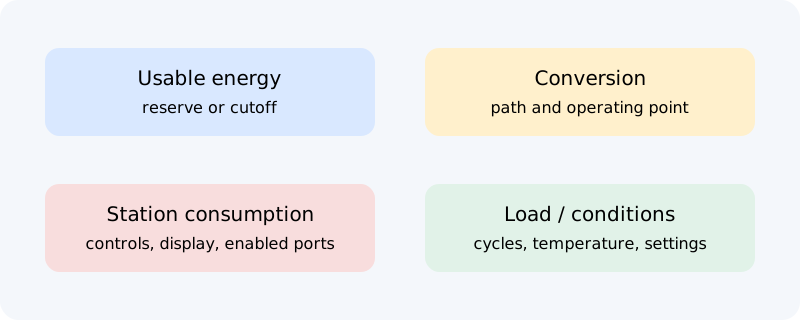
Name each source of difference
Usable energy: Battery management may reserve a portion of nominal capacity or stop output at a defined state. Use only a model-specific documented value; do not assume that every displayed Wh is available at the outlet.
Conversion: An inverter or regulator changes voltage and can consume energy. Efficiency depends on the exact design, operating point, and output path. A published value from one model is not a safe factor for another.
Station consumption: Displays, controls, fans, and enabled outputs can draw energy even when the appliance load is small. In that case a fixed station draw can be a large share of total demand. Check whether the manual includes it and whether the selected output remains on.
Load and conditions: Power may vary with the device’s cycle, temperature, speed, or setting. Battery performance and station control behavior can also depend on temperature and load. Use the documented range for the exact unit or measure the relevant scenario; broad lab or grid-storage results are not a portable-station correction.
Make a transparent comparison
Suppose an estimate begins with a station’s nominal Wh and a measured appliance average. Record the manual’s usable-energy or runtime equation if one exists. If it does not, label the simple Wh/W result as an ideal upper-bound calculation, then show a second scenario only when there is evidence for each adjustment. A range is more honest than a precise answer built from guessed efficiency, reserve, age, and temperature factors.
The BLUETTI AC180P manual illustrates a bounded model calculation: it identifies a depth-of-discharge value, an inverter-efficiency statement, and an AC self-consumption value for its own runtime equation. Those figures show which terms can matter; they do not tell you what to enter for a different brand, another AC load, or a DC port. The Jackery Explorer 2000 Pro manual also describes operating and standby behavior for that product, not a cross-brand idle allowance.
For a useful field comparison, record the station model and firmware if available, selected port and mode, load model and setting, average power or Wh, ambient conditions, and start/end state shown by the station. Keep the load and station settings constant when comparing runs. If they differ, report the difference rather than adjusting one result by an unexplained multiplier.
Know what you still do not know
Mark capacity, load, conversion, station overhead, and environmental inputs as documented, measured, estimated, or unknown. If only the appliance’s label and the station’s nominal capacity are known, the result is an ideal estimate. If station overhead or usable energy is undocumented, leave it visible as uncertainty. Do not turn one measured runtime into a correction factor for other products.
For a step-by-step calculation, see runtime from watt-hours and watts. For AC and DC paths, compare the specific output route in AC versus direct DC. If a low-power load stops unexpectedly, diagnose the output setting separately in low-load shutdown.