Why a Power Station Shuts Off at Low Load
Distinguish low-load or ECO output shutdown from an empty battery and check the exact model’s threshold, port, timer, and selected settings.
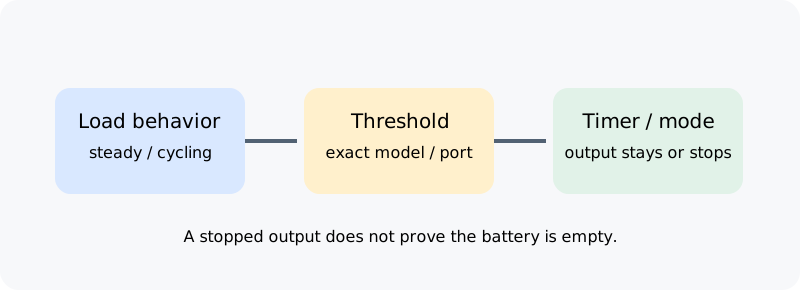
A low-load output can switch off while the battery still has charge. This may be an energy-saving, ECO, or automatic output timer behavior rather than a runtime estimate reaching zero. The exact trigger can depend on the station model, output, mode, timer, and load pattern. Diagnose the output setting separately from battery capacity.
Check the exact settings
Find the manual for the exact regional model and firmware if the manufacturer provides firmware-specific instructions. Look for names such as ECO, energy-saving, low-power, auto-off, and output timeout. Record whether the setting is enabled by default, which ports it applies to, the threshold or no-load condition, and how long the output waits. AC and DC ports may use different controls.
Two manufacturer examples show why a universal threshold is misleading. The Jackery Explorer 2000 Pro manual describes an Energy Saving setting that is off by default and says AC output at or below 25 W, or USB/car output at or below 2 W, can shut off after 12 hours under the stated no-load/low-load conditions. The BLUETTI Elite 300 manual describes selectable ECO thresholds of 10–40 W for AC and 5–20 W for DC, with a configurable one-to-four-hour timer. These settings belong to those named products and modes; they do not predict another station’s behavior.
Separate energy drain from an output cutoff
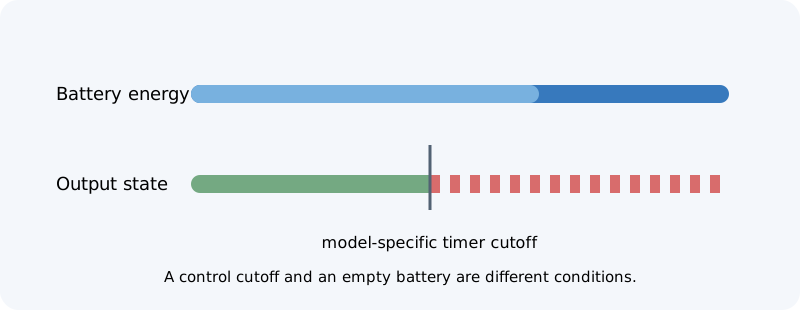
A running station may consume energy while an output is enabled, even when the connected device draws little. A shutdown threshold is different: it is a control condition that may turn a port off. A device may then lose power although the battery display still shows substantial energy. Conversely, an empty or protected battery can stop output regardless of the load threshold.
A cycling appliance can sometimes fall below a threshold while resting and then need power again later. A station might keep the output alive, apply a timer, or shut it off; use the manual and an observed non-critical test to determine what happens for the exact model. Do not infer behavior from a single instantaneous watt reading.
Use a safe diagnostic sequence
- Confirm the station model, output port, selected mode, and whether ECO or auto-off is enabled.
- Read the manual for the threshold, timer, default, and any exceptions for that port.
- Compare the appliance’s measured average and cycling pattern with that exact rule.
- If the manual permits it, observe the behavior with a non-critical load and record settings, time, and battery state.
- For a load that must not be interrupted, follow the device and station manufacturers’ specified backup method; do not rely on an unverified setting or workaround.
Some manuals advise disabling an energy-saving mode for loads that need uninterrupted output. That is model-specific guidance and may increase station consumption or change runtime. Do not claim that disabling ECO guarantees continuity. Do not use a test that could interrupt medical equipment, spoil temperature-sensitive contents, or create another safety issue.
A low-load shutdown warning should be included in a runtime estimate when the exact model’s manual supports it. If the threshold or timer is unknown, state that the output may switch off and leave the behavior unresolved. For measurement help, see appliance power draw; for the energy estimate itself, see runtime from watt-hours and watts.