Estimate Power Station Runtime for Cycling Appliances
Use measured energy over a representative cycle or schedule average, and check startup demand independently from the appliance’s average watts.
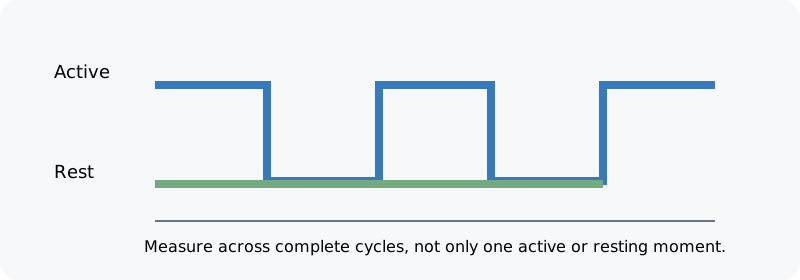
A cycling appliance does not draw its operating wattage every minute. A compressor, pump, heater, or thermostat-controlled device may alternate between active and resting states. Multiplying its active watts by the whole outage period can overstate energy use; using a short resting reading can understate it. Estimate from energy across a representative schedule.
Calculate an average over the right period
If an appliance draws approximately P-on watts while active and is active for fraction d of the period, a simplified average is:
Average power ≈ (P-on × d) + (P-off × (1 − d)).
For example, a hypothetical 250 W load that runs for 20 minutes of each hour and draws 0 W while off averages about 83 W: 250 × one-third. This is an arithmetic example, not a refrigerator duty-cycle estimate. Real equipment may have standby draw, variable power, defrost heaters, controls, or multiple independent cycles.
When possible, measure accumulated Wh across a full, representative cycle or several cycles and divide by elapsed hours. Choose an interval long enough to include relevant starts, pauses, and scheduled events. Record the operating mode, thermostat setting, room conditions, load, and time. If the use pattern changes through the day, measure separate periods rather than assuming one short interval represents all of them.
Keep average energy and startup separate
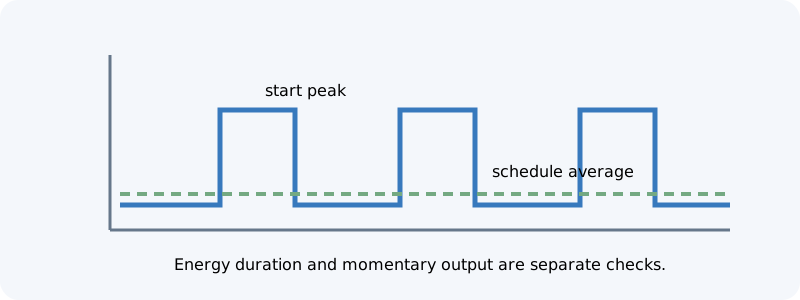
The average helps estimate how much energy the appliance uses over time. It does not tell you whether the station can supply the active operating demand or the brief startup demand. Check the exact station’s continuous output and port limits, then check startup separately where the appliance requires it. A device may have a low average and still exceed a station’s short-duration capability when it starts.
Some refrigeration systems also run independent defrost or ice-making cycles. Include them in the observation if they will matter to the planned use, or state that the sample did not capture them. A product’s maximum current or active rating is not a cycle-average energy value. Likewise, one laboratory or household profile should not be presented as a universal schedule for another refrigerator.
Avoid false precision
A label’s annual kWh can provide a comparison baseline, but its test conditions and represented use may differ from the actual location, settings, and schedule. A manufacturer’s typical runtime may use a specified room temperature or test mode. Keep that context with the number. Do not add a generic temperature multiplier, aging adjustment, or reserve percentage unless the exact station documentation or measured scenario supports it.
Calculate from Wh over the period when the appliance’s state changes. If one six-hour observation gives 500 Wh, the average over that interval is about 83 W. Show the interval and conditions alongside the result. Repeat when seasons, settings, or load change enough to make the first sample unrepresentative.
A runtime estimate cannot establish food safety or how long food will remain at a safe temperature. Follow local food-safety guidance and the appliance instructions for temperature-sensitive contents. Do not disable a critical appliance or risk spoilage to perform a measurement. For multiple cycling devices, add their energy over the same planning window, then separately check simultaneous output and startup in a multi-load budget.