Makita DCW180 Cooler and Warmer Runtime on Battery or Power Station
Read the DCW180's conditional Makita-battery operating times and verify the exact input accessory before estimating power-station use.
The Makita DCW180/ADCW180 is a 20 L portable cooler and warmer with an 18 V Makita battery path and separate vehicle and AC adaptor paths. The manual gives three approximate operating times for one named battery under specific ambient and control temperatures. Those examples are more useful than a generic “cooler watts” estimate, but they are not runtimes from a portable power station.
Match the exact model and power path
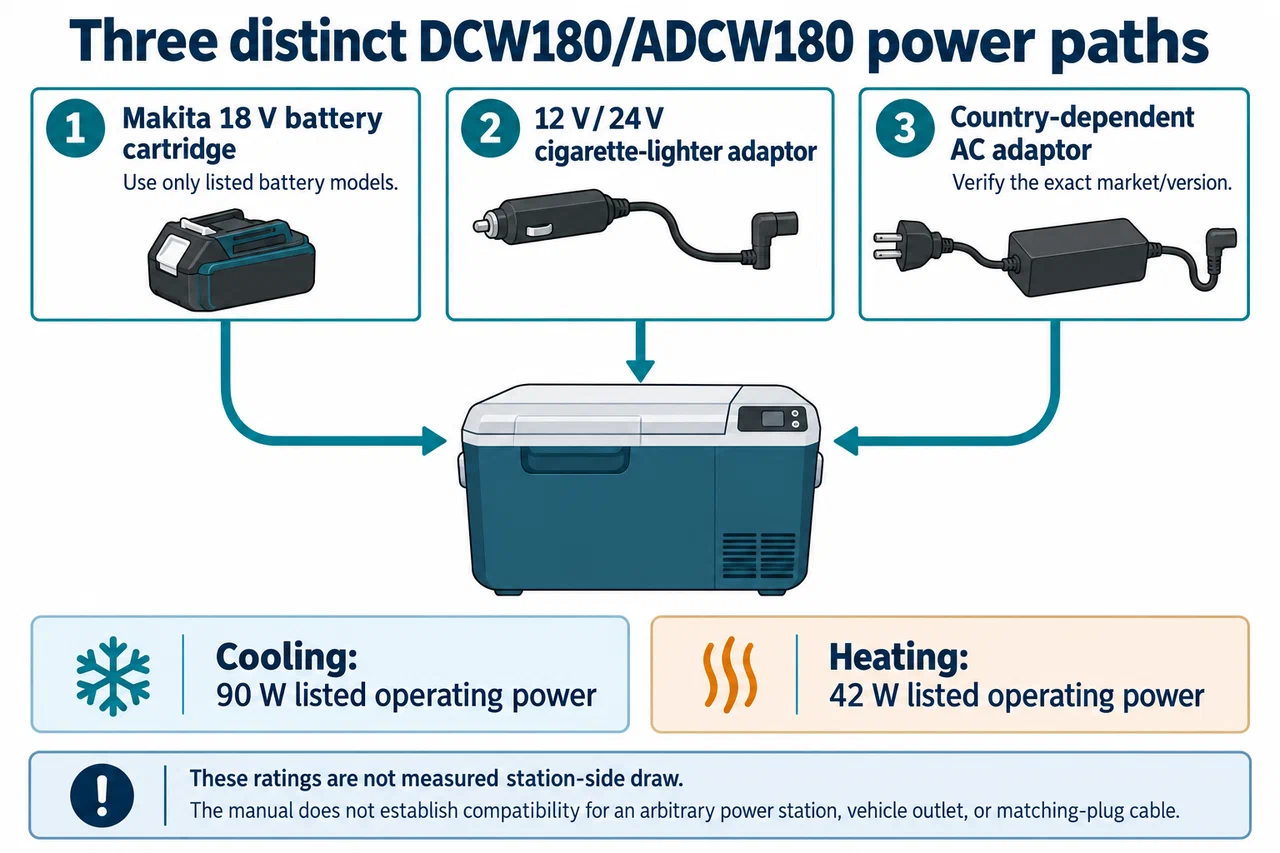
Check the model label and the manual for the version sold in your market. The manual lists a Makita 18 V battery cartridge, a 12 V / 24 V cigarette-lighter adaptor, and a country-dependent AC adaptor as distinct power paths. It lists 90 W operating power in cooling mode and 42 W in heating mode. These are manufacturer operating-power values, not measured station-side averages or a complete energy trace.
Use only the listed battery cartridges and chargers. Do not assume that another 18 V pack, a portable station’s vehicle outlet, or a DC cable with a matching plug is compatible. The manual does not establish a station model, port, custom cable, or cross-region AC adaptor that can be substituted. Confirm the exact input accessory and electrical limits before connecting an external supply.
Read the battery examples with their conditions
For one BL1860B battery, the manual reports approximately 4.5 hours with 30 °C ambient air and a −10 °C control temperature. At the same ambient temperature with a 5 °C control temperature, it reports approximately 8.5 hours. For warming to a 60 °C control temperature at 0 °C ambient, it reports approximately two hours. These figures belong to the stated battery and conditions; they do not describe every setting, battery age, load, or surrounding temperature.
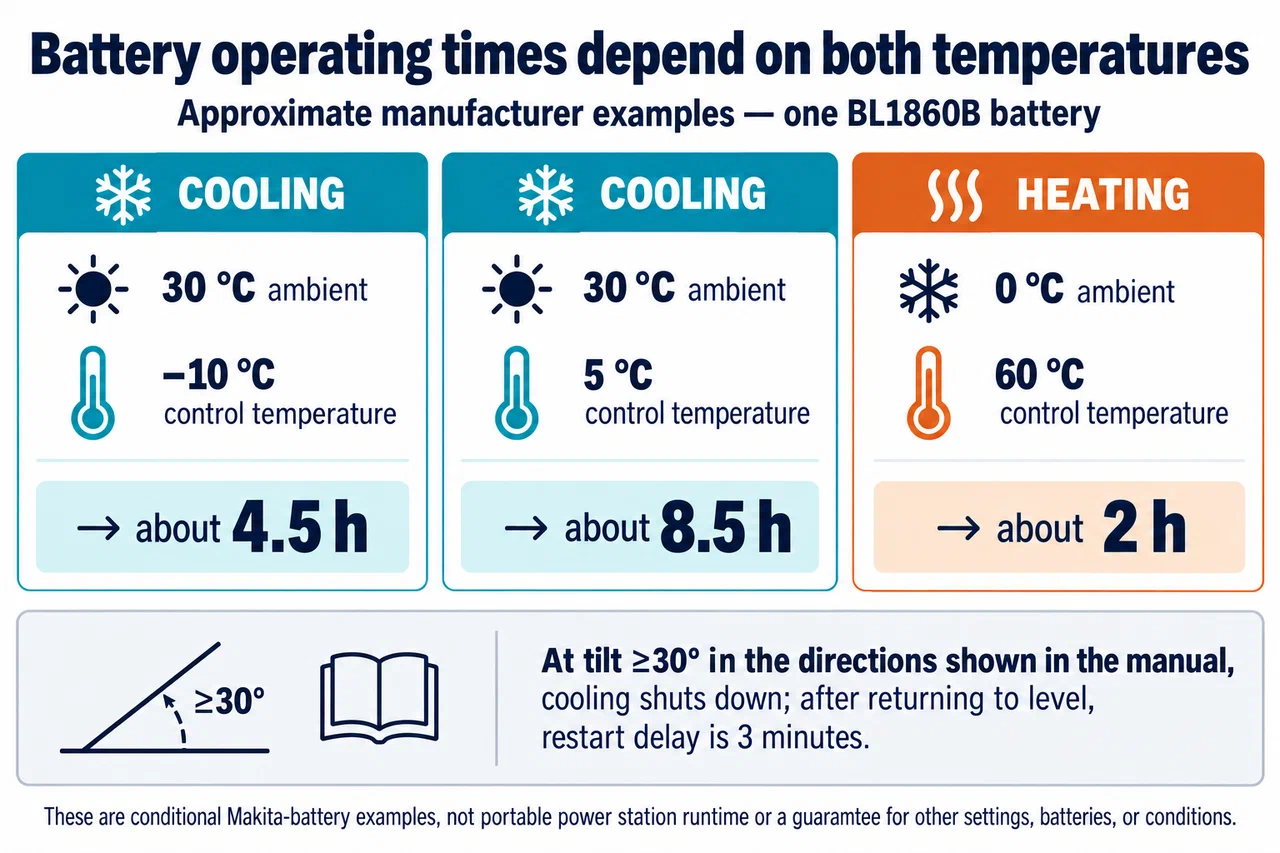
Do not divide a station’s capacity by the DCW180’s 90 W or 42 W label and call the result measured runtime. The manual’s battery operating times do not give the BL1860B’s usable watt-hours for these modes, station conversion losses, startup demand, or runtime from a station. A station estimate requires a supported input path and a measurement of energy for the selected mode and conditions.
Check operation and temperature behavior
Choose whether the intended task is cooling or warming and record the target temperature, ambient temperature, duration, and battery or source model. The manual includes protection behavior, battery and charger requirements, and a tilt-related cooling shutdown followed by a three-minute restart delay after the unit is returned to level. Follow the current manual’s diagrams and warnings; do not treat this delay or the approximate operating times as a continuous cooling guarantee.
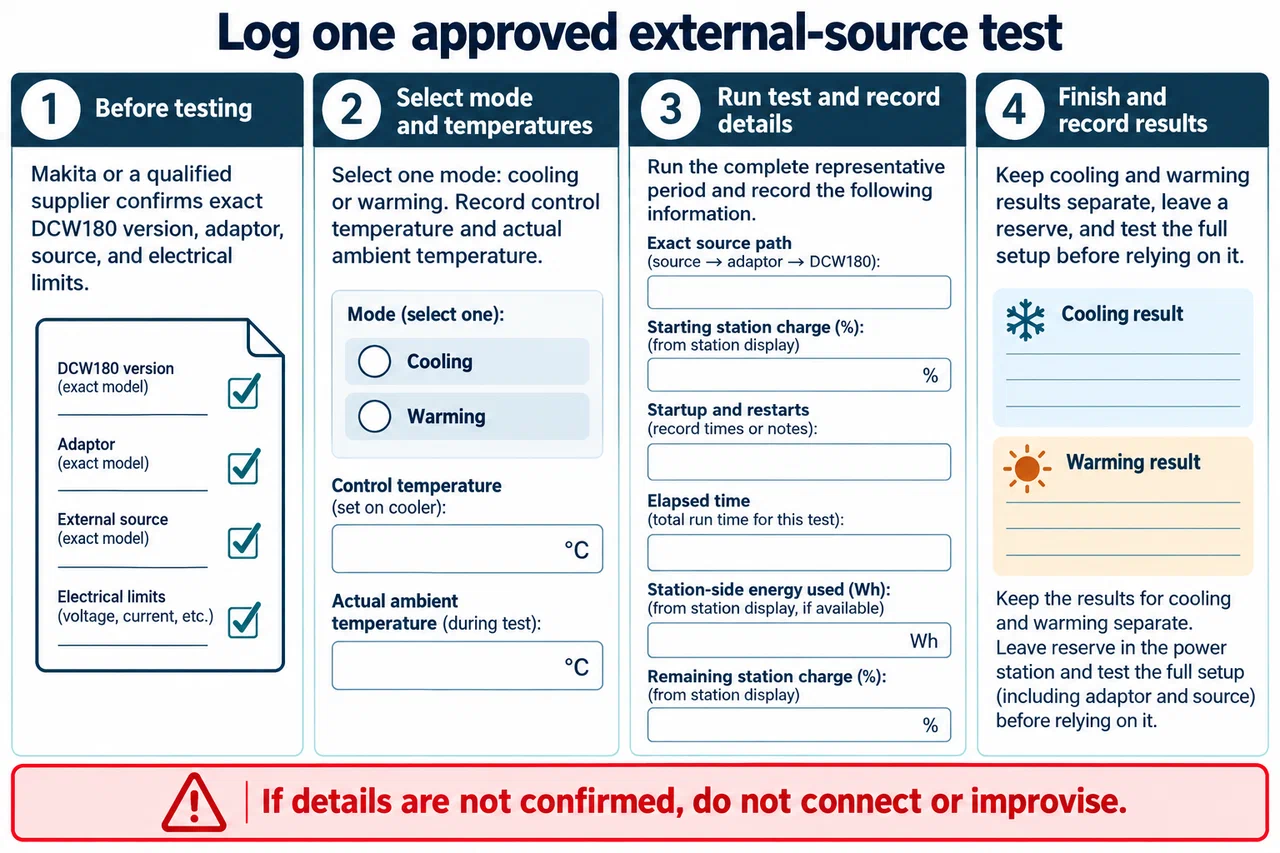
For station use, first have Makita or a qualified supplier confirm the exact adaptor and source combination. If approved, measure station-side watt-hours over a representative period at the selected setting. Record startup, restarts, temperature, and remaining charge. Keep cooling and warming results separate, leave a reserve, and test the full setup before relying on it during travel or at a remote jobsite.
The DCW180 is not interchangeable with a compressor refrigerator or a cordless-tool charger. For other direct-DC fridge inputs, see the 12 V refrigerator guide; for charging packs or running corded tools, see the jobsite tools guide.