Power Tools and Battery Charger Runtime from a Portable Power Station
Separate the station energy used by a charger from stored tool-battery energy and from the heavier demand of running a corded tool.
A charger’s watt rating, a battery pack’s stored energy, and a tool’s runtime describe different parts of a jobsite plan. A portable station supplies the charger; the charger converts that input and controls the tool battery; the battery then supplies a cordless tool. A corded saw or drill draws directly from the station and has a different startup and workload profile.
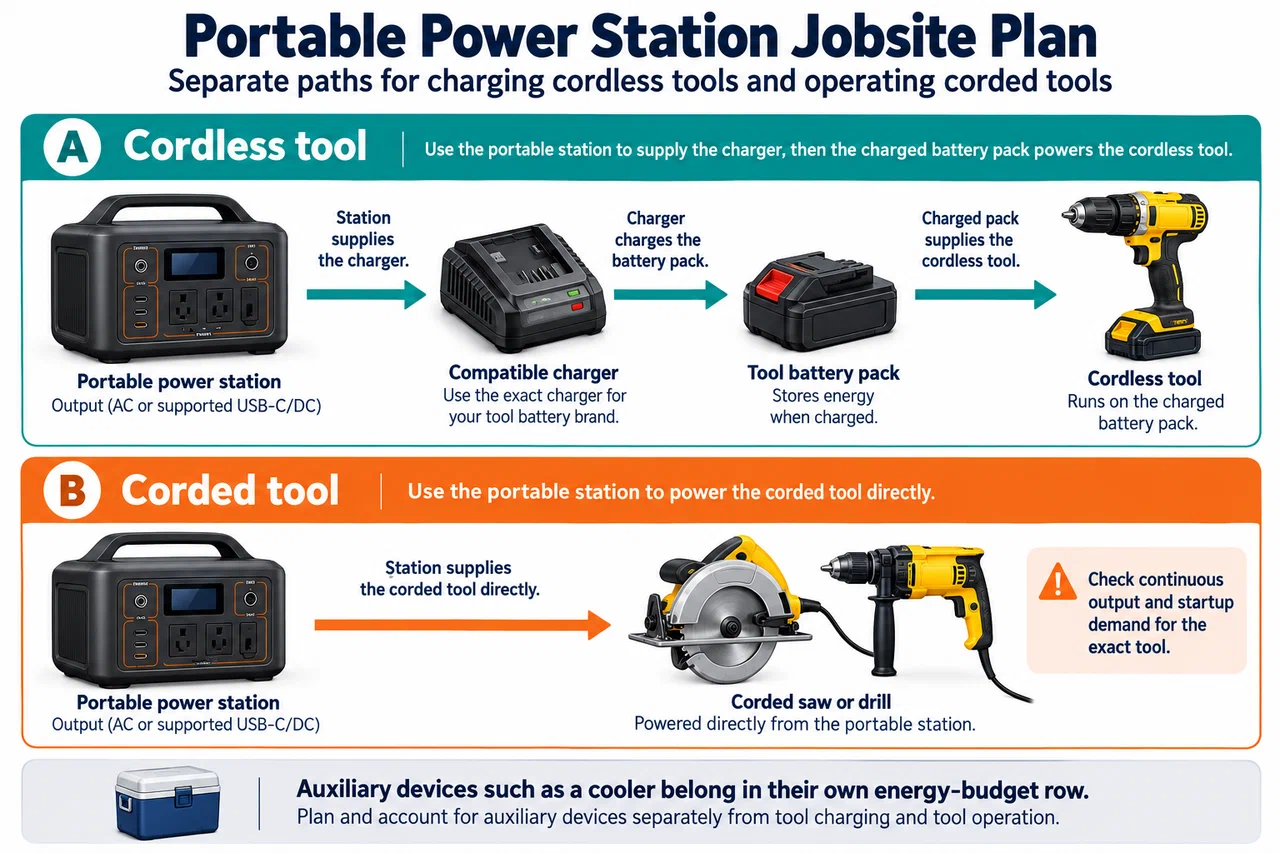
Make a power-path inventory
Record the station model and output port, charger model, exact battery pack, tool, and intended work. For the charger, distinguish its AC input from USB-C or other DC inputs and confirm supported voltage, current, cable, and power-delivery profile. A port advertised as 100 W does not mean the charger draws that continuously or that every cable can deliver it.
Named products show why these checks matter. The DEWALT DCB094K is described with up to 100 W USB-C output and a 65 W wall adapter, while the Milwaukee M18 TOP-OFF 2847-20 lists a 100 W USB-C port and an example charge time using an M18 XC 5.0 battery. These product specifications do not provide station-side watt-hours for every charge or establish a universal number of packs per station. A charger may taper near full, change its draw with battery temperature, or pause for battery protection.
Estimate energy per charging session
Use manufacturer battery watt-hours if available, or calculate nominal pack energy from voltage and amp-hours while recognizing that usable energy can differ. Then measure station energy for a full charge from the battery state you normally start with. Record the pack model, charger, temperature, starting charge, endpoint, and whether the station used AC or direct USB-C.
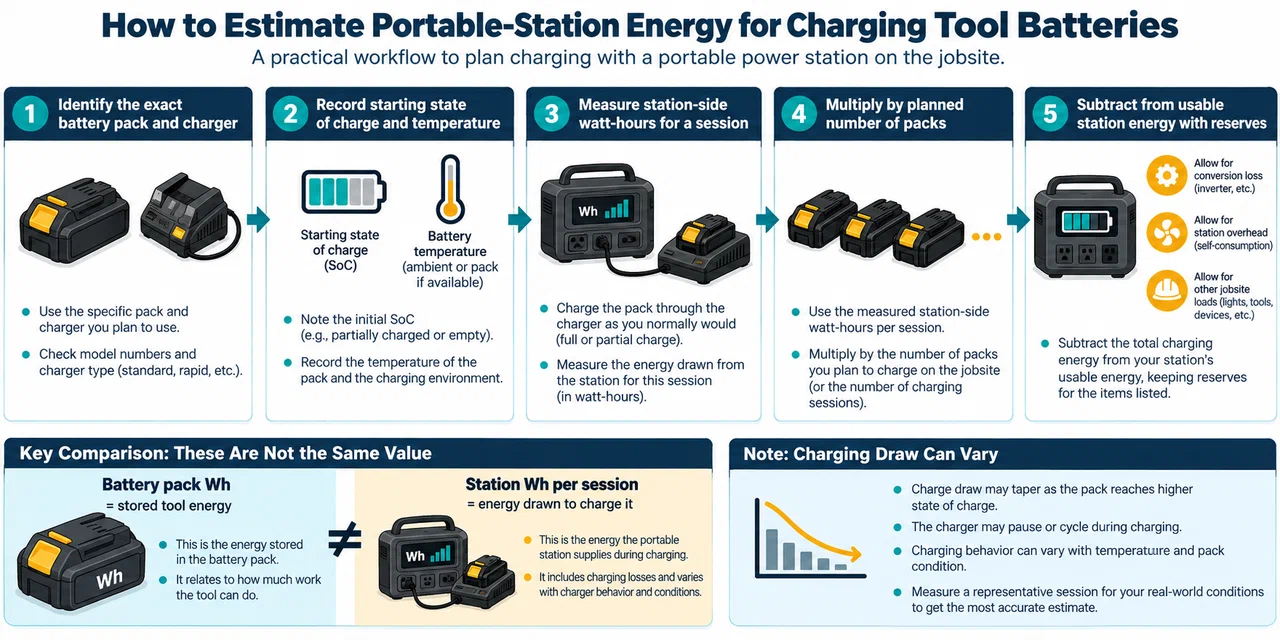
For planning, multiply measured station Wh per charging session by the number of packs needed. Divide the remaining usable station Wh by that session value, leaving reserve for conversion loss, station overhead, other tools, lights, radios, or a laptop. A product claim such as “charges in about 105 minutes” is not a universal runtime: it does not specify how much energy every partially charged pack will draw from your station.
Corded tools need a separate output check
For a corded tool, read the exact regional nameplate and manual. A Makita 5007F circular saw lists 15 A at 120 V in the cited North American material. Multiplying those values yields an apparent-power ceiling of 1,800 VA, not a measured real-watt draw. Cutting load, blade, material, startup, and operator use shape energy and peak demand. The nameplate does not prove that a station can start the saw.
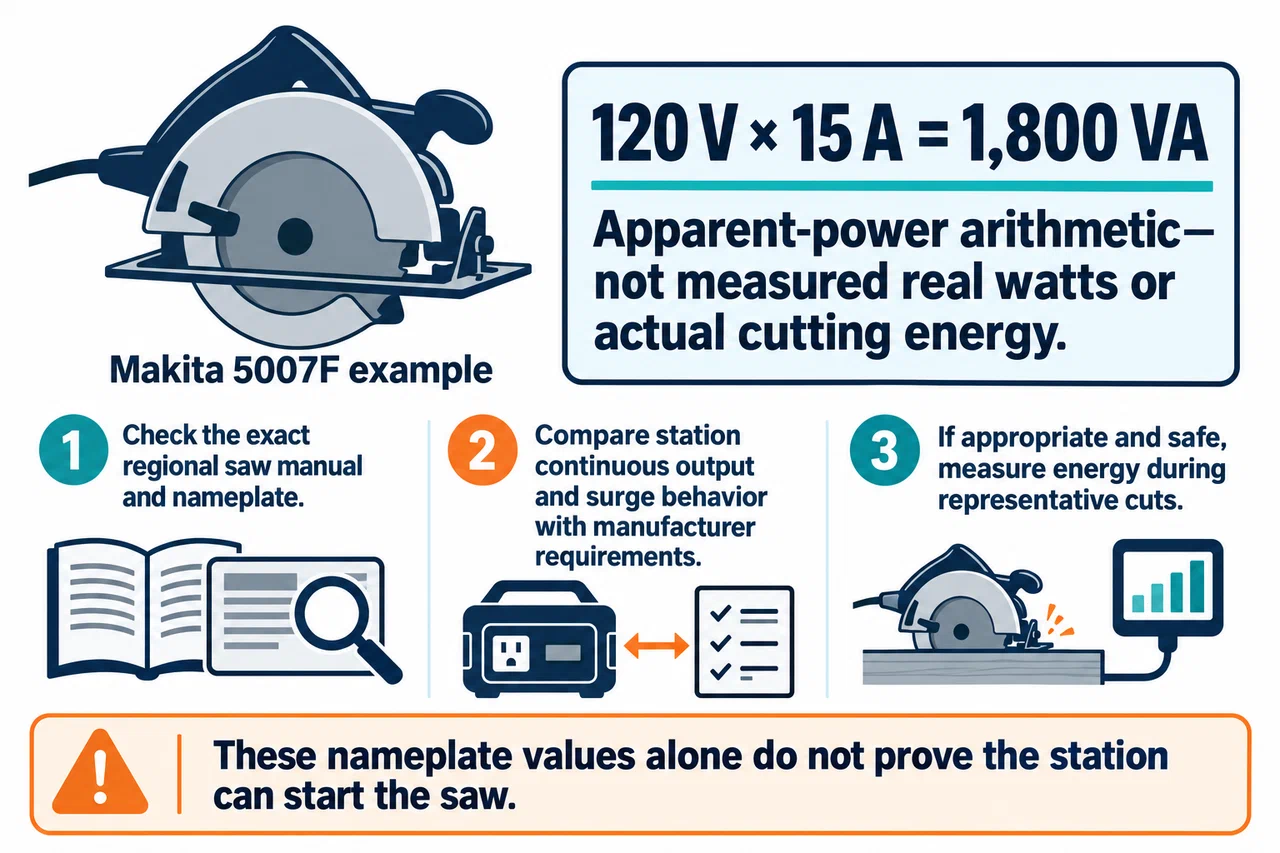
Check station continuous output and surge behavior against the tool manufacturer’s requirements or a suitable measurement. Do not use a generic startup multiplier to declare compatibility. For a short work task, log station Wh while performing representative cuts with appropriate guards and safe conditions; do not make the station or battery the reason to bypass tool safety procedures.
Keep tool runtime distinct from cooler runtime
Some jobsite devices have their own battery and DC paths. Makita’s DCW180 cooler/warmer, for example, supports a Makita battery platform and specified 12/24 V vehicle inputs. Its manufacturer gives operating times for one battery under three named ambient and control-temperature combinations; these are not station-side runtime tests. See the DCW180 cooler/warmer guide for those conditions. Keep each tool, charger, and auxiliary device as a separate row in the job energy budget.
Test the planned equipment together at the actual station and temperature before depending on it at a remote site. Keep batteries within their manufacturer temperature limits, protect equipment from dust and moisture as the manuals require, and plan recharge. A watt-hour estimate can help schedule charging and work; it cannot guarantee production hours or replace an alternate power source.