Estimate Runtime While a Power Station Is Charging and Supplying a Load
Separate battery discharge from bypass operation and use actual input energy and the station’s documented mode before estimating runtime while charging.
When a station charges while a device is connected, the ordinary battery-only runtime formula may not describe the whole situation. Incoming power can be routed through a bypass path, used to charge the battery, or managed by a model-specific combination of modes. Check the exact station manual before counting incoming watts as runtime.
Identify the operating mode
Read the manual’s separate input, discharge, bypass, and UPS/EPS specifications. These labels do not mean the same thing. The EcoFlow DELTA Pro Ultra specification, for example, lists separate discharging-only AC output, charging-only input, and bypass output rows. Those values apply to that identified system; they do not prove that another station powers every port from every source or that a connected device will ride through a transfer.
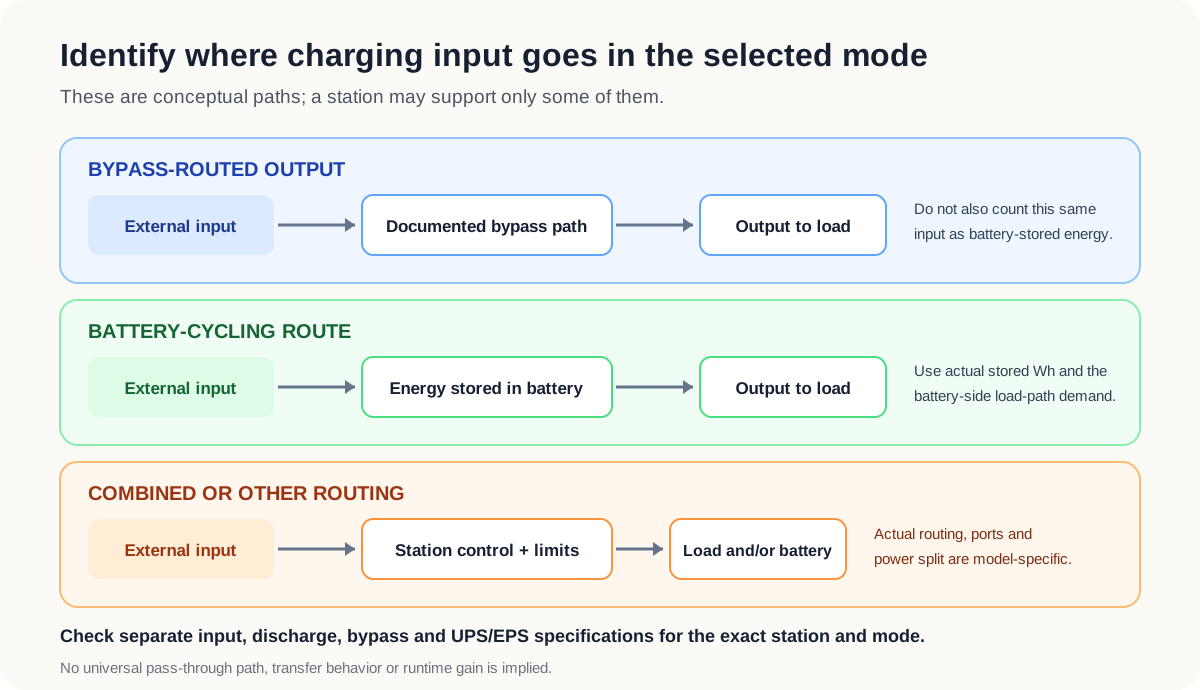
Before calculating, establish:
- the exact station, regional variant, port, firmware, and selected mode;
- whether input energy goes directly to the load, into the battery, or through more than one conversion stage;
- how much charging power actually reaches the battery over time;
- the load’s average and startup demand through the selected output;
- the station’s own use, reserve, input limits, and any automatic shutdown.
Panel nameplate watts or a charger rating are not the same as energy stored in the battery. Solar input can change with shade, orientation, weather, and charging controls. Use a measured or documented charging value for the exact path and period.
Use an energy balance without double counting
If the documented mode cycles the battery while charging and discharging, a useful accounting relationship is:
Net battery change = energy actually stored from input − battery-side energy used by the load path − station consumption.
Keep the terms on the same energy basis and over the same time interval. If the source provides the load directly through a bypass path, do not also count that same input as energy stored in the battery. If net battery energy is falling, estimate how long the current conditions could continue only after the exact model’s input and output behavior is verified. If it is stable or rising, that does not establish indefinite runtime: input may drop, a mode may change, or output may stop.
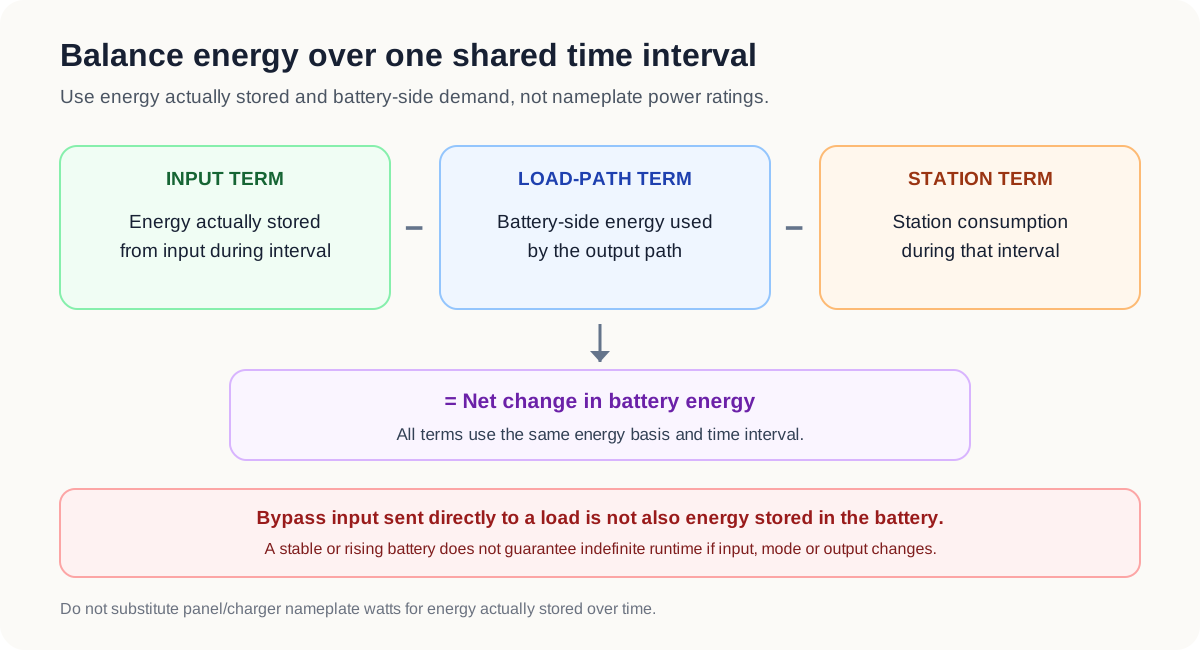
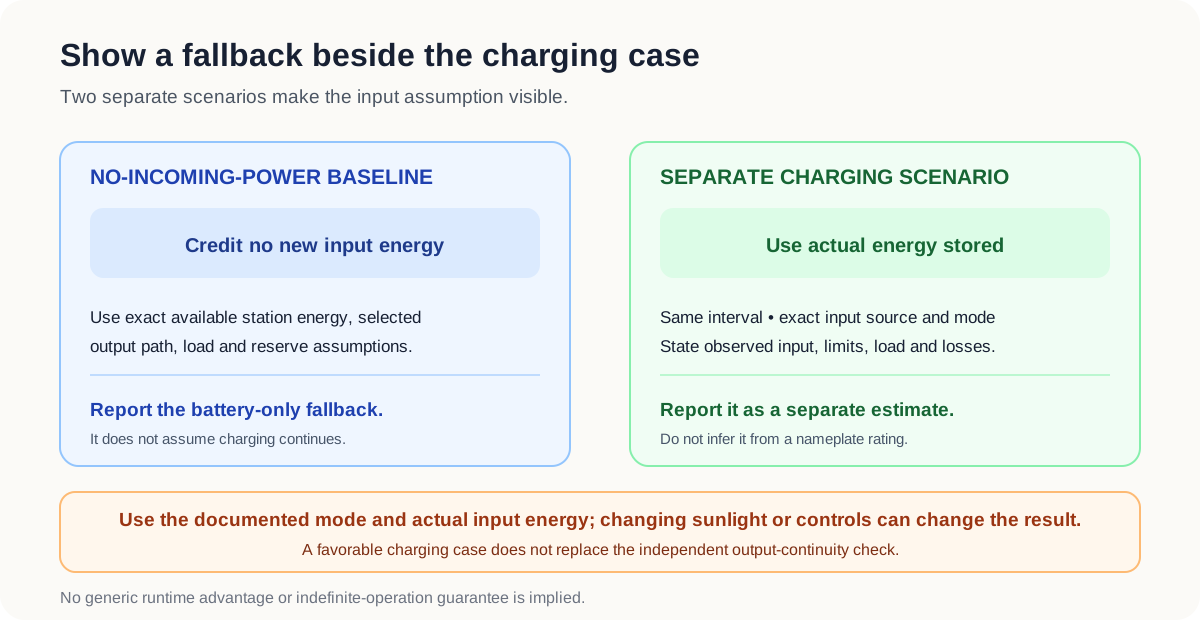
Do not subtract a panel’s rated output from the appliance’s rated watts and call the difference net charging. Conversion losses, station limits, and variable sunlight matter. When those values are unknown, show a no-incoming-power fallback estimate and a separate charging scenario with its assumptions.
Treat continuity as its own check
Pass-through, bypass, EPS, and UPS claims do not guarantee that a particular appliance stays on. Check supported ports and input limits, output voltage and frequency, startup demand, and any transfer-time requirement. A runtime calculation alone cannot establish safe operation for medical equipment, refrigeration of critical materials, or household wiring.
Key points
- Identify whether the system is discharging, bypassing, charging, or switching modes.
- Count only actual energy delivered along the documented path.
- Keep battery-only runtime separate from a charging or bypass scenario.
- Show a fallback result when incoming energy changes or is unavailable.