EcoFlow DELTA 3 Max U.S.: Output, Charging, and Bypass Limits
Identify the U.S. DELTA 3 Max by model code and separate its battery output, X-Boost claim, solar/DC input, and time-limited bypass current.
The U.S. DELTA 3 Max is a distinct model from the DELTA 3 Max Plus. EcoFlow’s U.S. page and U.S.-example manual identify model EF-DL-H02-3M, a 2,048 Wh LFP station with a 120 V / 60 Hz profile. Keep this page separate from the Max Plus profile: a similar family name does not establish the same output, accessories, or expansion support.
Identify the U.S. model and rated output
The manual lists 2,048 Wh / 51.2 V, 40 Ah for this model. It gives 2,400 W total AC discharge across four 120 V outlets, each listed for up to 20 A. The total inverter rating and an individual outlet’s current field answer different questions; the per-port value is not a 2,400 W rating for each outlet.
| U.S. DELTA 3 Max field | Manufacturer value | How to read it |
|---|---|---|
| AC discharge | 120 V / 60 Hz; 2,400 W total | Total output across four AC outlets. |
| Per-outlet current | Up to 20 A per outlet | Does not multiply the total inverter rating. |
| X-Boost | 3,400 W advertised | Manufacturer feature claim; exact operating conditions are not established here. |
| Battery | 2,048 Wh / 51.2 V, 40 Ah, LFP | Published energy and identity fields, not a measured runtime. |
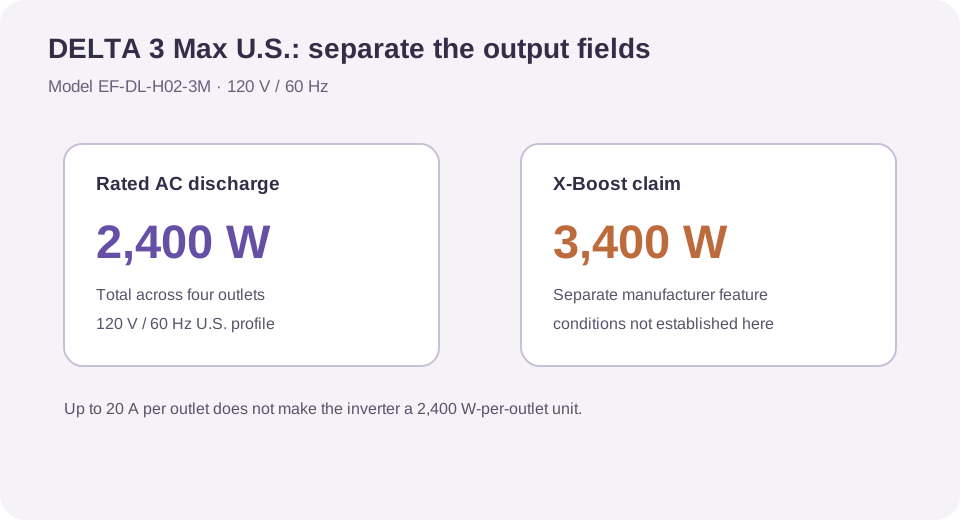
The U.S. product page advertises an under-10-ms UPS switchover. The manual describes automatic switching through its bypass circuit, but neither source establishes independent transfer performance or continuity for a named device. Check a connected device’s permitted interruption and follow the instructions for the exact unit before relying on this feature.
Read solar, vehicle, and AC input separately
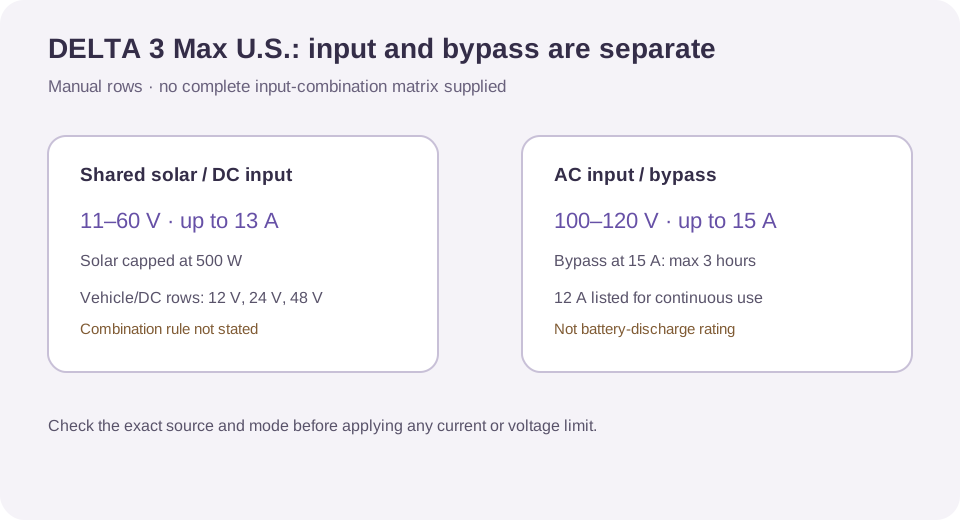
The manual lists one solar/DC input that accepts 11–60 V and up to 13 A, with solar input capped at 500 W. It separately lists vehicle/DC input fields of 12 V at 8 A, 24 V at 8 A, and 48 V at 10.4 A. These are source-listed electrical envelopes; the sources do not provide a complete panel-wiring matrix or a rule for combining the input rows. Confirm open-circuit voltage, operating voltage, current, connector, and configuration for the exact source and station.
AC charging input is listed at 100–120 V and up to 15 A. In bypass mode the manual limits 15 A to a maximum of three hours and lists 12 A for continuous use. Keep this bypass condition separate from battery-only AC discharge. Do not use the 2,400 W discharge figure to represent continuous bypass behavior.
Read the remaining ports without inventing a shared budget
The page and manual list a 12.6 V / 10 A car output at up to 126 W. USB fields include one USB-A port up to 18 W, one USB-C port up to 100 W, and two USB-C ports up to 30 W each with a 30 W combined limit for that pair. These port rows do not establish one aggregate AC/DC/USB budget for every simultaneous combination.
The manual instructs users not to carry the DELTA 3 Max onto a plane. That is a model-specific manufacturer instruction, not a replacement for current carrier or regulator rules. The reviewed sources do not establish extra-battery compatibility for the U.S. Max, a named-load runtime, or a complete simultaneous output budget. Do not borrow the Max Plus expansion specifications to fill those gaps.
For an exact comparison, record EF-DL-H02-3M, the U.S. 120 V / 60 Hz profile, the source version, and the mode attached to each figure. The DELTA 3 Max Plus profile covers a different model; the specification decoder explains how to separate discharge, input, and bypass fields.