Compare Power Stations by Capacity, Output, Portability, and Expansion
Build a task-specific shortlist of portable power stations by identity, usable capability, runtime inputs, portability, and verified expansion support.
There is no useful “best power station” ranking without a job and an exact unit. First identify each candidate’s model and market. Then eliminate units that miss a required voltage, continuous output, transfer behavior, input limit, or portability constraint. Compare the remaining options on the fields that affect your use.
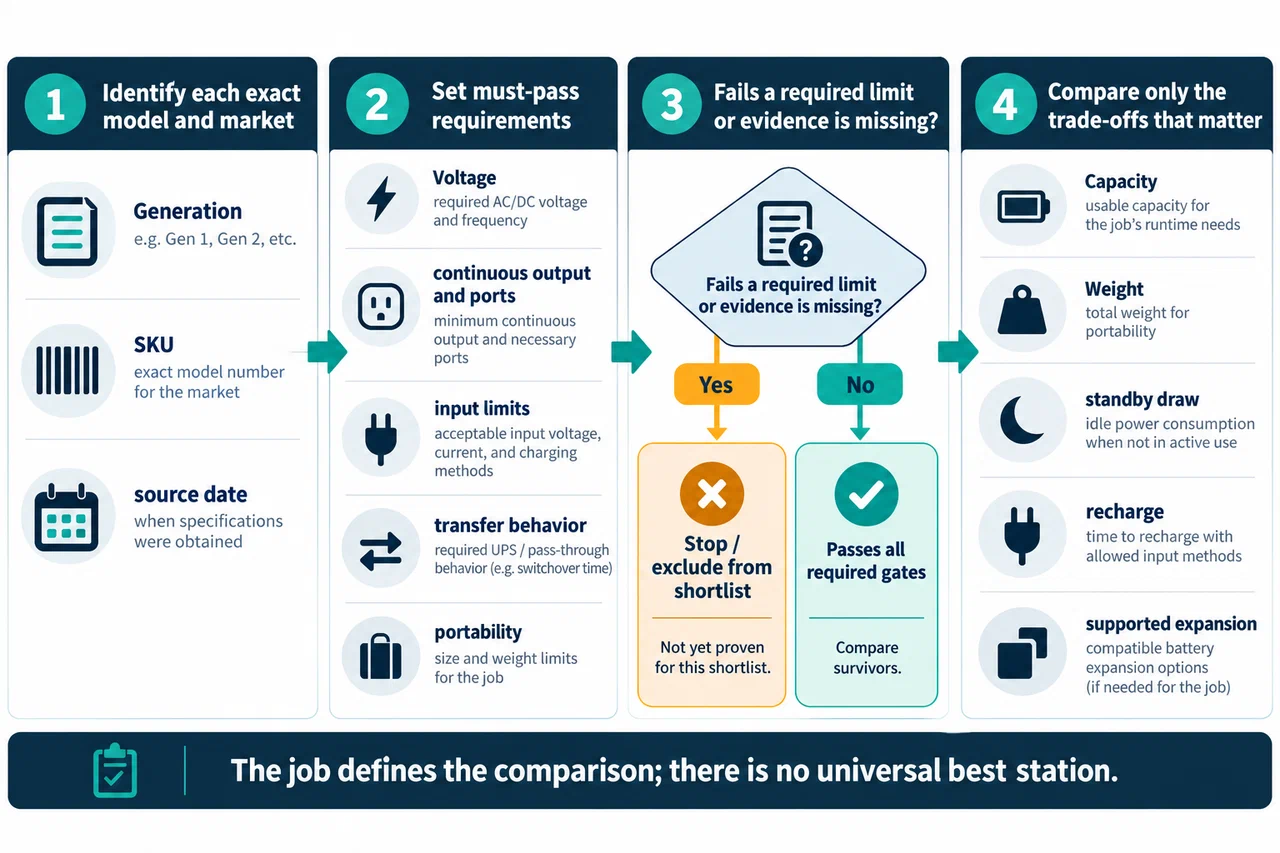
Start with a model and market selector
Before copying figures into a table, record the exact product name, generation, model or SKU, market, manual revision, and the date and URL of the source. Separate regional rows if the AC output, port layout, or source record differs. “One-kilowatt-hour model” is not a sufficient identity.
The examples below show why similarly sized products need separate rows:
| Profile | Documented capacity | AC profile | Useful comparison caution |
|---|---|---|---|
| EcoFlow DELTA 2, V1.0 manual | 1,024 Wh | 1,800 W total; 2,700 W surge | The manual is a 230 V profile and lists 2,400 W maximum X-Boost; current U.S. and Canada pages state up to 2,200 W |
| Jackery Explorer 1000 V2, Europe support record | 1,070 Wh | 230 V/50 Hz, 1,500 W; selectable 50/60 Hz | 18 W standby is material at low loads; stated transfer is 20 ms, not no-break |
| BLUETTI AC180 | 1,152 Wh | 1,800 W total | Power Lifting applies to pure resistive loads; it does not raise rated output |
| BLUETTI AC180P | 1,440 Wh | 1,800 W total | Separate model and manual from AC180 despite a shared rated-output figure |
These are model-specific examples, not a controlled lab comparison. Source documents use different markets, test conditions, and terminology. For the DELTA 2, the V1.0 manual also warns against X-Boost for loads with strict voltage requirements; keep that qualifier with its 230 V profile. Do not compare an undocumented field as though it were the same test.
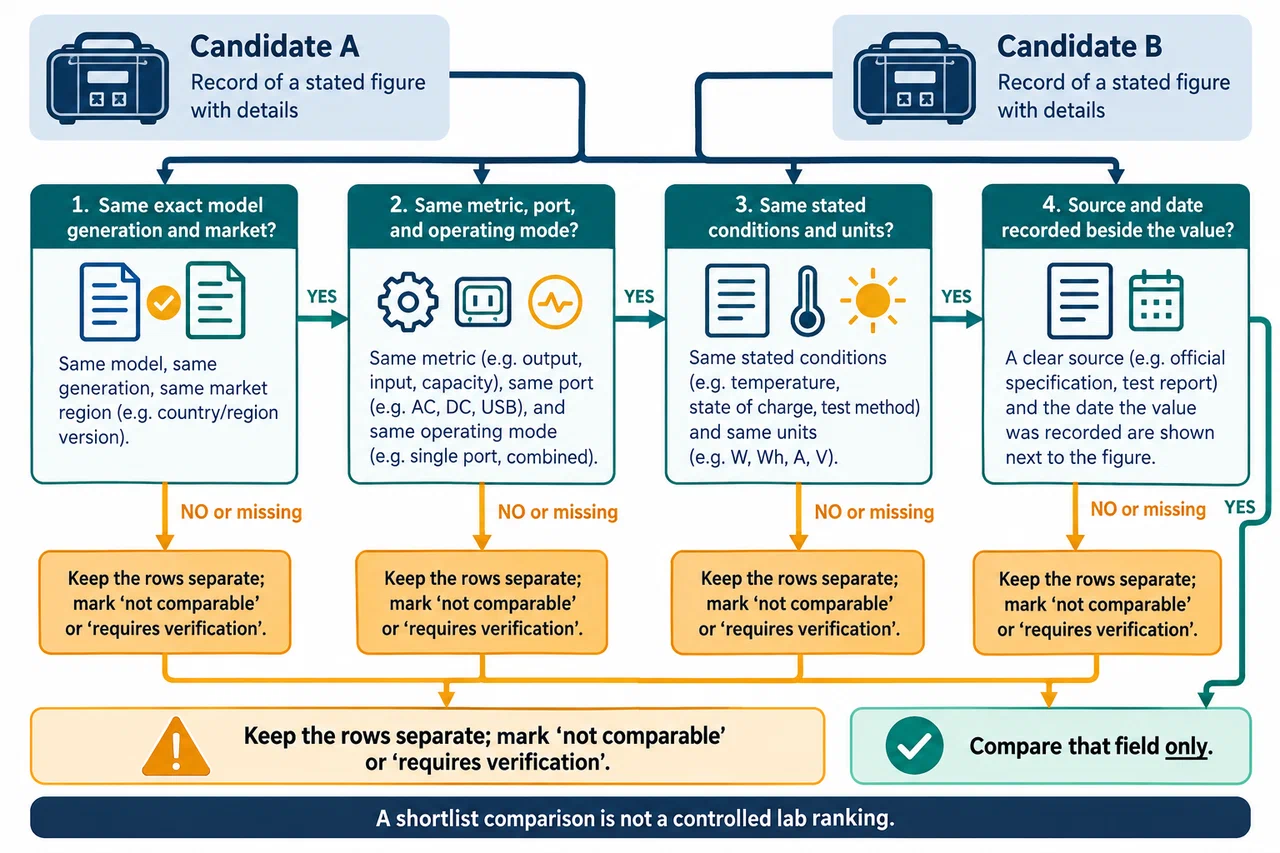
Compare the constraints that can rule a unit out
Load and output. List each device’s running wattage, startup demand if relevant, AC voltage/frequency, waveform requirement, and the ports it will occupy. Compare continuous demand with rated output and per-port or shared-group ceilings. Treat surge as a short-duration rating only when the duration and conditions are given. Do not convert X-Boost or Power Lifting into a continuous rating.
Energy and runtime. Watt-hours describe nominal capacity, not delivered energy at the appliance. Runtime depends on actual load, inverter and battery losses, station self-consumption, reserve settings, temperature, and mode. A published formula is an estimate based on stated assumptions. For a low-power device, standby draw can be a meaningful part of consumption; for a compressor, startup and cycling matter. Use measured load data where possible and leave uncertainty visible.
Weight and access. Compare the station’s mass and dimensions with how it must be moved, stored, ventilated, or charged. A larger battery may improve runtime but can make stairs, vehicle loading, and frequent handling impractical. Keep battery expansion separate: it can increase energy capacity while leaving the inverter’s output ceiling unchanged.
Charging and accessories. Compare solar voltage, current, maximum power, connector, panel topology, and matching rules together. Check vehicle input separately from the station’s 12 V vehicle output. For expansion, require an official compatibility statement for the exact base model and battery pack; a shared brand or connector is not enough.
Backup requirements. A transfer-time label is not a guarantee that your computer, router, pump, or medical equipment stays on. Check the load’s ride-through tolerance, the station’s exact backup mode, and any manufacturer exclusions. A station with pass-through charging may still have a transfer interruption.
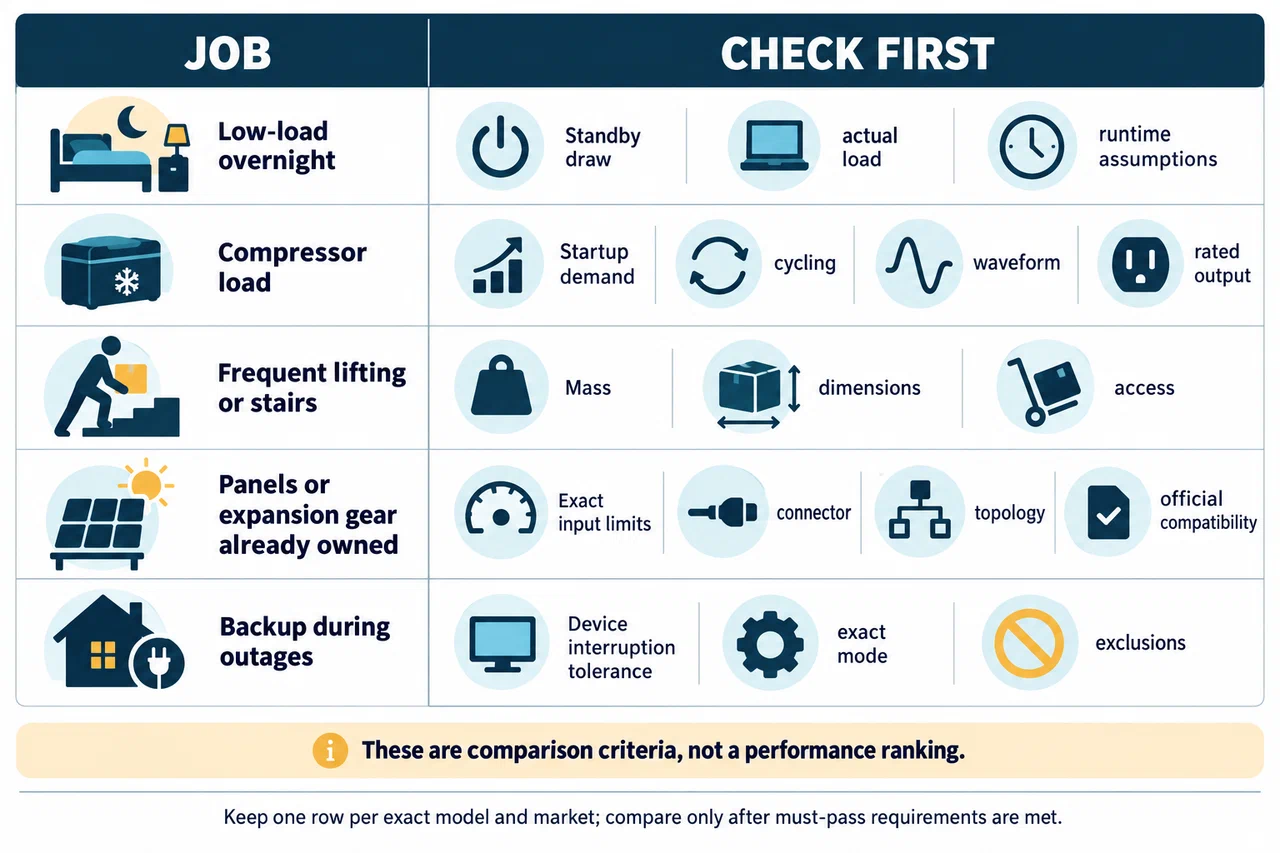
Make a decision by use case
Write down the one or two must-pass requirements first. Examples include a required AC voltage, enough continuous output for a particular load, an input compatible with the panels already owned, a maximum lift weight, or a specific expansion pack. Reject a candidate when its exact manual fails one of those gates or the necessary evidence is missing.
Then compare the survivors by the tradeoff you care about: stored energy, weight, standby draw, ports, recharge time, or supported accessories. Keep purchase price, current stock, bundle contents, and warranty out of a capability comparison unless you have current market-specific sources for them. Those facts change independently of the hardware specification.
For a reproducible shortlist, retain one line per exact model and market, attach the source URL and date beside each figure, and label missing data as “not specified” or “requires verification.” The specification decoder explains the fields; the identity guide explains how to resolve variants before comparing them.