How to Read a Portable Power Station Specification Sheet
Separate battery capacity, rated output, surge, charging input, standby draw, transfer time, and missing data when reading a power station's specifications.
A specification sheet is a set of limits and named operating conditions, not a runtime promise. Read it only after checking the exact model, generation, market, and manual version. The same number can answer very different questions depending on its label: battery capacity is not output power, surge is not continuous output, and solar-input wattage is not a panel recommendation by itself.
Decode the main fields
| Field | What it tells you | What it does not establish |
|---|---|---|
| Battery capacity, in Wh | Nominal stored energy stated for that model | Energy available at the outlet after inverter losses and reserve limits |
| Rated AC output, in W | Continuous inverter output within stated conditions | Whether a load’s startup, waveform, or voltage requirements are satisfied |
| Surge or instantaneous output | A short-duration ceiling, if the duration and test conditions are given | A general motor-start guarantee or a second continuous rating |
| AC voltage and frequency | The electrical profile for the relevant market or outlet | Compatibility with a device designed for another profile |
| Standby consumption | Power the station itself uses while an output or mode is active, where specified | A universal amount for every mode, load, firmware, or temperature |
| Solar input | Voltage, current, and power limits for a charging input | That any panel with a matching wattage or connector is compatible |
| Transfer time | A manufacturer-stated switchover figure under its stated configuration | A guarantee that a connected device will ride through the interruption |
Always check how a total is shared. A car socket and smaller DC outputs may have separate labels but draw from one shared limit. Several AC sockets usually share an inverter ceiling. Port count is not the same as simultaneous output capacity.
Separate rated output from special modes
Compare a device’s normal and startup demand with the station’s rated output and the relevant port limits. A surge figure matters only when the source states how long it is available and what conditions apply. A feature with a name like “Power Lifting” or “X-Boost” may change voltage behavior or restrict the allowed load class; it does not automatically raise the inverter’s rated continuous output.
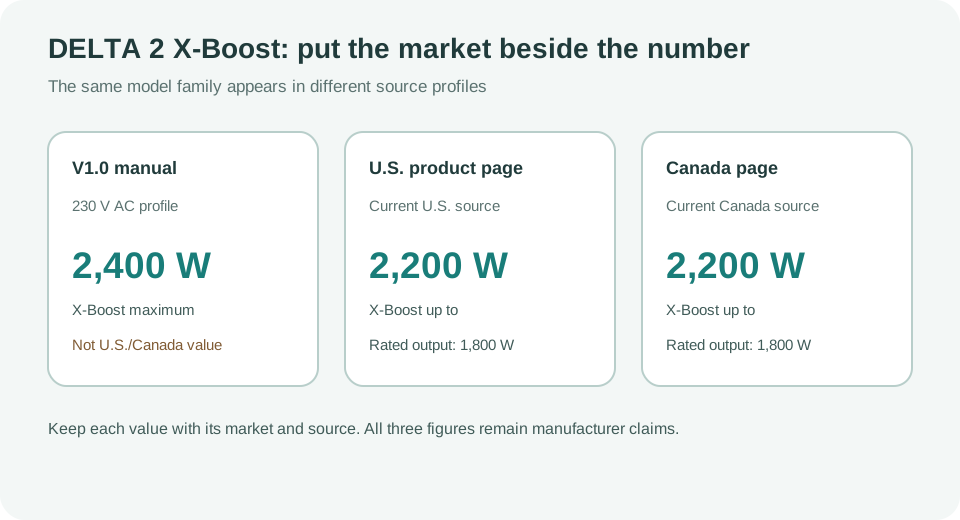
For example, the DELTA 2 V1.0 manual lists a 230 V AC profile, 1,800 W total output, a 2,700 W surge, and X-Boost up to 2,400 W. Current U.S. and Canada DELTA 2 product pages state 1,800 W output and X-Boost up to 2,200 W. Keep those market-specific figures in separate rows; the 230 V manual value is not a replacement for the current North American value. The manual also warns that X-Boost is unsuitable for loads with strict voltage requirements. The AC180 manual says its Power Lifting mode is for high-drain pure resistive loads while rated output remains 1,800 W. Neither feature is proof that an unspecified compressor, medical device, or motor will operate correctly.
Record the outlet and operating topology
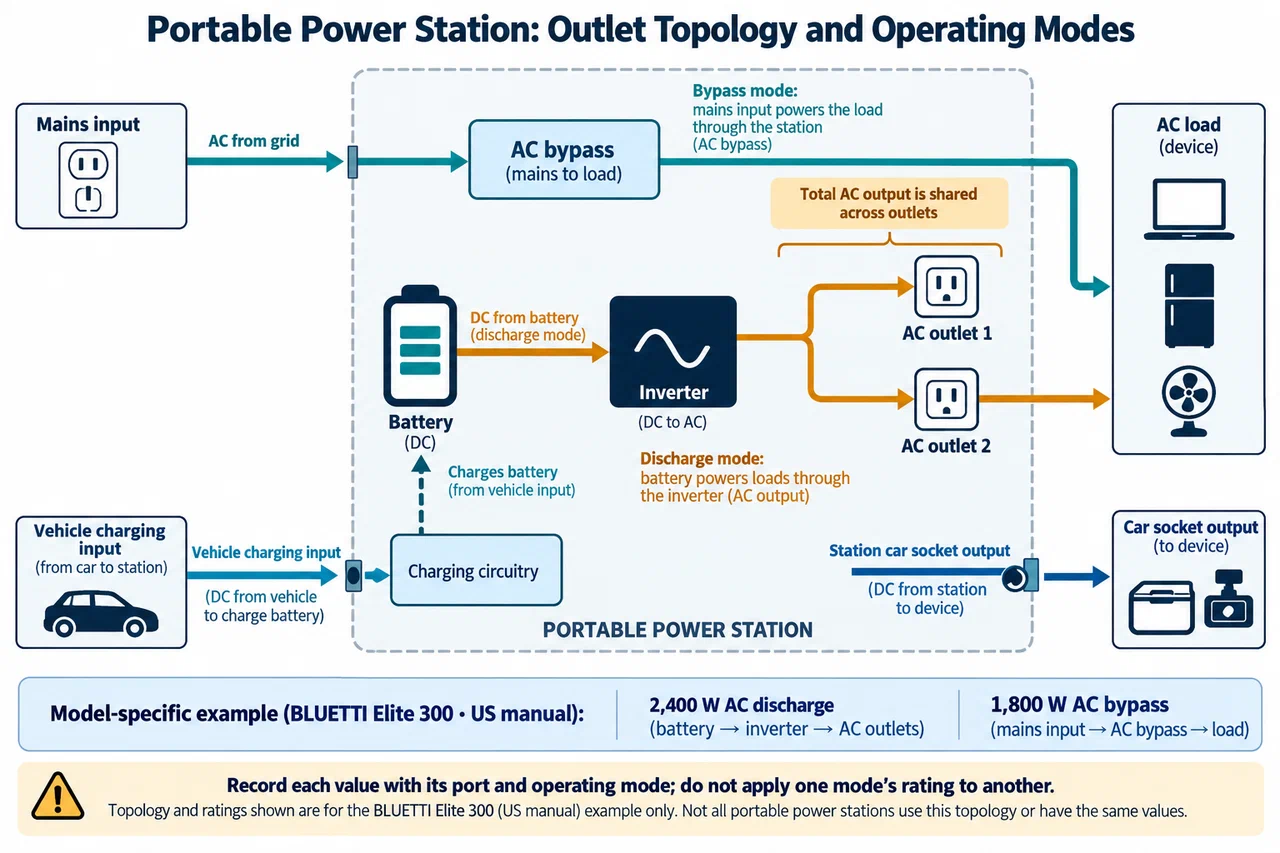
Write down the outlet type, voltage, current, shared-group limit, and mode for each port. A household receptacle, TT-30 or L14-30 outlet, regulated 48 V DC output, and cigarette-lighter socket are different paths with different loads and limits. Do not add each port’s maximum as though every outlet has an independent inverter.
For example, the BLUETTI AC500 US page lists several outlet types under one 5,000 W total. Its manual describes a different 220–240 V profile; those source states must remain separate. The AC200P L manual also lists a dedicated 48 V/8 A output alongside its AC outlets. That is a model-specific port, not permission to wire a station into a house or vehicle system.
Some station manuals give separate values for battery discharge and AC bypass while connected to mains. The BLUETTI Elite 300 manual, for instance, lists a 2,400 W US discharge ceiling and a lower 1,800 W US bypass ceiling. Record both with their modes; using the headline discharge value during bypass would overstate what the manual documents.
Treat input ratings as a set of limits
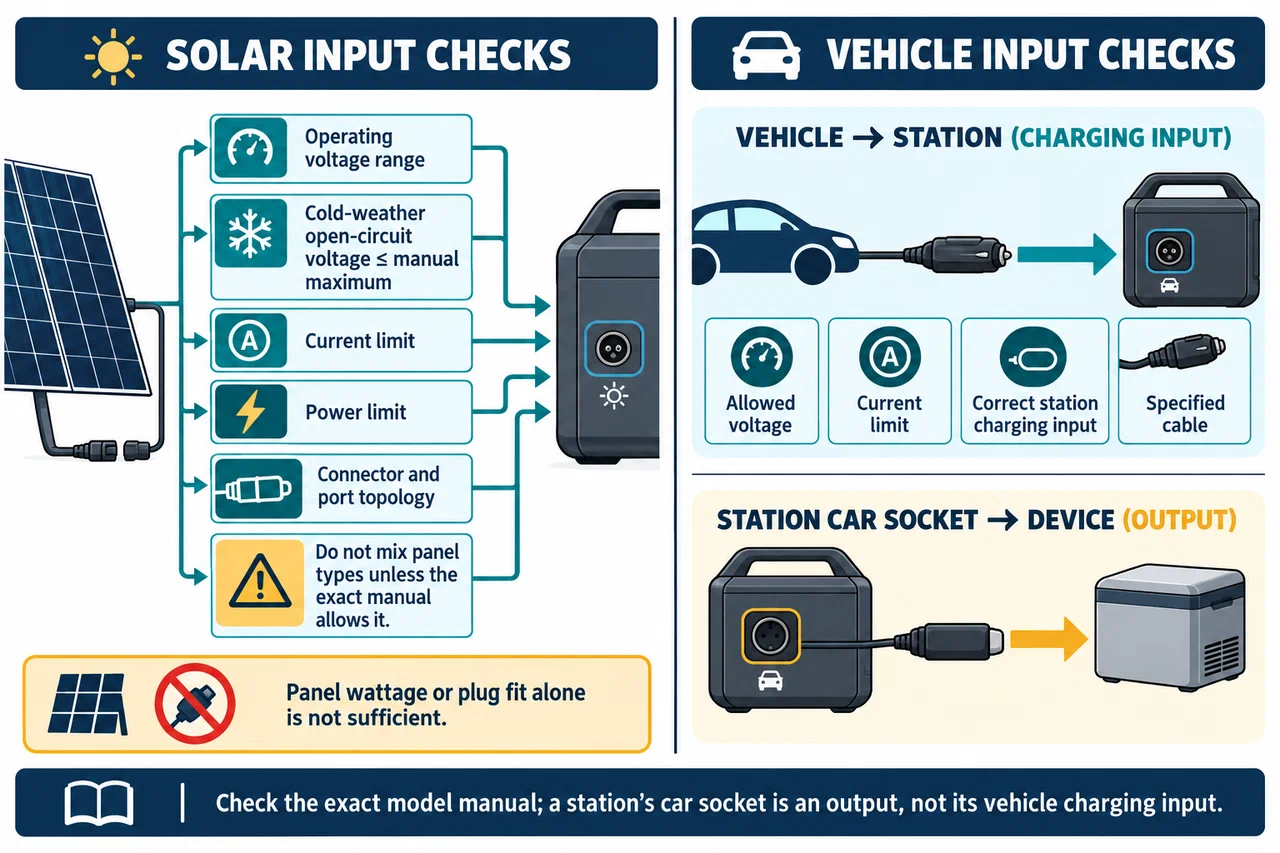
For a solar input, check minimum and maximum operating voltage, maximum open-circuit voltage, current, power, connector, and whether multiple ports are independent or connected in parallel. An array may exceed the station’s voltage limit in cold weather even when its panel wattage looks modest. Do not mix panel types unless the exact manual gives a compatible configuration.
For a vehicle input, check the allowed voltage range, current limit, connector, and whether the station needs a specific cable. A car socket on the station is an output; it is not the same as the station’s vehicle charging input. Expansion is another separate capability: extra battery capacity may add stored energy without raising AC output.
Keep provenance beside each value
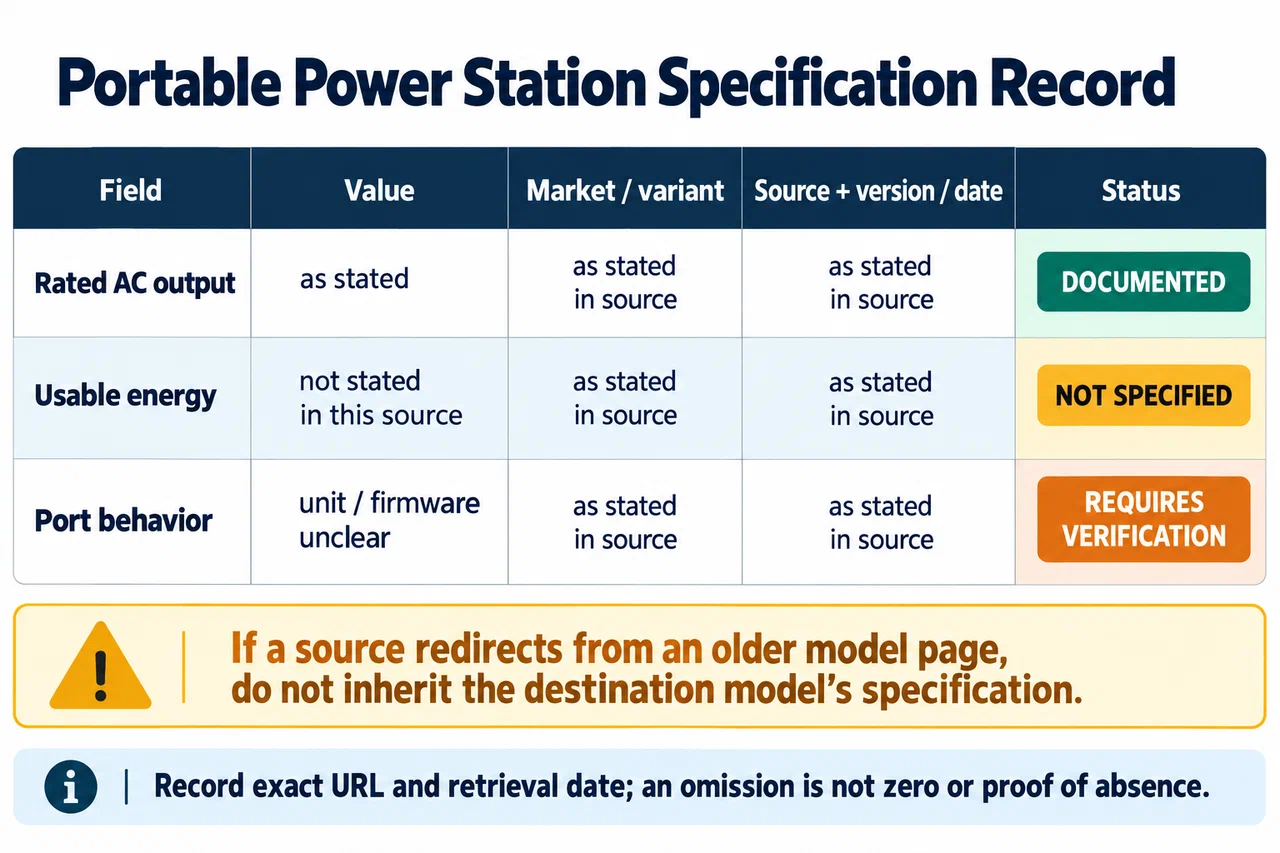
A useful comparison records the source and its scope next to every changing field: manual title and revision, support-page market, retrieval date, and exact URL. If one source is current but incomplete, say so. If another is a manufacturer manual for a different regional variant, do not use it to fill a gap by analogy.
Mark a field as documented when the exact applicable source states it, not specified when the source is silent, and requires verification when the unit, market, firmware, accessory, or test condition remains uncertain. An omitted figure is not a zero and is not evidence that a function is absent.
For example, the Jackery Explorer 1000 V2 Europe support page gives an 18 W standby figure and 20 ms transfer claim for its documented profile. The exact user manual is a North American 120 V/60 Hz source. Those two sources should not be silently combined into one regional specification. Use the exact model identity guide before applying a value, then use the comparison guide to choose which fields matter for your load.