How to Prioritize Essential Loads During a Short Power Outage
Sort outage loads by consequence, schedule, and electrical fit before estimating portable power station runtime.
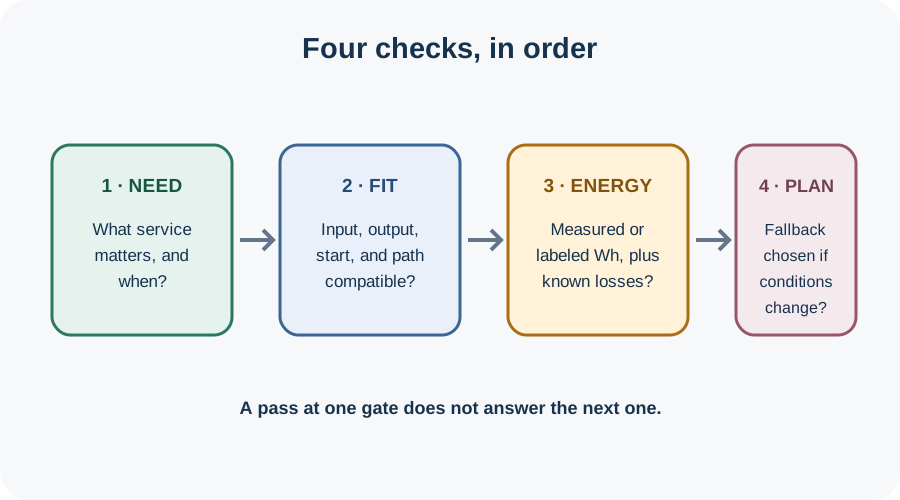
When an outage is expected to last a few hours, start by deciding what must keep working and what can wait. A portable power station may help with selected devices, but its advertised energy does not tell you which household needs to serve first. Build a short, household-specific list, check electrical compatibility, then estimate the energy for the loads you choose.
Set the scenario before ranking devices
Write down the outage window you are planning for, who is at home, and what changes if power is not restored on time. “Essential” depends on the consequence of losing a function. A refrigerator, phone, room light, water pump, heating control, and a medical device have different jobs; no universal order fits every home.
Use three working groups:
| Group | Planning question | Examples to consider |
|---|---|---|
| Must-run or safety-critical | What interruption needs a provider, clinician, utility, or local emergency plan? | A prescribed device, alarm, essential communications, or a pump tied to a time-sensitive household need |
| Scheduled | What can run in a defined window or be shared between household members? | Phone charging, task lighting, brief network use, or an appliance cycle if its manual permits it |
| Defer or drop | What can stop without creating a material safety or care problem? | Optional entertainment, duplicate chargers, or convenience appliances |
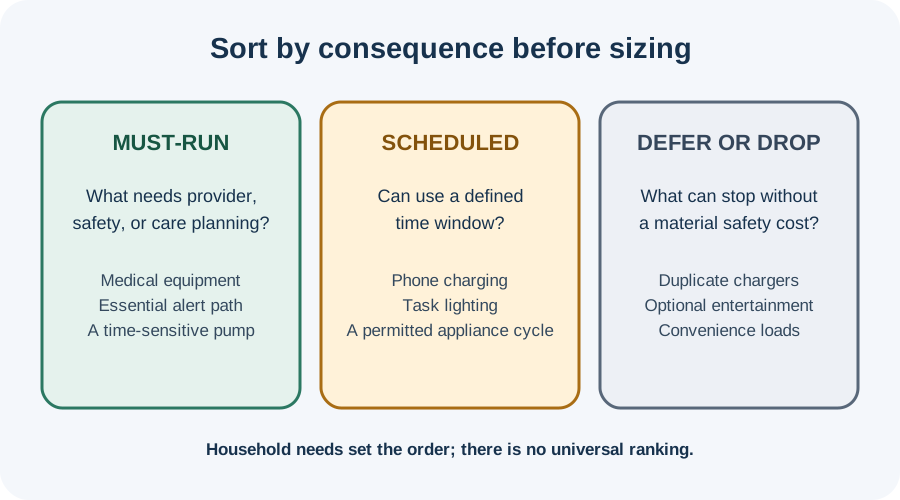
These are prompts, not a ranked checklist. A household may give communications, cooling, water, food, mobility, or care needs different priority. Include non-electrical dependencies too: water supply, fuel, transportation, safe indoor temperature, and a place to go if the home is no longer a safe location.
Make a load row for each function
Record the device and the service it provides. Note the exact model, input label, power path, when it runs, and what failure means. Mark every value as measured, copied from a device label or manual, or an estimate. A population average can suggest what to check, but it is not a household measurement.
| Function / device | When needed | Input evidence | Start or peak demand | Duration or measured Wh | If unavailable |
|---|---|---|---|---|---|
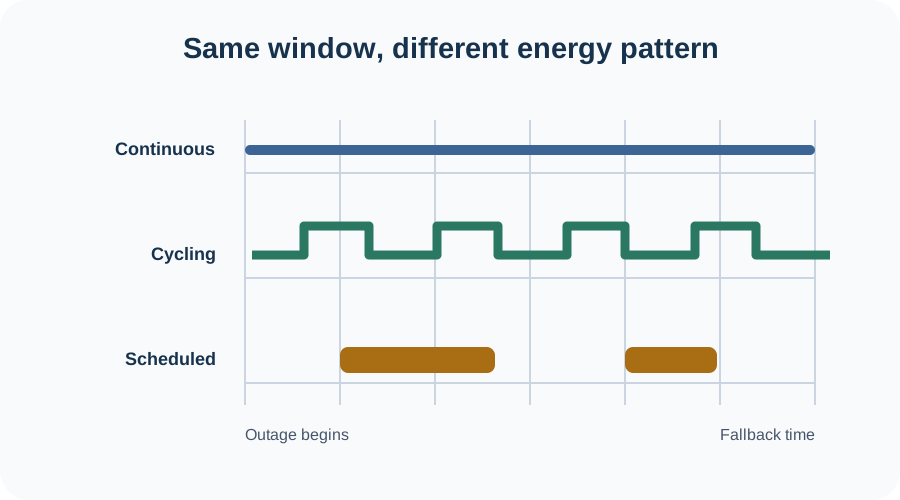
| Continuous / scheduled / cycling | Model, label, manual, or meter | ||||
| Continuous / scheduled / cycling | Model, label, manual, or meter | ||||
| Continuous / scheduled / cycling | Model, label, manual, or meter |
For a steady load, watts multiplied by hours gives an energy estimate in watt-hours. For a refrigerator or pump that cycles, measure energy over a representative period or use a source that describes the exact configuration. Nameplate watts multiplied by the whole outage can greatly overstate or understate a cycling device. Keep station conversion loss and idle use as separate unknowns unless you have a measurement or exact-model data.
Check compatibility before adding watt-hours
Energy arithmetic cannot make an incompatible device work. Compare the station output with the appliance input: voltage, frequency, current, connector, polarity for DC, and any manufacturer restrictions. Check continuous output and startup or surge demand while accounting for other loads that may start at the same time. A matching plug or a large watt-hour label is not proof of compatibility.
Also confirm whether the necessary port can operate for the whole planned interval and whether low-load shutoff, inverter behavior, or a shared output limit affects the device. For a hard-wired appliance or a station connection to household wiring, stop at the manual and contact a qualified professional; this article is not a wiring or transfer-switch guide.
Keep safety and service decisions separate
An energy plan does not establish that food is safe, that medicine can remain at a particular temperature, or that a medical device has an approved backup arrangement. Follow the relevant food guidance and device labeling, and ask the clinician, pharmacist, equipment provider, or utility for an individual continuity plan where needed. Canada’s power outage guidance includes planning for medical devices and evacuation access; use the current equivalent in your area. A battery estimate cannot replace those decisions.
Fuel generators also have carbon-monoxide and placement hazards. Keep their safety rules separate from battery-station planning and follow current CDC outage guidance and manufacturer instructions. Do not infer that a station can restore mains water, sewage service, heat output, or communications coverage just because one connected device can run.
Add a local support and stop plan
For households in the United States, Canada, and the United Kingdom, check the current instructions from the local electricity provider and emergency authorities. The NOVA Home Guide to Emergency Preparedness provides a general household-planning reference. In Great Britain, Ofgem explains how to contact a supplier’s Priority Services Register; eligibility and services are supplier-specific and do not guarantee continuity of power. Save the relevant phone numbers and choose a reachable backup location before an outage.
Before relying on the plan, test the exact device and power path during ordinary conditions, record what ran and for how long, and revise the list. If the outage lasts longer than the plan, a weather or medical concern rises, or a service dependency fails, switch to the non-battery fallback early. See the 24-hour budget, multi-day recharge plan, medical contingency guide, and food-safety guide.