Plan Overnight Backup for a Refrigerator, Network, and Lights
Budget a chosen overnight window for a cycling refrigerator, low-load network equipment, and scheduled lighting without assuming a universal station size.
An overnight backup is a defined service window, not a generic station-size recommendation. Choose the hours you want to cover, then estimate the refrigerator, network, and lights in different ways. A refrigerator cycles, network equipment may draw a small load continuously, and lights are often scheduled. Combining those patterns gives a more useful estimate than multiplying every nameplate wattage by the full night.
Choose the horizon and what counts as backup
Write the start and end times. An 8-hour, 10-hour, and 12-hour plan are different energy requests. Decide whether “overnight” means keeping food cold, receiving alerts, maintaining internet, charging phones, or simply lighting a path. Internet service itself may fail, and a working router is only one part of the connection.
Decide what reserve means for your household before comparing stations. It could be a stated number of hours for a critical function or an early-morning threshold that triggers load reduction or relocation. There is no universal reserve percentage that works for every appliance, battery condition, weather, or outage.
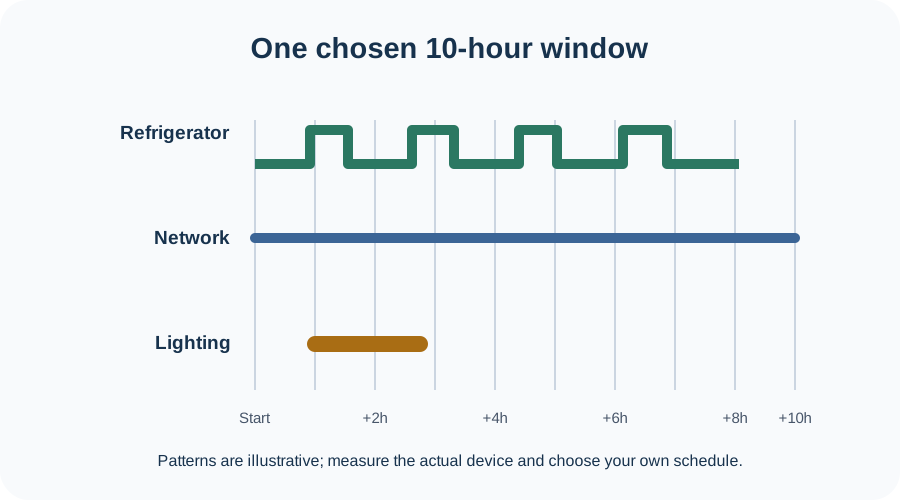
Measure each load in the way it behaves
For a refrigerator, record the exact model and settings, then measure its energy across a representative window if you can do so safely and with an appropriately rated device. Temperature, door openings, room conditions, and the amount of warm food can change compressor operation. A rating label or an annual energy estimate is not the same as measured energy for this particular night.
For the modem, router, or other network equipment, record the model and input path. If it is expected to stay on, estimate output energy as measured average watts multiplied by hours, then separately account for the station’s own conversion and idle use. Small loads can be affected by station low-load behavior, so test the exact combination rather than assume it will remain on.
For lighting, add the watt-hours for the bulbs and the hours they will actually be used. A planned two-hour task-lighting window is not the same as leaving every light on throughout the night. If a phone or laptop is also needed, make its charging window a separate row.
| Load | Method for this plan | Your input |
|---|---|---|
| Refrigerator | Measured Wh across the selected window, or a clearly labeled estimate | Wh |
| Network | Measured average W × hours; account separately for station overhead | W × hours = Wh |
| Lighting | Bulb W × number of bulbs × planned hours | W × bulbs × hours = Wh |
| Other scheduled device | Measured or manual-based energy for its actual use window | Wh |
Work through a replaceable example
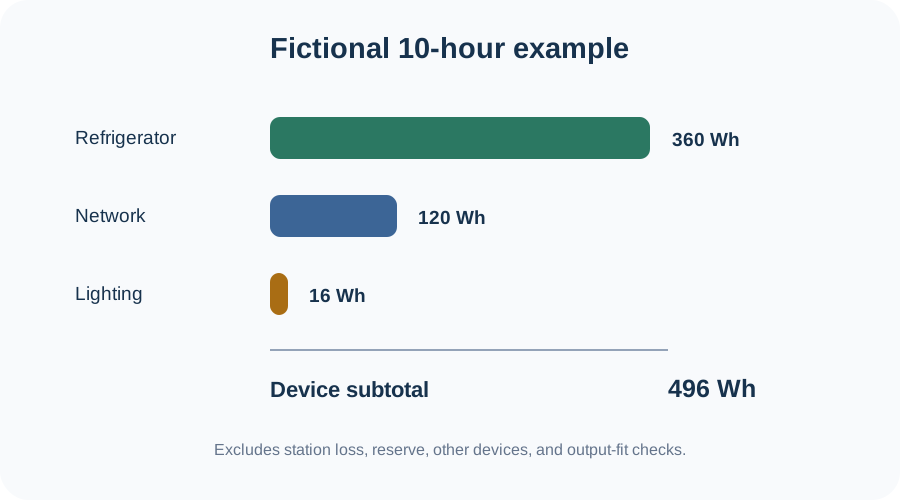
Suppose a fictional household measured 360 Wh for its refrigerator during a chosen 10-hour test. Assume, only for this example, that its network equipment used an average 12 W for all 10 hours and two 4 W lights were used for two hours. The simple device-energy subtotal is 360 + (12 × 10) + (2 × 4 × 2) = 496 Wh.
These are example inputs, not typical refrigerator or network values. Replace every number with the exact household result. The 496 Wh subtotal does not include station conversion losses, station idle use, a reserve, battery aging, additional devices, or a simultaneous-output limit. Do not convert it directly into a station purchase recommendation.
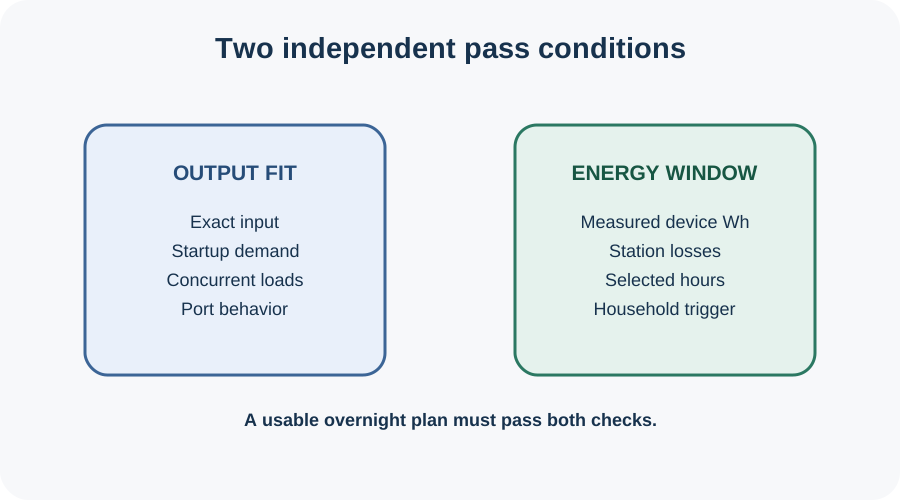
Keep energy and output compatibility as separate checks: enough watt-hours cannot fix an unsupported input or a failed startup.
Apply the electrical and food-safety checks
Before using the station, check the refrigerator’s voltage, frequency, running input, startup behavior, and connection method against the exact station manual. Include other loads that may run at the same time. The refrigerator’s total energy and its peak output requirement answer different questions; both must fit.
Keep temperature and food decisions separate from the watt-hour total. Follow the appliance instructions and current food-safety guidance; Health Canada’s emergency food and drinking-water guidance is one regional reference, and local advice may differ. A runtime estimate does not confirm that food remained at a safe temperature. For prescription medicine, follow its label and ask a pharmacist or clinician about an excursion rather than treating refrigerator runtime as a medication decision.
Test the whole setup before relying on it. Observe the refrigerator through a representative cycle, check whether low-load equipment stays on, record the station’s displayed energy change, and note any warnings or resets. If network access is important, keep an alternate way to receive emergency information. Use the 24-hour budget, food-safety guidance, remote-work plan, and multi-day recharge plan for the next planning window.