Plan Portable Battery Backup for a Multi-Day Storm
Balance a minimum daily load, uncertain recharge, reserve, and early fallback decisions across a prolonged storm outage.
A multi-day storm plan needs a daily energy budget and a realistic recharge branch. A larger battery can delay a shortfall, but it does not guarantee enough energy for an uncertain outage. Choose the minimum services the household needs each day, identify which charging paths are truly available, and decide what to do if all of them are delayed.
Define the minimum daily service
Start with an outage horizon and the people, devices, food, water, communications, and weather risks that shape the plan. Separate essential functions from loads that can be rotated or dropped. Record what must stay on continuously, what can run in a window, and what cycles. A refrigerator, pump, fan, light, and phone should not all be treated as steady loads unless measured use supports that assumption.
Pick a reserve trigger in practical terms: for example, the point at which you stop a nonessential load, contact a support provider, or leave for a safer place. The trigger should be early enough to act while transport, communications, and local services remain available. It is a household decision, not a universal reserve fraction.
Track energy day by day
Use one row per day, not one total for the whole storm. Record starting energy, planned load, energy actually accepted from a charging source, and ending energy. Label uncertain values instead of hiding them in a daily average.
| Day / period | Starting usable energy | Planned device energy | Recharge received | Ending energy / action |
|---|---|---|---|---|
| Day 1 | ||||
| Day 2 | ||||
| Day 3 or longer |
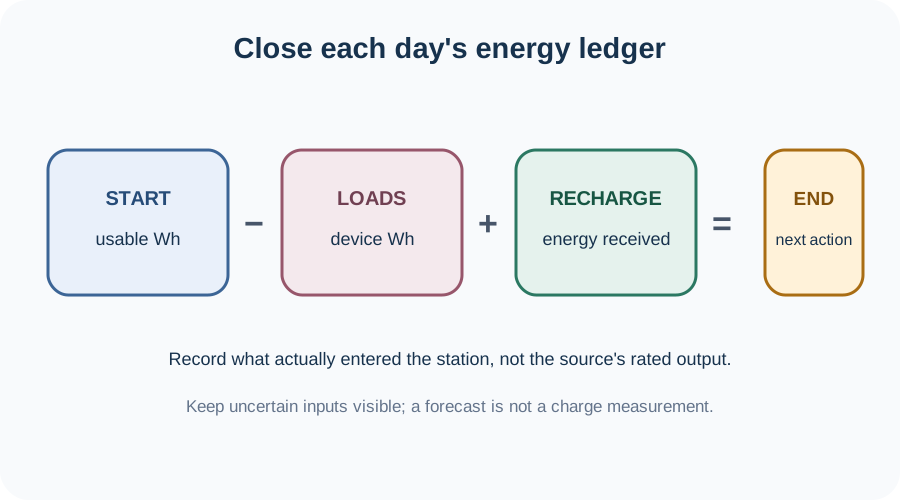
Do not equate rated input with energy harvested. Wall, vehicle, solar, and fuel-generator recharge each have separate availability and equipment limits. Solar delivery depends on location, weather, panel orientation and shade, temperature, cables, and the station’s accepted input. Vehicle charging depends on the vehicle and station instructions and on whether the route or vehicle remains available. Use the manufacturer’s exact limits and a conservative local forecast; no source is guaranteed merely because it appears in the plan.
Decide before recharge fails
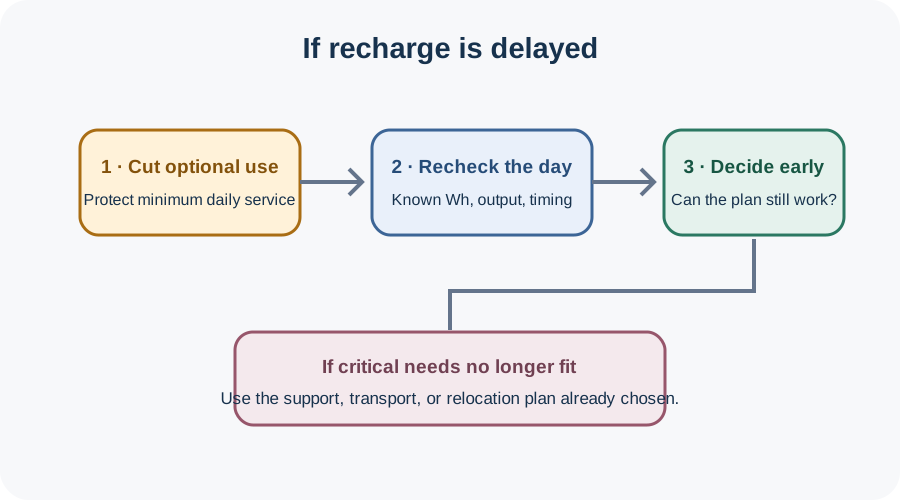
Write a second plan for the case where the grid, solar, vehicle, and any generator route are unavailable or delayed. On the first shortfall, remove the least consequential scheduled loads and shorten discretionary operating windows. Recalculate the next day’s minimum service. If the remaining energy cannot cover the critical plan, do not wait for a battery display to reach empty before arranging another location, support, or transport.
Weather changes both recharge expectations and household risk. Follow local emergency and weather instructions, protect equipment within the maker’s temperature and storage limits, and avoid going outdoors to reposition panels during dangerous conditions. Canada’s outage guidance recommends planning for household needs and local information; the CDC’s outage guidance covers health and safety hazards. An outage is also a food, water, communications, road-access, and service-restoration problem; watt-hours do not restore those services.
Fuel generators are a distinct source with their own carbon-monoxide, fuel, and placement hazards. Follow the CDC’s generator safety instructions and manufacturer directions; never use a generator or gasoline-powered engine indoors. Do not connect a station or generator to household wiring without a properly designed and professionally confirmed arrangement. See the 24-hour budget, essential-load method, and solar recharge guide before committing to an untested charging path.