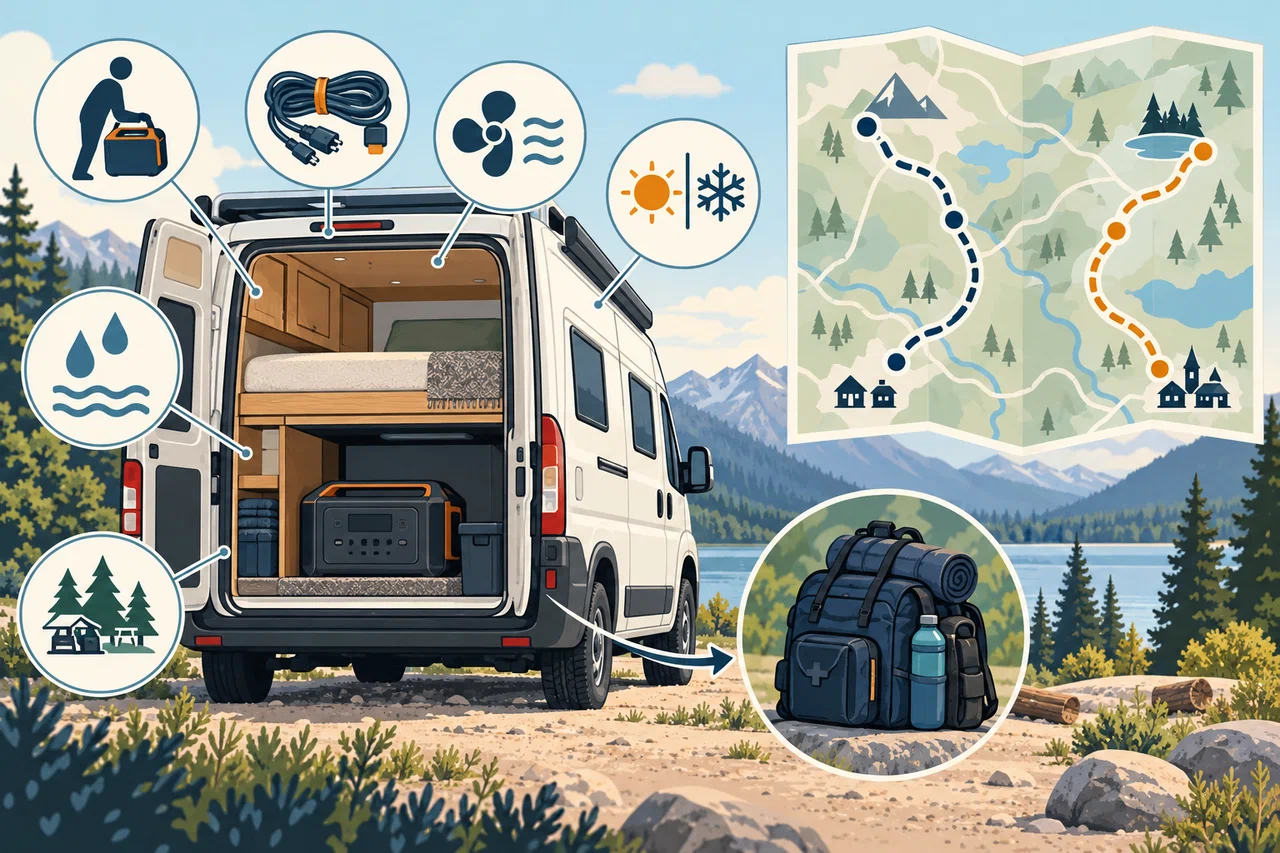
Build an RV, Campervan, or Camping Power Station Plan
Balance travel-day and overnight loads with direct-DC paths, vehicle or solar charging, weather, weight, and a realistic fallback.
A travel plan needs to fit both the day’s energy use and the equipment you can carry. A refrigerator, phone, lights, fan, laptop, cooking appliance, and satellite terminal can use different power paths and have different schedules. Start with the trip, not with a station’s advertised capacity.
Build a day-and-night load list
| Device | Power path | When it runs | Evidence to collect |
|---|---|---|---|
| 12 V refrigerator or cooler | Direct DC or AC adapter | Cycling through day and night | Exact model, input label, measured energy over representative conditions, startup need |
| Phones, lights, and laptop | USB, USB-C, DC, or AC | Scheduled charging and evening use | Exact charger input, charging time, and number of devices |
| Fan, cooking device, or tool | Model-specific AC or DC path | Short periods or repeated sessions | Startup demand, run time, simultaneous-use plan, and environmental limits |
| Satellite or network equipment | Exact manufacturer-approved connection | Work or communication windows | Model, active use, required router path, service coverage, and charging accessory |
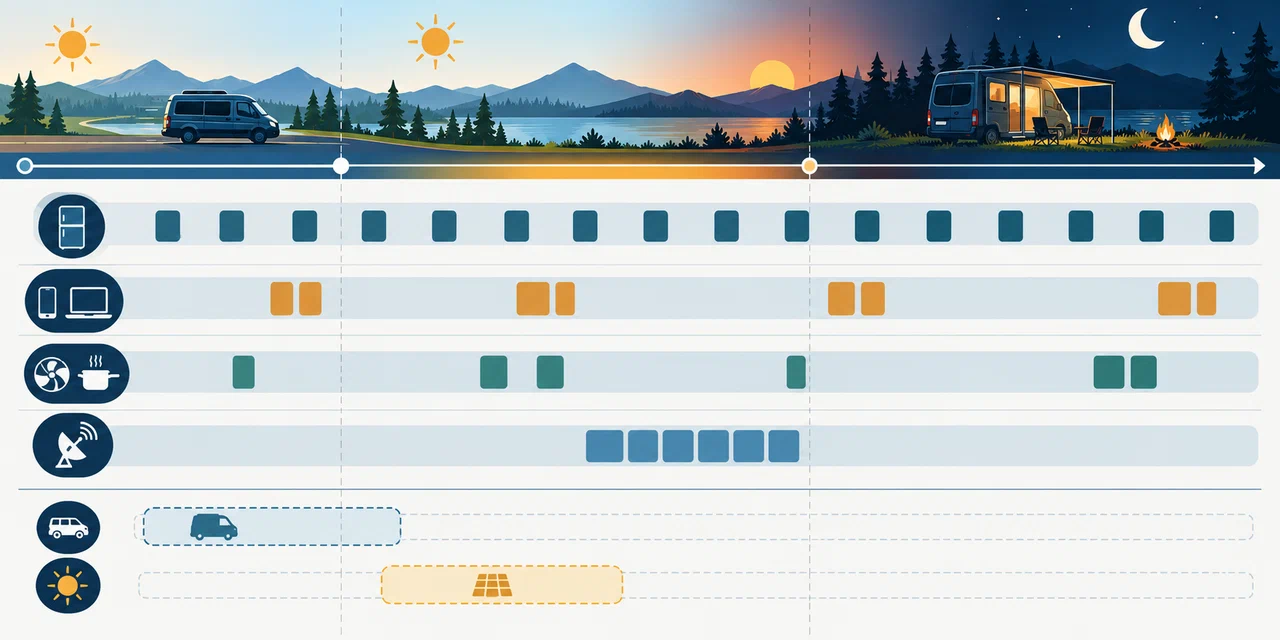
Set the target autonomy: hours until the next drive, a full day without shore power, or several days without a reliable charge. Use measured watt-hours for cycling loads and a schedule for intermittent ones. Add the energy by time window, then check the station’s usable energy and simultaneous-output limits. The daily total is not enough if a motor’s startup demand exceeds an output limit or two devices share a restricted port.
Verify the power route, not just the plug
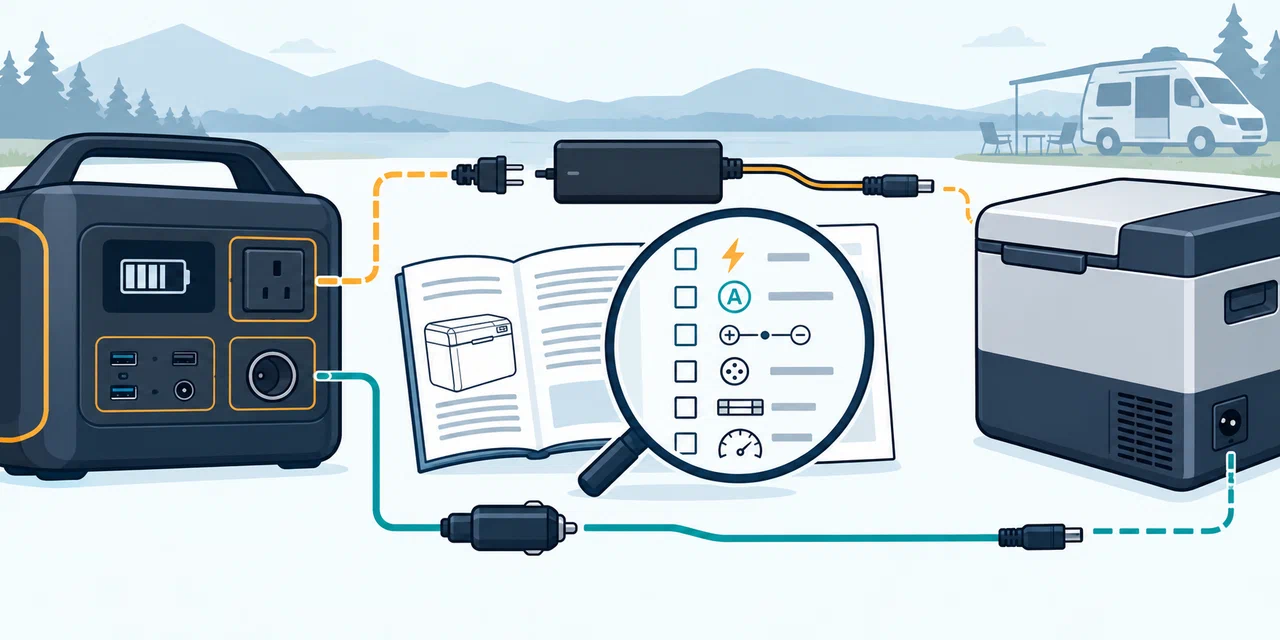
For each device, compare its voltage, current, polarity, connector, and accepted input path with the station manual. A 12 V plug does not prove that a device and station are compatible. Direct DC may avoid some AC conversion overhead, but the cable, fuse, current limit, and device input must all be correct. Do not build or adapt a connection from plug appearance alone.
Vehicle charging depends on the vehicle’s outlet, alternator or charging system, station input limit, drive schedule, and the maker’s instructions. Solar charging depends on panel limits, temperature, cable, shade, orientation, and weather. Test the arrangement at camp before depending on it. Do not count on campsite power, a public charger, or a vehicle charging opportunity unless it is confirmed for the actual route.
Include travel constraints and an exit plan
Weight, storage, cable routing, ventilation, water exposure, temperature, and campsite rules can matter as much as battery capacity. Keep the station and cables within their operating conditions, secure gear for travel, and follow the exact manuals. If using a fuel generator, follow its outdoor placement and local safety rules; never treat it as interchangeable with a battery station.
An RV may also have permanently installed AC or DC wiring. Do not feed an RV inlet or household circuit from a station unless the exact equipment is designed for that method and the required transfer/isolation arrangement is confirmed by a qualified professional. A portable station is not an automatic substitute for shore power or a built-in inverter.
If the trip includes medical equipment, refrigeration of medicine, dangerous weather, or a no-service route, plan the fallback with the relevant provider and local authorities. Keep an evacuation kit separate from the station energy budget; a heavy station may not be practical to carry. See the Starlink Mini guide, multi-day recharge plan, exact station models, and solar charging guidance.