Build a 24-Hour Portable Power Station Outage Budget
Plan a full day by separating continuous, cycling, and scheduled loads, then check output, reserve, and recharge assumptions.
A 24-hour plan is a schedule of selected services, not a promise that a battery can run a home for a day. Define what the plan must cover, divide the day into continuous, cycling, and scheduled loads, then check energy and output separately. If the plan needs more energy than the available system can supply, reduce loads, arrange a verified recharge window, or choose another safe location.
Define the service and the fallback trigger
Write down when the 24-hour period begins and what “backup” includes. Is the goal to preserve a few foods, keep a communications path, support a pump during selected periods, or cover all of those? Record the country, the exact appliance and station model, the power path, and whether each input is measured, copied from a manual, or illustrative.
Choose a household-specific trigger before calculating. For example, decide what happens if the battery display reaches a chosen level earlier than expected, if a critical device cannot be supported, or if weather or a utility update changes the safe plan. This is a decision rule, not a universal percentage or a prediction of remaining runtime.
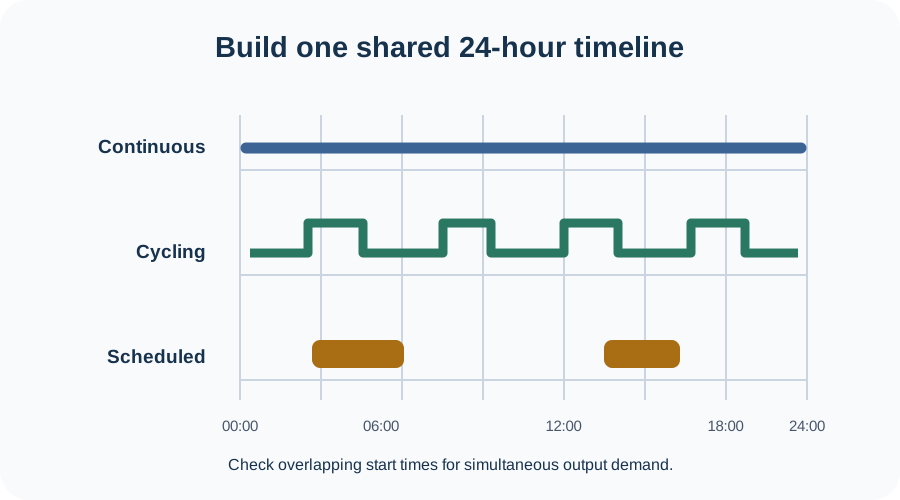
Build the day in time blocks
Use the same timeline for every load. Continuous loads accumulate across the full day. Cycling devices need measured energy across a representative period. Scheduled devices belong only in their planned window. If several loads overlap, check that the station can supply their combined running and startup demand at that time.
| Device or function | Pattern | Evidence / assumption | Planned window | Energy (Wh) |
|---|---|---|---|---|
| Refrigerator or freezer | Cycling | Household meter over representative use | Full day | |
| Modem/router or alert path | Continuous or selected window | Measured average draw and station low-load behavior | ||
| Lighting and charging | Scheduled | Actual device input and use time | ||
| Pump, heating control, or other motor | Intermittent / startup-sensitive | Exact model, measured cycle, and manual limits | ||
| Other must-run service |
Example subtotal, not a recommendation
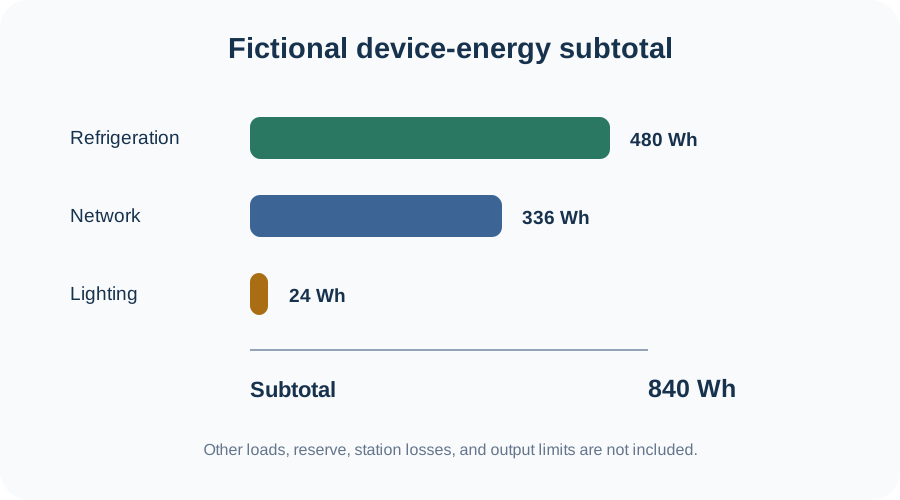
For arithmetic only, imagine a household’s refrigerator meter showed 480 Wh over a representative day, its network equipment averaged 14 W for 24 hours, and its lights used 8 W for three planned hours. Those inputs produce 480 + (14 × 24) + (8 × 3) = 840 Wh of device use before any other load. This is a fictional example, not a typical appliance profile or a suggested station capacity.
Add your actual pump, charging, heating-control, medical, and other required rows. If a value is unknown, leave it visibly unknown; do not silently replace it with a population average. The runtime method explains energy accounting, while the essential-load guide helps decide which functions can be removed first.
Separate the energy and output decisions
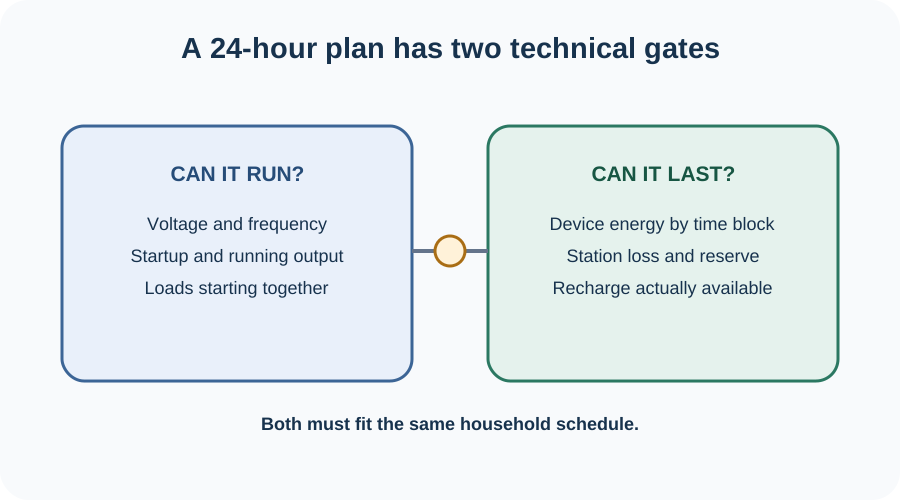
For every time block, ask two different questions: can the station deliver the required voltage and running or startup output, and is enough usable energy left for the planned window? Passing one does not prove the other. Include any overlap between motors, network equipment, and scheduled charging in the output check.
Test output, reserve, and recharge separately
First test electrical fit. Compare each device’s voltage, frequency, current, connector, continuous output, and startup need with the exact station and cable instructions. Do not treat a matching plug or a large capacity number as compatibility. Then compare the total device energy with the station’s usable energy under its manual’s conditions. AC conversion, low-load draw, temperature, battery age, and other operating limits can reduce delivered energy; use exact-model information or a test rather than an invented universal multiplier.
If the plan includes charging during the day, record when the source is actually available and the station’s accepted input under the same conditions. Do not enter a solar panel’s nameplate watts as energy received. A hoped-for vehicle or wall outlet is not a confirmed recharge window. Keep charging energy, load energy, and remaining reserve as separate lines.
At home, try the planned schedule before an outage and log the station’s energy display at each block. Confirm that critical loads do not reset as other devices start. If the device sum, required output, and available recharge do not fit, remove optional uses or start the fallback earlier. A 24-hour budget cannot guarantee safe food, medicine, heat, water, or internet service; follow the appropriate authority, provider, or product guidance for those decisions. The CDC’s current power outage guidance and Canada’s household outage guide illustrate the separate health and household-planning checks.