Why Space Heaters and Electric Cooking Drain Power Stations Quickly
Estimate high-draw heater and cooking use from measured watt-hours, and check the appliance rating against the station's continuous output.
Electric resistance heating can consume a large share of a small station’s usable energy in a short time. Cooking appliances may also cycle, pulse, or change draw as a task progresses. Begin with the exact regional model and its label, confirm the station can continuously supply the load, then measure energy for the intended task. A heater’s advertised setting or cooktop’s maximum is not the same as energy used per hour or meal.
Check the rating before estimating time
Read the appliance label for voltage, frequency, rated watts or current, plug and grounding, and any required circuit. Match those requirements to the station’s continuous AC rating and outlet limits. Check simultaneous-load limits if other appliances share the station. Short peak or “power boost” claims must be read in context: they may have a limited duration or apply only under specified conditions. Do not assume that a station with a large battery can safely operate any appliance that fits its outlet.
Regional ratings matter. The DeLonghi HMP1500WH-6A product page lists a 1,500 W panel heater for its US-market product. That rating does not establish UK or Canadian equivalence, watts at each thermostat setting, cycling frequency, or room-heating performance from a station. The Iwatani DI-1800 is a North American 120 V / 60 Hz built-in induction unit rated 15 A, with a stated approximate 300–1,800 W range and nine settings. Its sources do not map each setting to a wattage or provide energy for a cooking task. Neither example represents every heater or cooktop.
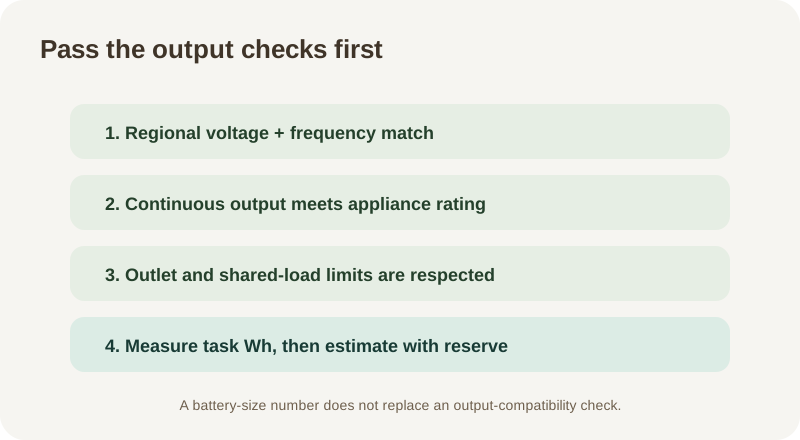
Measure energy for the real task
For a heater, record watt-hours across a representative interval after the room and appliance reach the expected operating state. A thermostat may switch the element off and on, so measuring only the highest setting overstates some sessions while a brief low reading understates them. Log the room temperature and chosen setting. Keep doors, ventilation, and heater placement within its instructions; do not block an intake or use a high-draw appliance in a way the manufacturer prohibits.
For cooking, measure from the cold start through the task’s end, including preheat, heating, pauses, and keep-warm if used. Include the food amount, cookware, and repeatable task description. Do not infer meal energy from the maximum label or linearly scale from a setting number. The Iwatani manual gives nine power levels but no watts per level; the 300–1,800 W range is an appliance specification, not a measured station-side curve. For intermittent countertop appliances, the air-fryer and toaster-oven guide and kettle guide discuss task-based measurement.
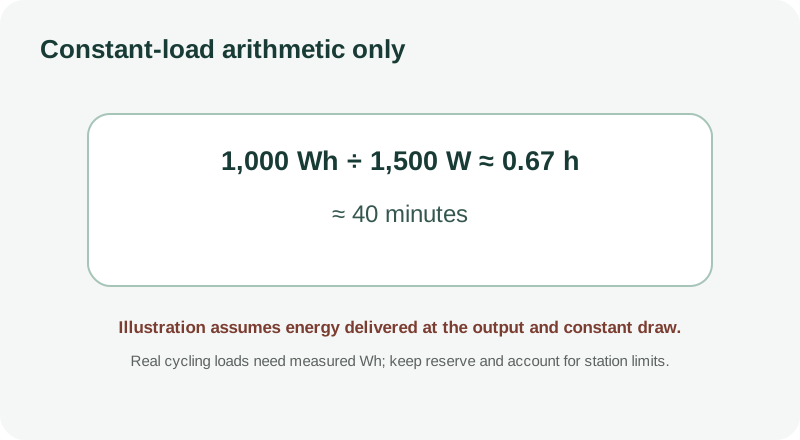
Use calculations with clear limits
For a genuinely constant load, runtime in hours is available output energy in Wh divided by load in W. As arithmetic only, 1,000 Wh delivered at a constant 1,500 W equals about 0.67 hour, or 40 minutes. That ideal example excludes reserve, conversion losses if 1,000 Wh is a battery-side figure, other loads, and station cutoff. A heater that cycles or a cooking task with varying draw needs its measured Wh over the same interval instead. If the meter reports at the station outlet, use compatible station-output energy; avoid subtracting conversion loss twice.
Estimate duration from usable output energy and measured Wh, keeping reserve. Near the station’s maximum, include temperature derating and time limits from its manual; overload protection is not a runtime-management feature. Do not run a heater unattended or use cooking equipment for space heat. Limit use to a safe, manufacturer-permitted task window and keep a separate heat plan for longer outages.
Use the runtime calculator after measuring your task, then check continuous output and startup surge against the exact model.