Air Fryer and Toaster Oven Runtime from a Portable Power Station
Use the exact oven rating and measured cooking-task energy to check whether a station can supply a high-draw air-fry or toaster-oven load.
Air fryers and toaster ovens heat food with electrical elements, so a short cooking task can use a noticeable share of a portable station’s energy. The nameplate tells you the load ceiling to check against inverter output. It does not tell you the Wh used for a recipe or whether the station can support other appliances at the same time.
Confirm the exact oven and mode
Read the full model, market, voltage, frequency, and maximum power from the manual and rating plate. Breville lists 1,800 W for the BOV860 Smart Oven Air Fryer. Hamilton Beach’s 31222/type O83 manual also lists 120 V, 60 Hz, and 1,800 W, with BAKE, CONV BAKE, BROIL, AIR FRY, and TOAST functions. These are specific North American appliances, not universal air-fryer specifications.
The Hamilton Beach guide instructs a five-minute preheat for BAKE and CONV BAKE, but a preheat instruction is not measured energy for the task. Its convection suggestions for cooking time or temperature do not establish a 25 percent reduction in power. The manuals do not publish separate mode-specific wattage or a full heater duty cycle. Do not assume that the appliance draws its rated maximum constantly or that it cycles at a fixed percentage.
Check station output first
Compare the appliance’s voltage and frequency to the station output. Ensure that continuous AC output supports the full possible load and include other devices on the inverter. A toaster oven might have no compressor startup, but its heating elements can still exceed a station’s continuous limit. A battery with enough Wh cannot overcome an inverter overload.
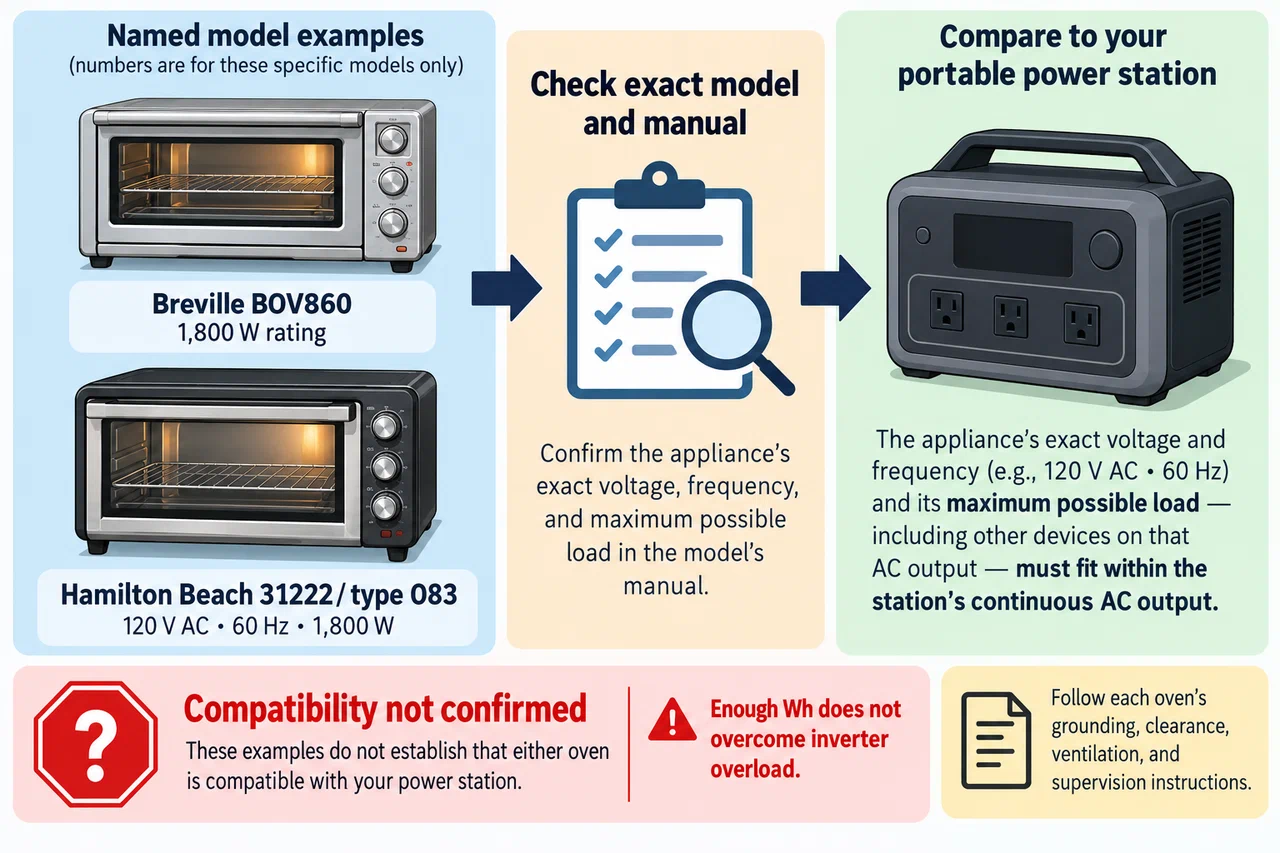
Follow appliance requirements for grounding, clearances, ventilation, and supervision. Use the exact regional model; a 120 V oven is not made compatible with a 230 V outlet by a plug adapter. Do not use an improvised extension or wiring arrangement where the manual prohibits it.
Measure energy for a real cooking task
If the appliance and station manuals allow the setup, measure Wh from preheat through cooking, including warm-up, element cycling, and any keep-warm period. Record food load, mode, temperature, duration, room temperature, station output, and starting charge. A peak watt display answers a different question than total task energy. If the station displays cumulative Wh, note the reading before preheat and after the meal task rather than multiplying the maximum rating by the timer setting. For repeated use, measure more than one normal task and include recovery time between batches; element cycling and a warm oven can change the next task’s energy.
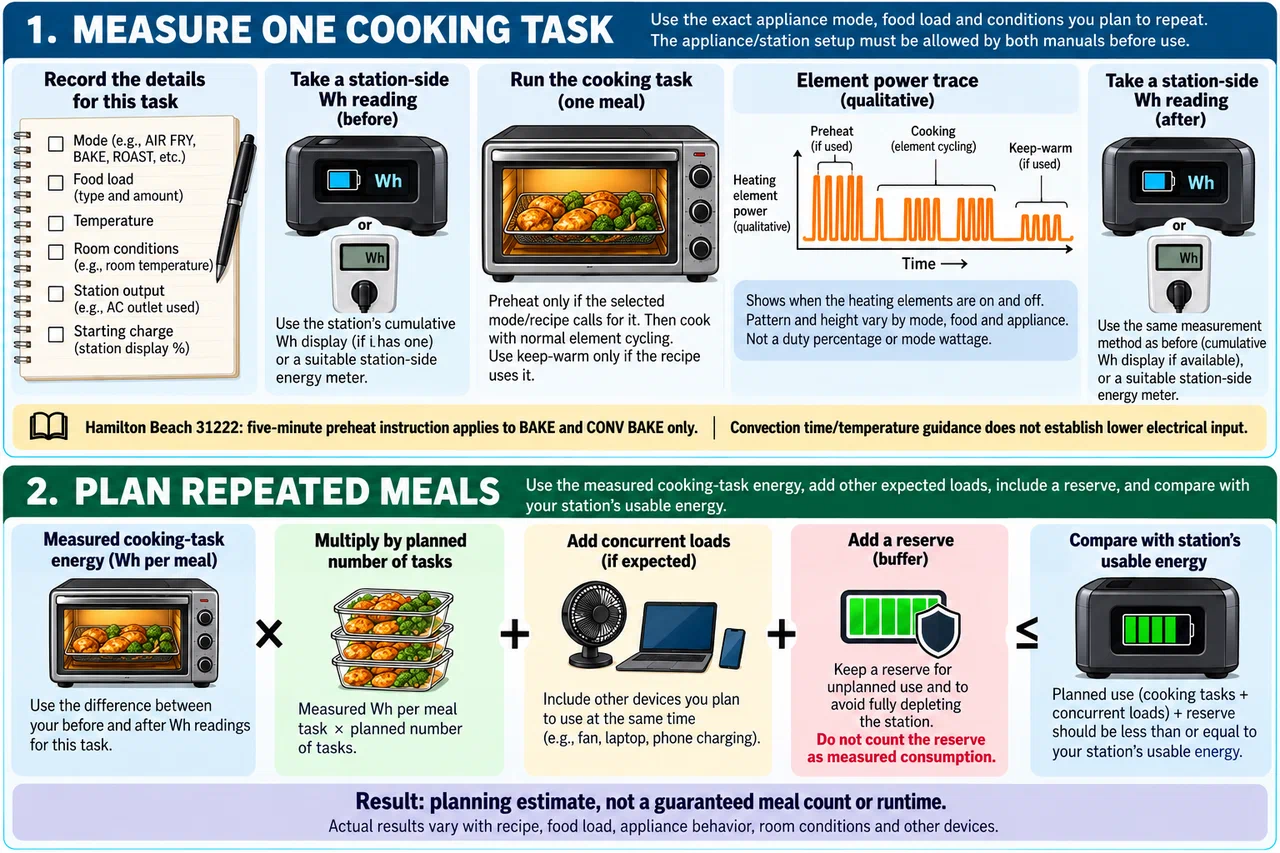
To plan several meals, multiply measured Wh per task by the number of tasks, add any concurrent loads, and leave a reserve for inverter conversion and recharge uncertainty. To estimate continuous runtime, divide usable station Wh by measured average station-side W, but be clear that this scenario does not predict a recipe. Rated watts multiplied by cooking time may be shown as a conservative upper-bound calculation only if labeled as such.
Decide what matters in the outage
Cooking is a discretionary or scheduled load for many readers, while communications, medical devices, and refrigeration may need priority. Set a station reserve before using an oven and decide when to stop. A portable station estimate cannot guarantee a complete meal or food safety, and the appliance must remain attended according to its manual. Test a representative task before depending on the combination.