Portable Dishwasher Runtime and Energy from a Power Station
Check the dishwasher's combined pump and heating load, supply requirements, and full cycle energy before treating a station as a suitable source.
A portable dishwasher combines a water pump, controls, and heating demand. Its nameplate watts are useful for checking the station’s output limit, but not for predicting energy per cycle. Cycle time and energy vary with incoming water temperature, soil, options, and appliance behavior. Verify both the electrical and water setup before calculating a runtime.
Use the exact model and supply instructions
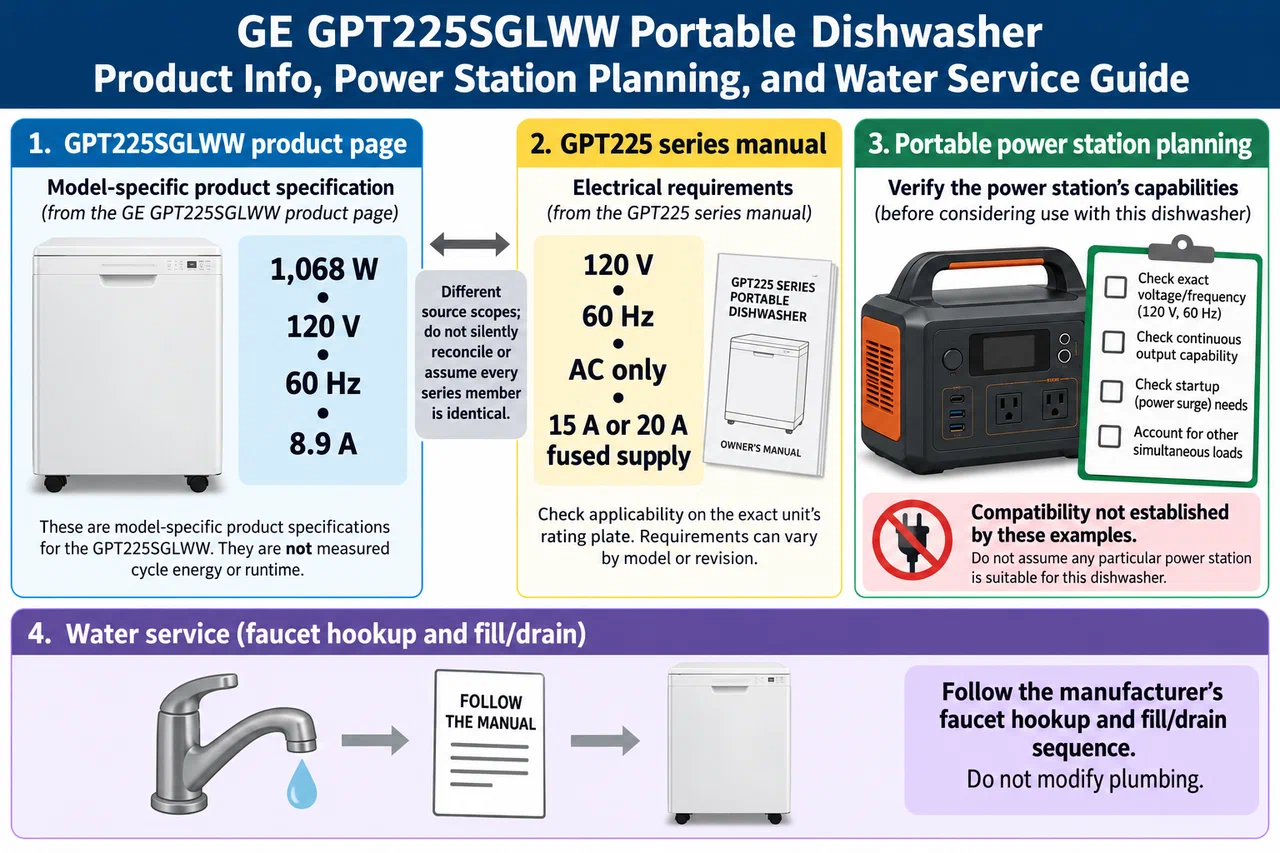
GE lists the GPT225SGLWW at 1,068 W, 120 V, 60 Hz, and 8.9 A. The product specification is model-specific and is not measured average consumption across a wash. The related GPT225 series manual calls for 120 V, 60 Hz, AC-only service on a 15 A or 20 A fused supply. Confirm the exact unit against its rating plate and manual; do not assume every series member is identical.
The machine has pumps and a water-heating cycle. The manual reports that cycle length varies with soil level, incoming water temperature, and selected options. It lists 2 hours 10 minutes for Heavy Wash time but excludes drying, Auto Hot Start, and options from that figure. The sanitize option raises final-rinse temperature and may change cycle length. These details make elapsed cycle time an unreliable substitute for measured Wh.
Compatibility includes more than watts
Check station output voltage and frequency, continuous power, and any startup behavior against the exact dishwasher requirements. Add other loads sharing the output. A station might have enough battery energy for an estimated cycle but still trip when the heater, pump, or motor operates. No cited source establishes startup current, power factor, real-world cycle Wh, or compatibility with a portable station.
The series manual also specifies a faucet hookup and a fill/drain sequence. That is a water-service dependency, not authorization to modify plumbing. Use manufacturer instructions for the portable connection and safe drainage; do not improvise a water or electrical arrangement.
Measure full-cycle energy before estimating
Only test an appliance and source combination that both manufacturers allow. Meter station-side Wh for complete representative cycles, including hot start, wash, pump-out, selected options, and drying if used. Record incoming water temperature, selected cycle, soil load, and starting station charge. Repeat if conditions vary materially.
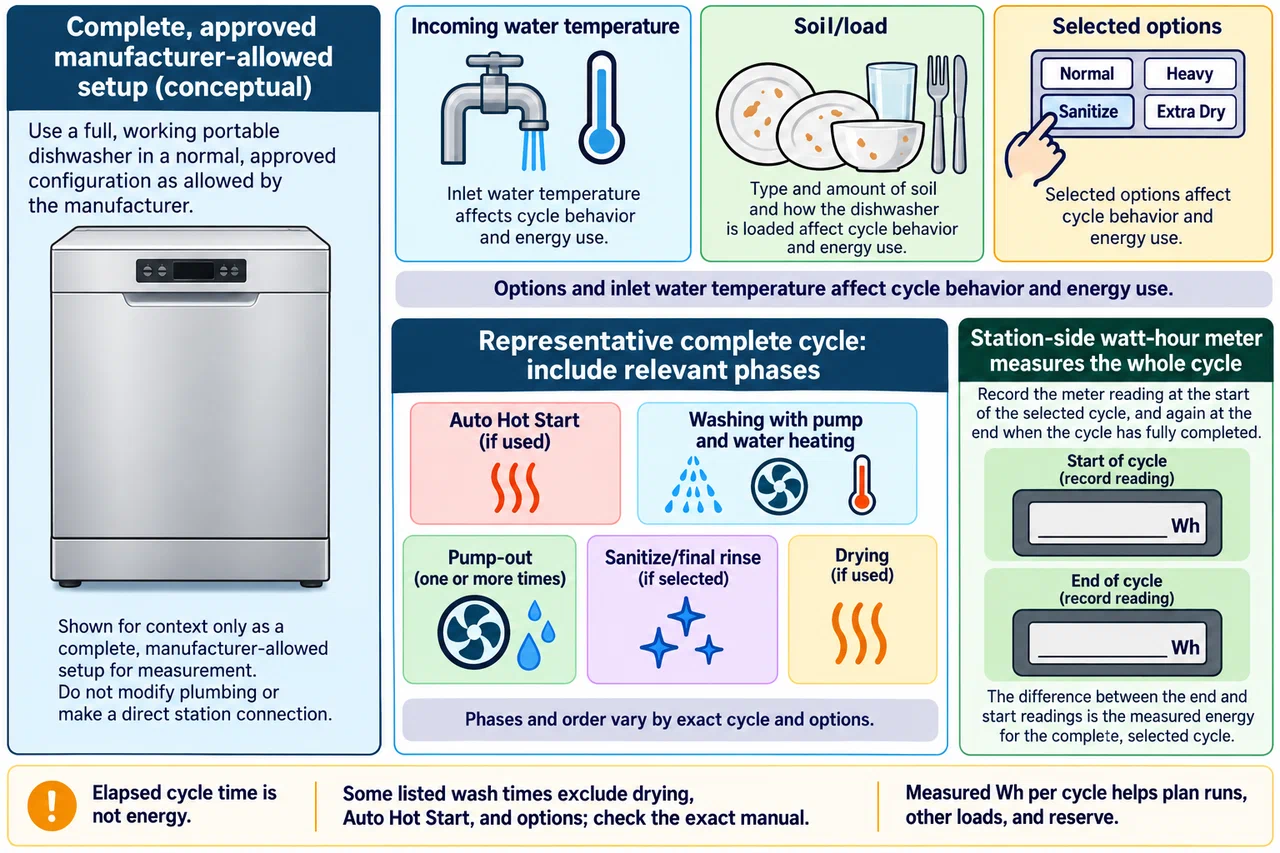
Use the measured Wh per cycle to budget the number of runs. If only average watts are known, calculate an approximate time from usable station Wh divided by average W and make clear that a complete cycle has multiple phases. Include inverter losses, other concurrent loads, station reserve, and recharge. Do not multiply 1,068 W by the entire listed wash time and call it measured consumption; that is only a clearly labeled continuous-maximum scenario.
Decide whether dishwashing belongs in the plan
During a short outage, preserving station energy for more consequential loads may matter more than running a dishwasher. Check local water availability and sanitation needs separately. Do not rely on the dishwasher for essential infection-control or medical sterilization needs unless the relevant authority and appliance instructions support that use. Test a normal cycle before an outage and identify a safe manual alternative if the station or water connection fails.