Electric Kettle Runtime and Boil Energy from a Portable Power Station
Treat kettle use as a measured heating task: verify the rated load, amount of water, and energy per boil before planning power-station use.
A kettle usually runs for a short, high-power heating task, so the useful planning quantity is watt-hours for the amount of water you actually boil. Its rated watts help check whether the station can supply the load, but they do not reveal how many boils fit in a battery. Starting water temperature, fill level, and time to shutoff matter.
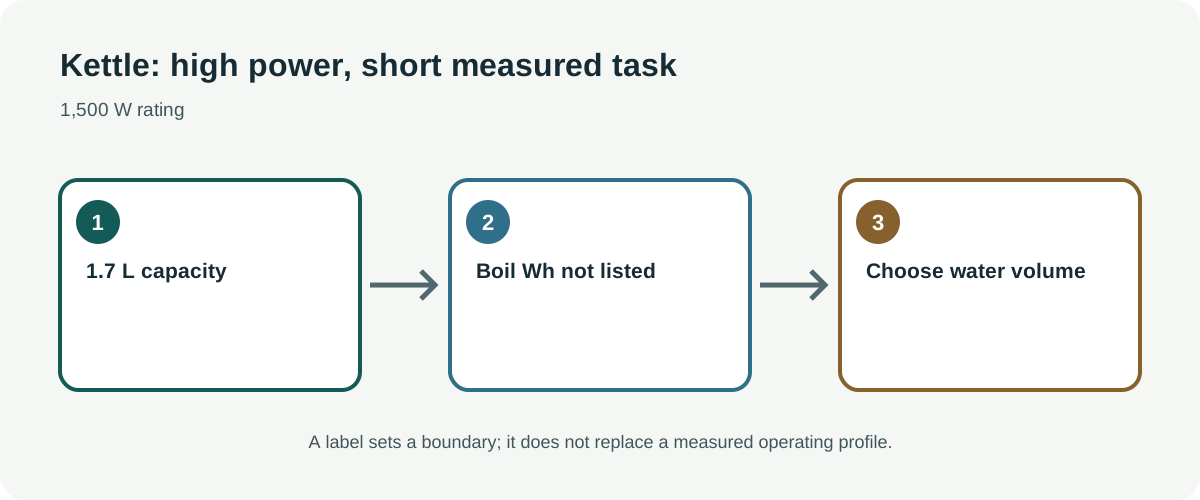
Model example: Hamilton Beach 41038G
Hamilton Beach lists the 41038G as a 1.7 L electric kettle rated at 1,500 W. Its illuminated switch remains on while water heats and the kettle switches off automatically when the water reaches a boil. The product information does not give voltage and frequency, watt draw through the heating period, or energy for a stated quantity and starting temperature. Check the label on your exact kettle rather than assuming every 1.7 L model shares this rating.
A 1,500 W input is a power level, not the energy of one boil. A kettle will not necessarily draw that exact amount throughout the entire heating period, and the switch-off feature describes control behavior rather than a measured Wh value. Do not turn a product rating into an assumed number of cups per battery without a measurement.
Check station output before heating water
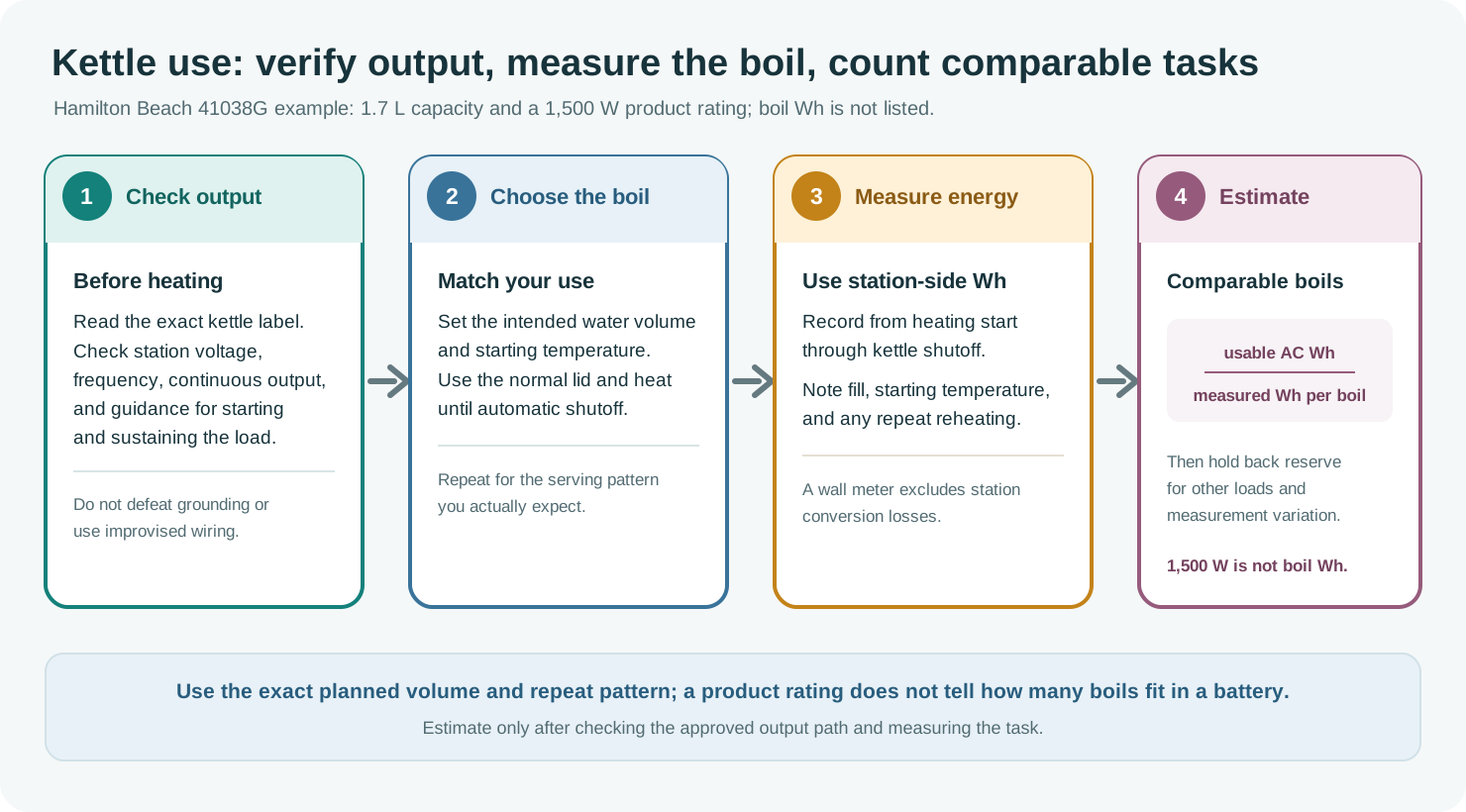
Compare the kettle’s nameplate voltage, frequency, and current or watt requirement with the station’s AC output. A 1,500 W kettle can approach the continuous limit of some small stations. The station must support the load without tripping, overheating, or reducing output; account for other connected devices. Check the manufacturer guidance for outlet, cord, grounding, and ventilation. Do not defeat protective grounding or use improvised wiring to power a household circuit.
Keep the kettle on a stable, dry surface and use it according to its manual. Water can spill, steam can burn, and a station should not be positioned where it can be splashed or overheated. Use only the intended cord and avoid sharing an undersized extension lead. If the appliance or station instructions do not permit the arrangement, do not rely on it for an outage.
Measure the boil you need
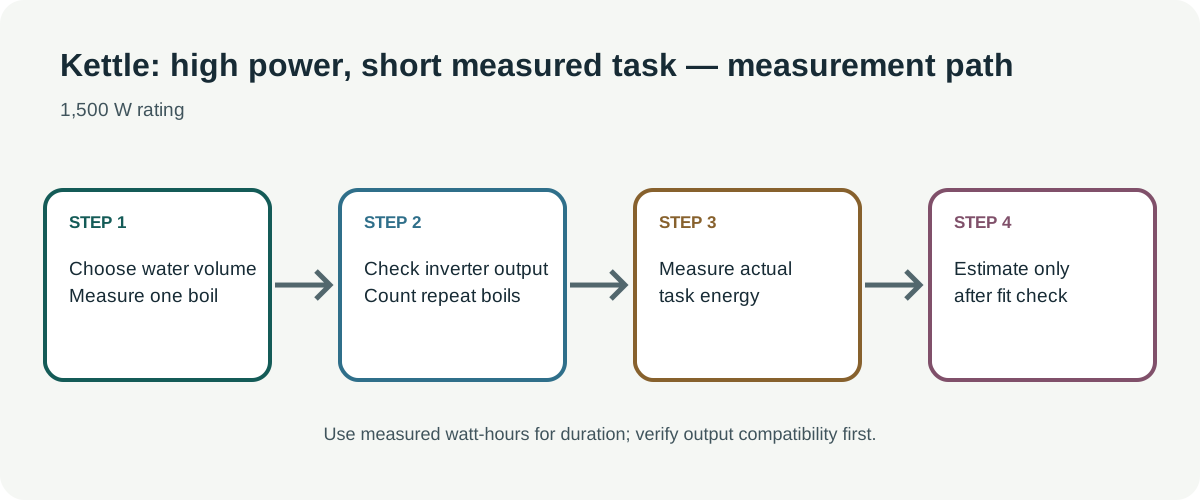
For an approved pairing, measure station-side Wh from the start of heating until the kettle switches off. Record the water volume, starting temperature, lid position, and whether the kettle was reheated between servings. Repeat for the number of boils you expect; a single test with a nearly full kettle will not represent a small cup. If you use a wall meter, note that it excludes power-station conversion losses.
Use total measured Wh for the planned batch, not just the label watts. Divide the station’s usable AC energy by measured station-side Wh per boil to estimate the theoretical number of comparable boils, then hold back reserve for other loads and measurement variation. If you only know the watt rating, you can estimate the energy ceiling for an assumed duration as watts multiplied by hours, but be explicit that the duration is an assumption rather than the appliance’s measured boil time.
Short use still needs a plan
Kettle energy can be manageable when use is limited to measured amounts, but high output can prevent the station from running another load at the same time. Choose priorities before starting and avoid repeatedly heating water that will not be used. Keep water handling and serving separate from the electrical runtime estimate. For broader high-draw cooking comparisons, see the space heater and cooking guide.