Portable Air Conditioner Runtime from a Portable Power Station
Check compressor startup, rated input, and measured cooling energy for the exact portable air conditioner before estimating station runtime.
Portable air conditioners combine a compressor and fans with a high electrical load. A station’s stored watt-hours tell only part of the story: its inverter must also start and operate the exact compressor, and the cooling effect depends on room conditions, exhaust setup, and heat entering the space.
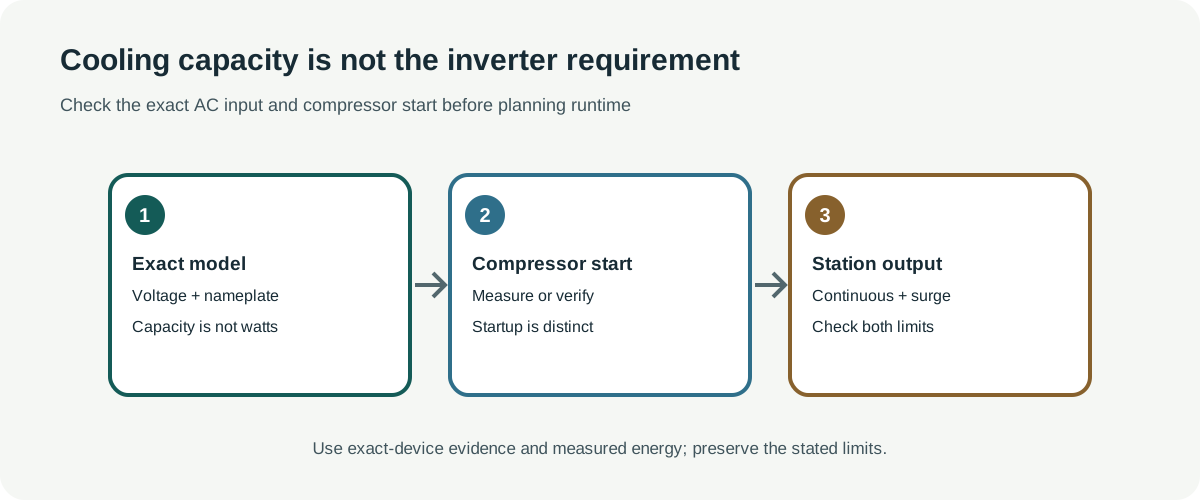
Begin with the full model and rating plate
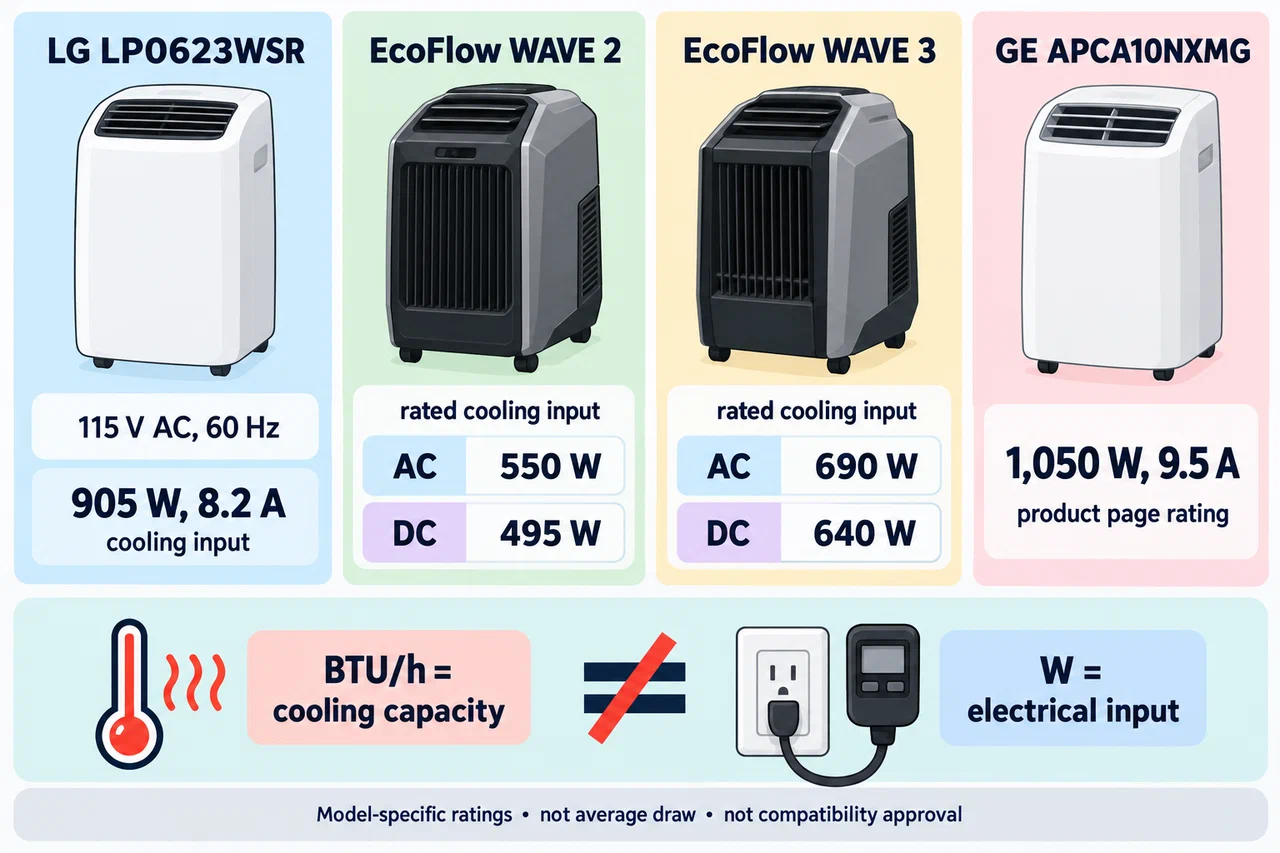
Record voltage, frequency, running current or watts, any startup requirements, operating modes, and whether the unit uses one or more compressors. Compare the same regional version: US 115/120 V specifications do not transfer directly to a UK 230 V appliance. The cooling capacity in BTU/h describes heat removal under a test method, not electrical watts or station runtime.
The LG LP0623WSR product information lists 905 W and 8.2 A at 115 V, 60 Hz. That is an exact model specification, not a cycle-average trace or compressor-start result. EcoFlow WAVE 2 lists 550 W cooling and 600 W heating on AC, with separate 495 W and 540 W DC inputs. WAVE 3 lists 690 W cooling and 645 W heating on AC, and 640 W and 606 W on DC. The manuals describe model-specific operating modes, not guaranteed runtime. These lower DC values cannot be transferred to a household portable AC. Treat each source path and model independently.
Verify startup and continuous output
Check the station manual for continuous output, surge duration, voltage waveform, temperature limits, and output shutdown behavior. Then compare with the air conditioner’s manufacturer requirements or a safe measurement of startup. The running label alone does not establish that the inverter can start the compressor. Avoid a generic multiplier as proof of compatibility, and include any other loads on the AC output.
Follow the air conditioner’s installation and ventilation directions. A unit may draw more energy when the room is hot, the exhaust path is poor, filters are dirty, or the thermostat target is difficult to maintain. Never defeat grounding or use an unapproved wiring path to reach an outlet.
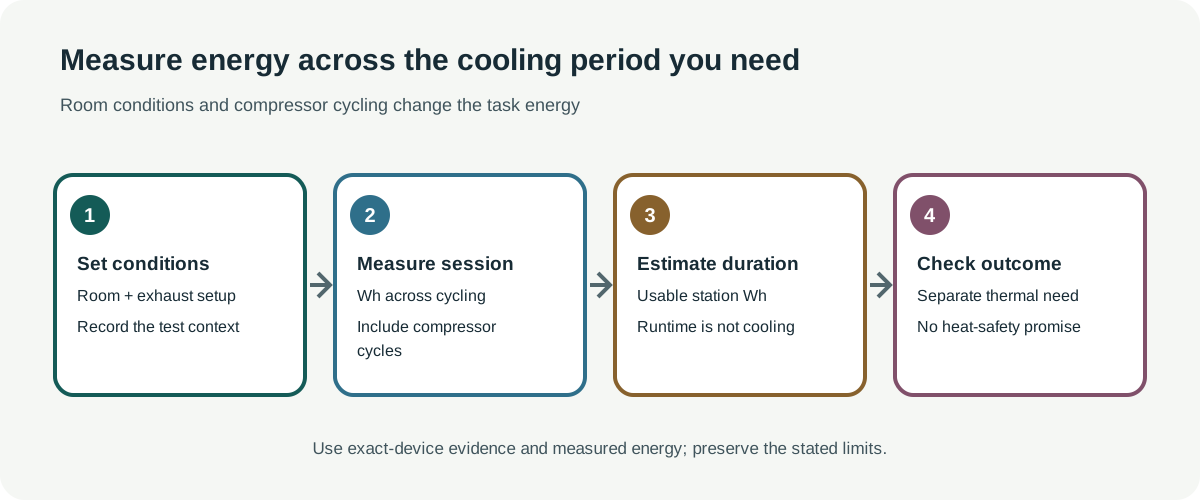
Measure the cooling period you need
If the exact combination is within both manufacturers’ instructions, measure station-side Wh over representative cooling. Record outdoor and indoor temperature, setpoint, mode, run time, and compressor cycling. A brief reading during startup or fan-only mode is not enough to estimate an afternoon.
Estimate duration as usable station energy for the chosen output divided by measured average input in watts. For a logged interval, scale measured Wh to the target period, then add reserve for hotter weather, startup attempts, and other loads. If the source is an annual appliance label or the manufacturer publishes only rated watts, describe a scenario using that value as a conservative continuous-load assumption rather than calling it typical.
A named room-unit comparison
GE lists its discontinued APCA10NXMG portable air conditioner at 1,050 W and 9.5 A, with 10,000 BTU ASHRAE / 5,200 SACC cooling-capacity figures. Those capacity figures are not electrical watts, and the power rating is not a measured compressor cycle or start requirement. This is a different product from a window-style room unit. See the room air conditioner guide for GE’s 115 V ASC05LA example at 590 W and 5.5 A. Verify each actual nameplate and measure its use; neither GE example establishes a generic model-family runtime.
Cooling power is not a thermal guarantee
Even if the compressor runs, room temperature may not reach a safe or comfortable level. Room size, insulation, solar gain, humidity, venting, and doors affect results. Plan shade, an alternate cool location, and a way to check indoor conditions. A battery runtime estimate cannot guarantee heat protection or substitute for local health guidance. Test the full setup before an outage and decide when to move people or stop using the equipment.