DreamStation Go Battery Runtime and Power-Station Backup
Understand the Philips DreamStation Go battery pack's runtime claims and UPS mode, and what must be verified before considering a portable power station.
Philips Respironics DreamStation Go has a model-specific battery accessory and a documented UPS mode. Those details can help owners identify a supported backup path, but they do not establish how long a third-party portable power station will run the device. Start with the exact DreamStation Go system and prescribed setup, then confirm any external power arrangement with the equipment supplier or clinician.
What the DreamStation Go battery manual specifies
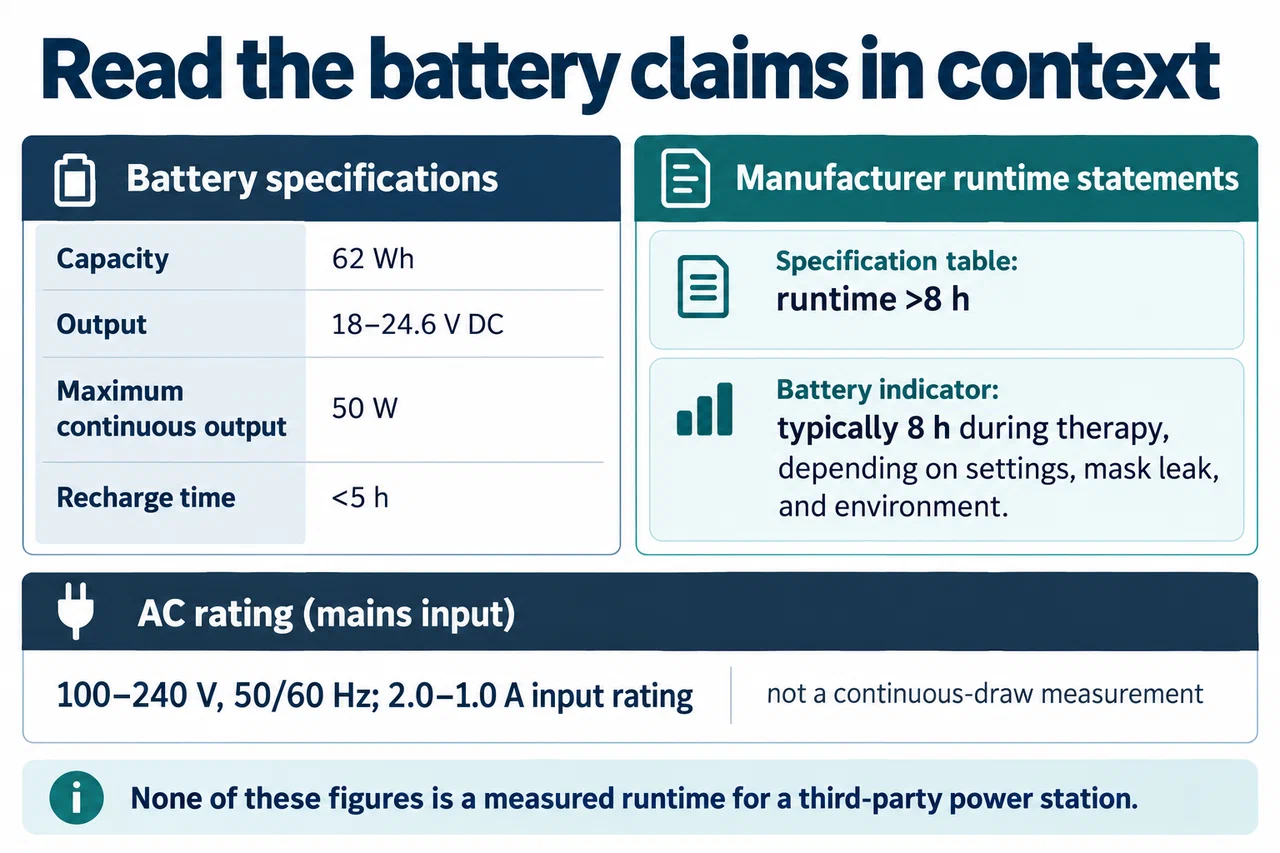
The DreamStation Go user manual describes an optional Philips Respironics battery pack. Its specifications list a 62 Wh capacity, an 18–24.6 V DC output range, 50 W maximum continuous output, and a recharge time of less than five hours. The table lists battery runtime as more than eight hours. Separately, the battery indicator section says a fully charged pack typically lasts eight hours during therapy, depending on settings, mask leak, and environmental conditions. These are manufacturer statements for the named device and battery; they are not a measured energy trace for every night or a promise of therapy duration.
The system’s AC specification lists 100–240 V, 50/60 Hz input and 2.0–1.0 A. That is electrical input information, not a statement that the machine continuously draws the listed current. It also does not tell you how many watt-hours your prescribed configuration will use. Do not divide the battery’s 62 Wh by an assumed draw or treat the greater-than-eight-hour table entry as a portable-station estimate.
Standalone battery and UPS mode are different paths
In standalone mode, the charged battery pack attaches directly to the therapy device and supplies it after the AC cord is disconnected. The manual also describes a UPS mode: the battery remains attached to the device and connected to AC. Philips specifies that the pack can remain in this arrangement without losing charge; it stops charging at full and begins again after the charge level falls to 90 percent. This is a DreamStation Go accessory procedure. Follow the current manual and supplier instructions for the exact pack and device.
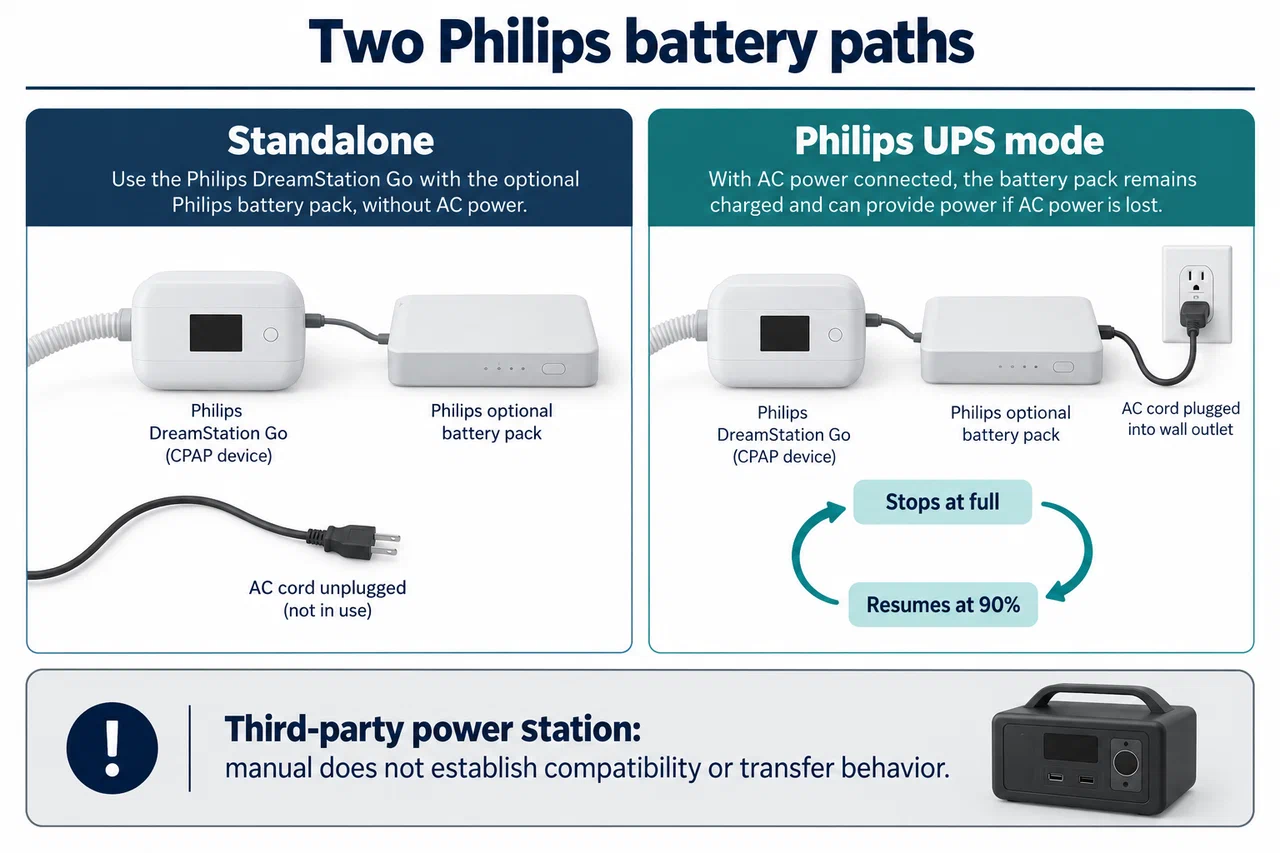
The word “UPS” does not make this a general approval for other battery systems. The manual does not establish compatibility with a third-party power station, a generic DC cable, or every AC pass-through or transfer arrangement. The pack’s 18–24.6 V output and 50 W limit describe the Philips accessory, not the acceptable input range of an unrelated station port. A connector that appears to fit is not enough to verify voltage, polarity, current, waveform, grounding, or interruption behavior.
What to verify before using a portable station
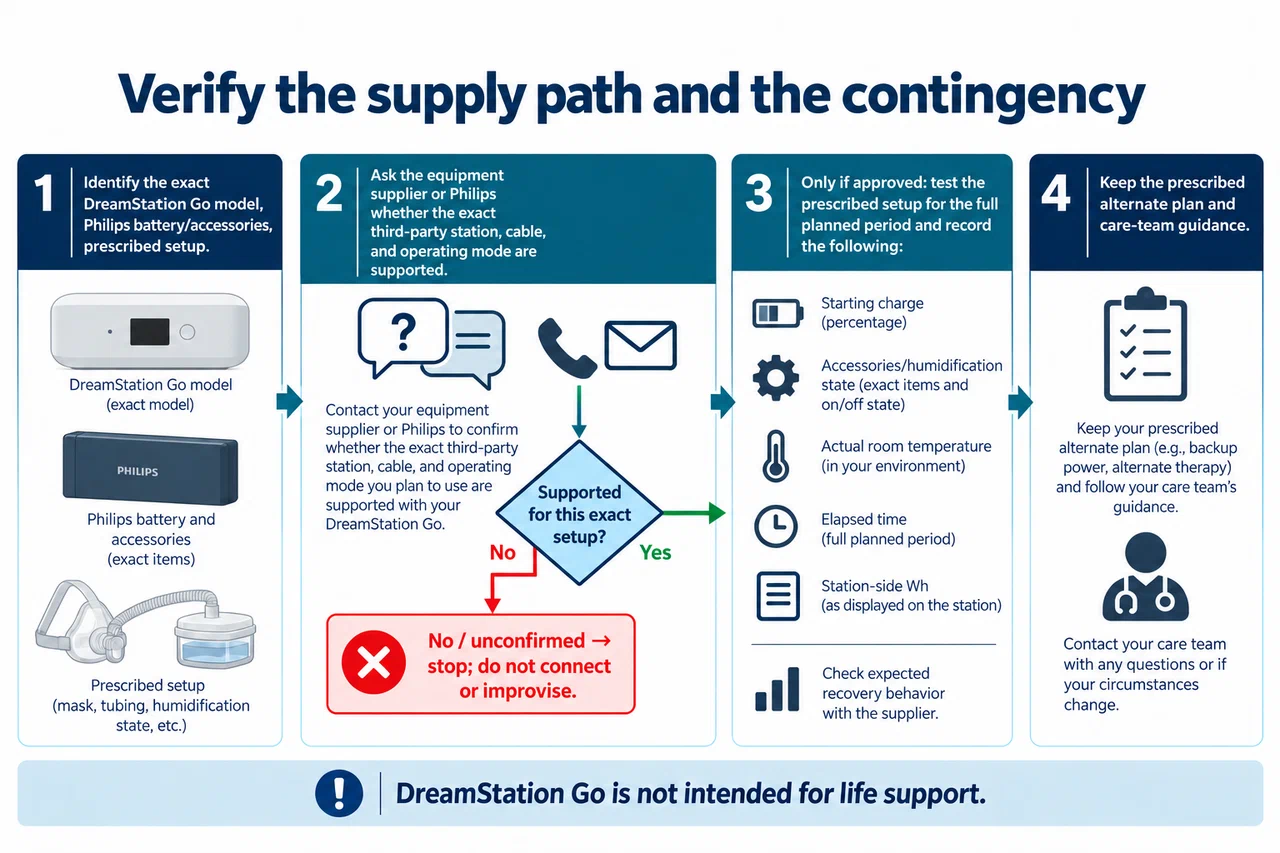
Confirm the full device and accessory model against the manual. Ask the equipment supplier or Philips whether the specific station and intended power path are supported. If they are, check the exact station output, cable, and operating mode against that guidance. Do not replace the named battery pack, modify the device, or make a custom cable based on the battery’s voltage range.
If the proposed setup is approved, measure energy at the station with the prescribed therapy and actual accessories for the full planned period. Record the starting charge, humidification or other accessory state, temperature, elapsed time, and station-side watt-hours. Test alarms and expected recovery behavior with the supplier’s guidance. The manual’s pack runtime is not a substitute for measuring a different supply path, and a brief low-load reading cannot establish an overnight result.
Keep the medical contingency separate
The manual says DreamStation Go is not intended for life support and that it must be used on a licensed physician’s instruction. Keep therapy settings and accessory decisions with the care team. Ask the supplier or clinician what to do if power ends, the battery reaches its limit, the station shuts down, or the device does not behave as expected. Maintain the prescribed alternate plan rather than relying on a single battery estimate.
For broader device comparisons, see CPAP backup planning, AirSense 10 power checks, and AirMini compatibility. The models use different power supplies and accessories; their specifications should not be transferred between devices.