Portable Oxygen Concentrator Backup Power and Runtime Planning
Use the exact concentrator manual and prescribed backup plan to check power paths; station watt-hours alone cannot establish oxygen continuity.
A portable oxygen concentrator is prescribed medical equipment. Start with the person’s oxygen plan and the exact device manual, then ask the equipment provider or clinician about approved backup arrangements. A power-station calculation can be one planning input, but it does not prove that oxygen therapy will remain clinically adequate or uninterrupted.
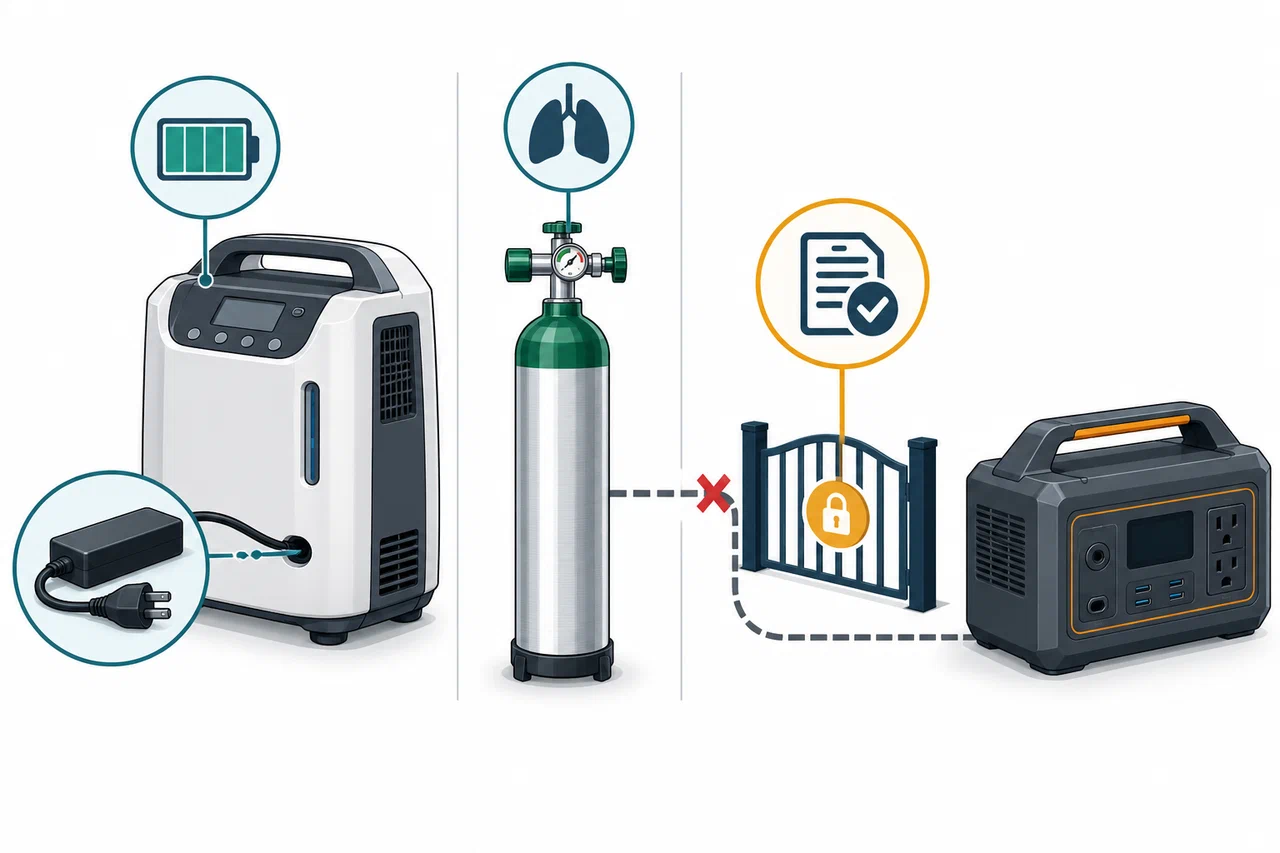
Identify the exact device and therapy
Record the concentrator model, serial or regional variant where relevant, prescribed setting, breathing pattern assumptions, battery options, alarm behavior, and manufacturer-approved external supplies. Pulse-dose setting numbers are not equivalent to continuous-flow litres per minute and cannot be compared across models. Confirm the specified accessory for each AC or vehicle/DC source; a connector that fits is not authorization to use a third-party cable.
The Inogen Rove 6 manual specifies 100–240 V AC, 50–60 Hz through its AC supply, and 13.5–15.0 V DC / 100 W through the named DC power cable. It also says the internal battery should remain installed during external power use. Those numbers define a Rove 6 boundary, not compatibility with a station’s nominal 12 V output. Philips SimplyGo Mini has its own manufacturer supply, battery, setting, and runtime conditions. Its manual lists a 97.9 Wh battery and a manufacturer estimate of up to 4.5 hours at setting 2 and 20 breaths per minute. That is a device-battery claim under stated conditions, not runtime from a portable station. Do not transfer one unit’s profile to the other or to another concentrator.
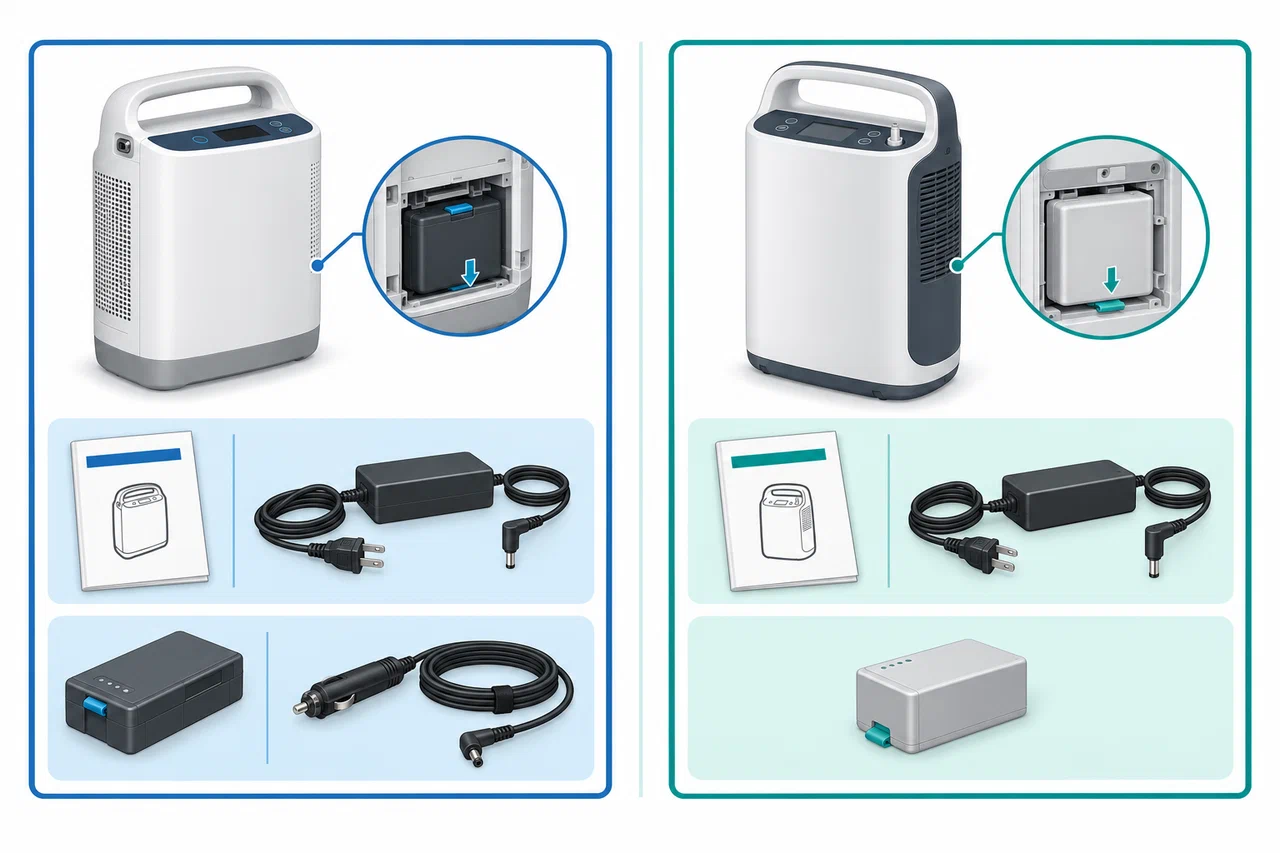
Treat the backup requirement as part of the device plan
The Rove 6 manual says the unit is not intended to be life-sustaining or life-supporting and that the user is responsible for an alternate oxygen source in case of power outage or mechanical failure. It directs users to prescribed flow settings and specified accessories. Follow the instructions for your own device and prescription; do not rely on an online runtime estimate to decide whether to change therapy or source oxygen.
Ask the provider what should happen if the concentrator stops, alarms, or the power path fails. Keep the prescribed alternate oxygen supply available, know how to contact the provider, and identify a location with reliable power if needed. A station does not replace this fallback.
Check a station only after approved options are clear
Compare the station output with the exact required supply: AC voltage and frequency, or DC voltage range, current, connector, polarity, and specified cable. Check continuous power and any device startup behavior. Verify whether the manufacturer supports use with an inverter or portable station. None of the cited concentrator manuals establishes compatibility with a generic power station.
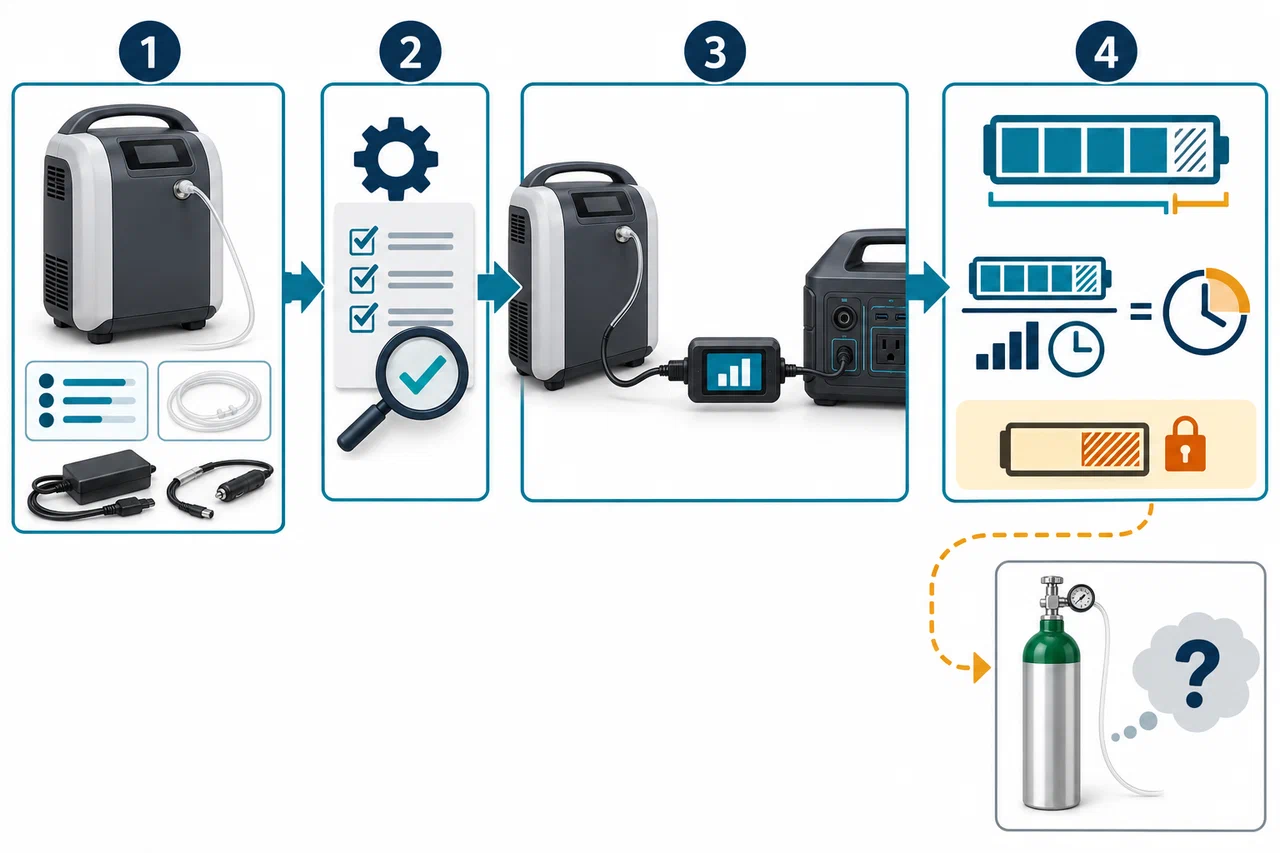
If the provider and manufacturer confirm a suitable path, measure energy with the prescribed setting and accessories under a supervised representative setup. For an estimate, divide usable station energy on that output path by measured station-side average energy per hour, then retain a substantial reserve for battery conversion, alarms, temperature, therapy variation, and unexpected duration. Do not infer hours from the adapter’s maximum rating or from a manufacturer battery duration tested under different conditions.
Prepare and test with the care team
Keep the exact power supplies, approved cables, and charged device batteries together. Follow battery storage, charging, temperature, and inspection instructions. Test the whole backup plan with the provider before an outage and document who to contact and where to go if power is lost. If the equipment or prescribed setting changes, update the plan. The correct next step for a missing compatibility fact is manufacturer or provider verification, not a guessed adapter or a longer arithmetic estimate.