AirCurve 10 and AirCurve 11 Power-Station Backup Checks
Compare the model-specific AirCurve supply and power figures, then verify the prescribed accessory path before considering a portable station.
AirCurve 10 ASV and AirCurve 11 are prescription therapy devices with different model-specific electrical profiles. Their supply ratings and typical or peak power values can help identify what to verify, but they do not show how many hours a portable station will run a configured therapy setup. Confirm the exact AirCurve model, accessories, and regional guide before making a backup plan.
Keep the two power profiles separate
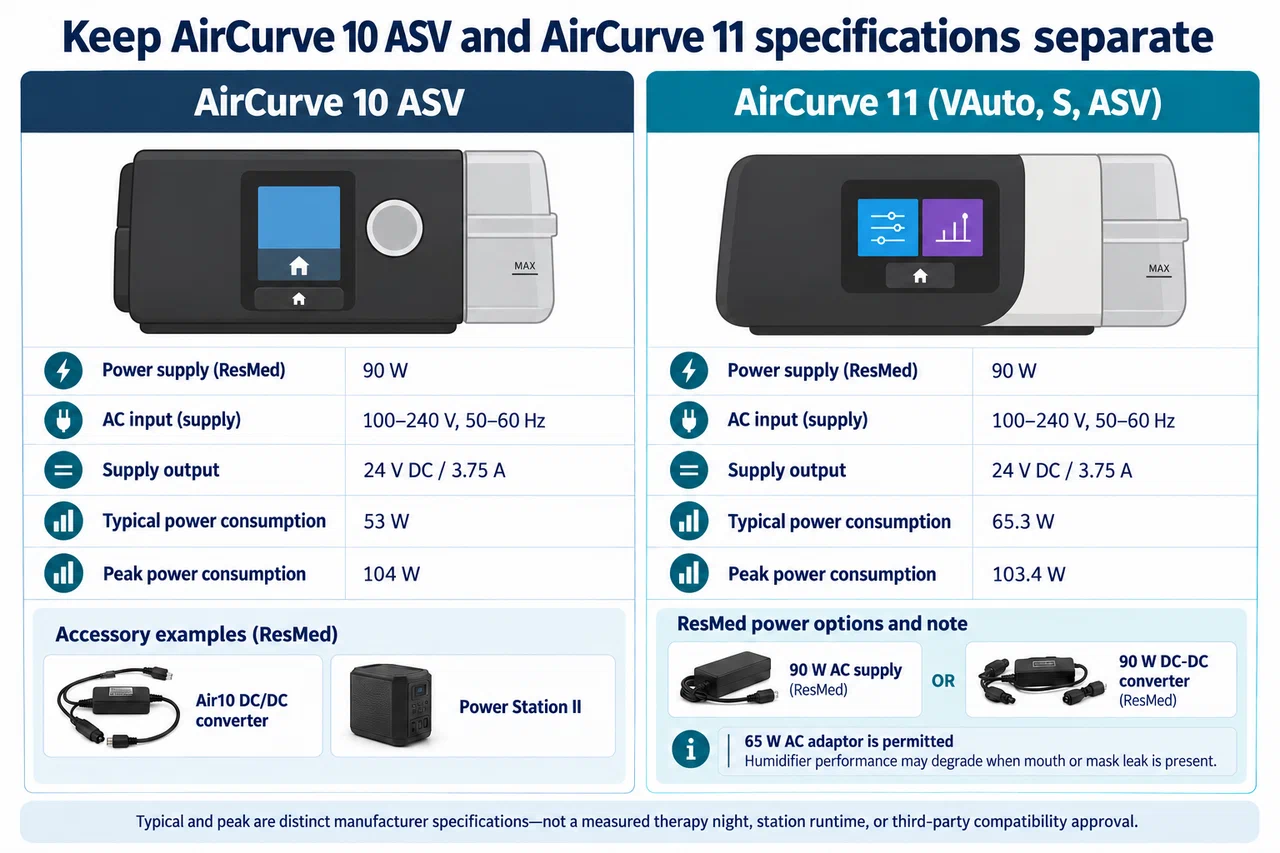
The American English AirCurve 10 ASV guide lists a 90 W supply with 100–240 V, 50–60 Hz AC input and 24 V / 3.75 A DC output. It separately reports typical consumption of 53 W and peak consumption of 104 W under its technical specification. The guide also lists the Air10 DC/DC converter and Power Station II among accessories. These are product-specific supply and accessory details; they do not approve an arbitrary DC cable or a third-party station.
The AirCurve 11 guide covers VAuto, S, and ASV versions. It lists a 90 W power supply, 100–240 V / 50–60 Hz input, 24 V / 3.75 A output, 65.3 W typical consumption, and 103.4 W peak consumption. The guide identifies the Air11 90 W AC supply and 90 W DC-DC converter. It also permits an Air11 65 W AC adaptor, while warning that humidifier performance may degrade when mouth or mask leak is present. Those are device-specific paths; they do not approve a generic station cable or port.
Typical and peak figures describe different specification points, not a measured night of therapy. Pressure, leak, humidifier use, heated tubing, device mode, and environmental conditions affect the actual setup. Neither model guide provides station-side watt-hours for a person’s prescribed configuration.
Verify the complete power path
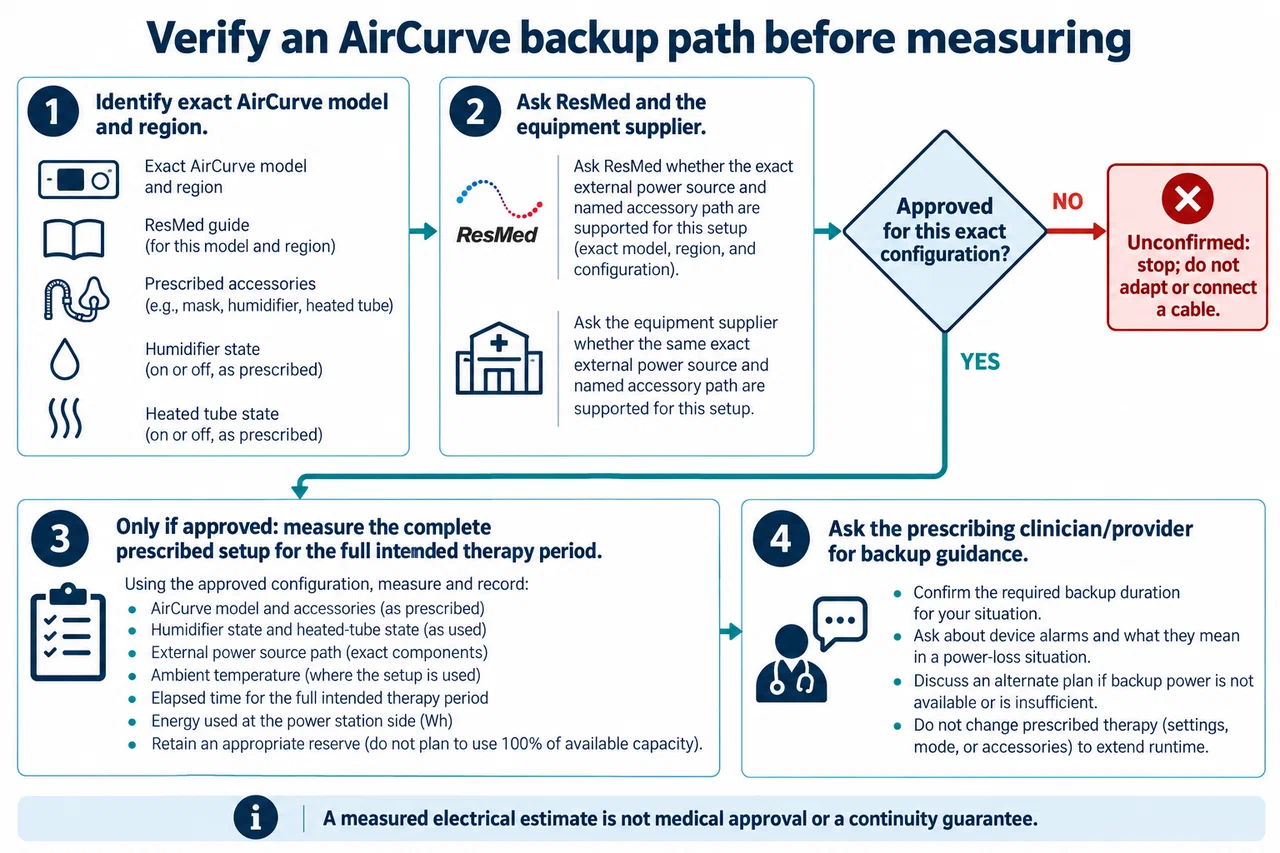
Read the device label and the guide for the exact model and market. Confirm the specified ResMed supply or converter with the care provider. A 24 V DC label alone does not establish that a station port has the right voltage range, connector, polarity, current limit, protection, or interruption behavior. Likewise, a station’s AC output rating does not show that the device will continue therapy through an outage or restart without a clinically relevant pause.
Do not adapt a cable, combine accessories across AirCurve generations, or treat a matching connector as compatibility approval. The AirCurve 11 guide’s 65 W adaptor caveat applies to that named AirCurve 11 path; it is not a workaround for an undersized station or an instruction to disable humidification. Follow the instructions for your device and ask ResMed or the equipment supplier about any proposed external source.
Measure only an approved configuration
If the manufacturer and care provider confirm a station setup, measure energy at the station for the full intended therapy period. Use the prescribed settings and accessories, and record the exact device, humidifier and heated-tube state, source path, temperature, elapsed time, and station-side watt-hours. A short reading, the power supply’s rating, or the guide’s typical watts cannot stand in for the full session. Keep reserve for battery condition, conversion loss, changes in use, and an outage longer than planned.
An electrical estimate is a planning input, not medical approval. Ask the prescribing clinician and equipment provider what backup duration, approved accessory, alarms, and alternate plan are appropriate. Do not alter prescribed therapy to extend a calculated runtime. For a broader overview, see CPAP backup planning, which keeps AirCurve data separate from AirSense, AirMini, and Philips devices.