Compare Wall, Car, and Alternator Charging for a Power Station
Choose a recharge source by the available charging window, station input, vehicle limits, and the exact cable path.
A useful recharge plan starts with the energy you need and the hours when a source is available. A wall outlet may offer the shortest charging window, a car socket may provide a slower model-specific input, and a dedicated alternator charger may support a higher-power vehicle path. Solar depends on local conditions. None of these sources is a universal rate that can be copied to every station.
Compare the source and the charging window
| Source | Useful question | What to verify |
|---|---|---|
| Wall AC | How many hours can the station remain at a suitable outlet? | Regional AC input, charger mode, maximum input, starting charge, and concurrent load |
| Car socket | Is the station’s specified vehicle cable and input available during the trip? | Exact voltage/current, vehicle instructions, cable, and whether the car input shares a port |
| Alternator charger | Is the exact charger, vehicle, cable, and receiving station combination documented? | Vehicle capacity, mode, station port limit, starter-battery protection, and professional installation requirements |
| Solar | What site, season, shade, and placement define the expected harvest? | Panel Voc/current, station limits, charging window, and measured stored Wh |
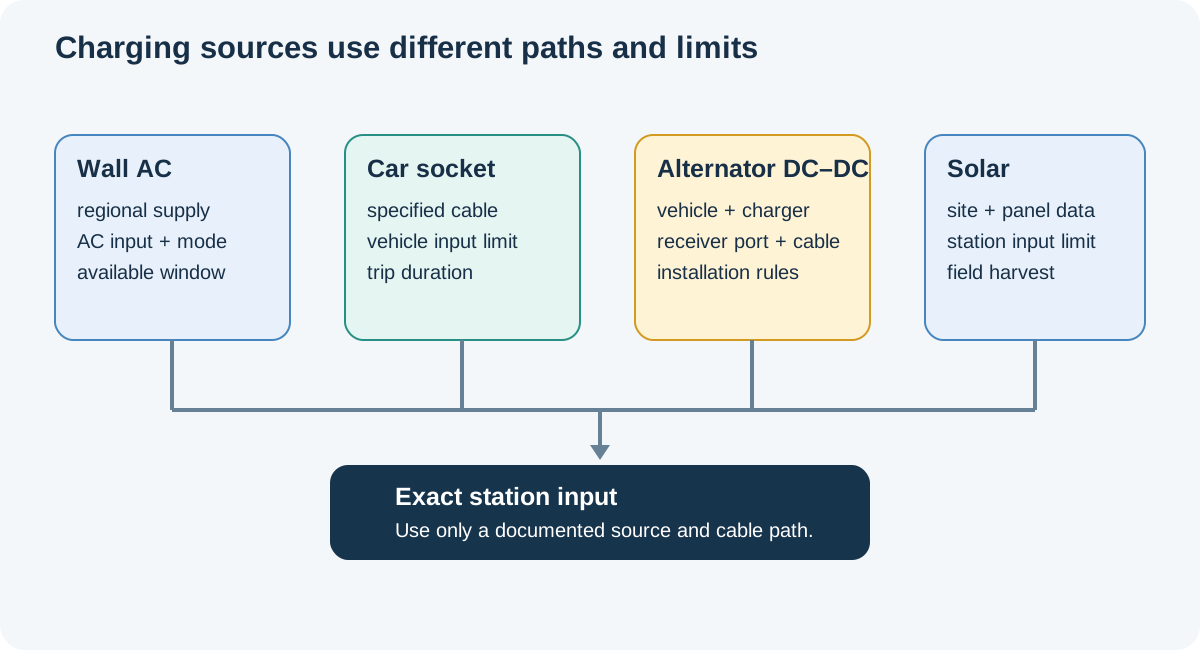
A source’s maximum input power is not the energy it will deliver on a trip. As a rough upper-bound calculation, watts multiplied by available hours gives watt-hours before conversion loss and charge behavior. A source that can provide 300 W for one hour does not necessarily add 300 Wh to the battery, and a live load can consume some of the incoming energy.
Keep model examples separate
Jackery’s Europe Explorer 1000 V2 support page describes a 12–16 V car input at up to 8 A and gives an approximate charging time. That is a reference for the named JE-1000D, not a general vehicle-socket rating. EcoFlow’s DELTA 3 Classic manual documents a shared XT60i solar/car input path, while AC input may supplement insufficient solar input under the stated combined-input behavior. A port that accepts one source does not automatically accept two at once.
Dedicated DC-DC chargers add another set of boundaries. EcoFlow describes the Alternator Charger 600 with mode-specific limits and a receiving-station example; BLUETTI Charger 2 documents separate solar and vehicle paths. Their manuals do not establish a universal alternator capacity, wiring plan, or supported-station list. The charger’s headline rate can be reduced by the vehicle, operating mode, cable, station, or battery state. Use each product’s current compatibility table and instructions.
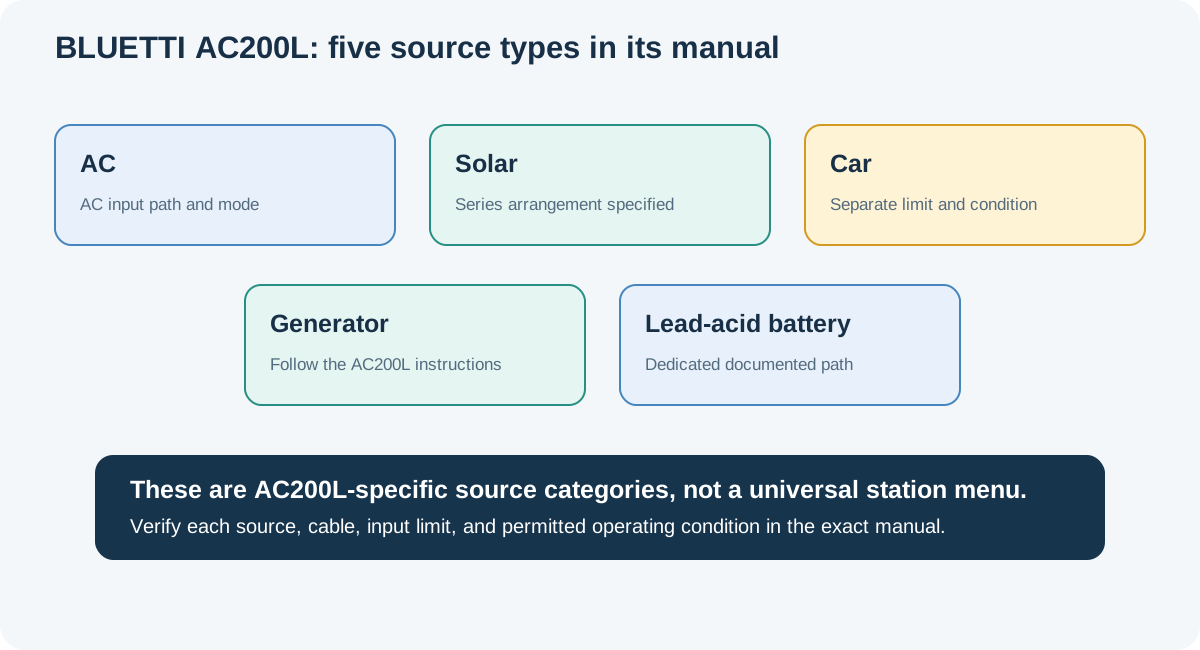
The BLUETTI AC200L manual provides a different model-specific example with five listed source types: AC, solar, car, generator, and lead-acid battery. Its solar connection is described in series, while the manual sets a separate car-charging limit and vehicle condition. That list is not a universal source menu, and the AC200L conditions do not transfer to another station.
Choose a fallback before relying on the trip
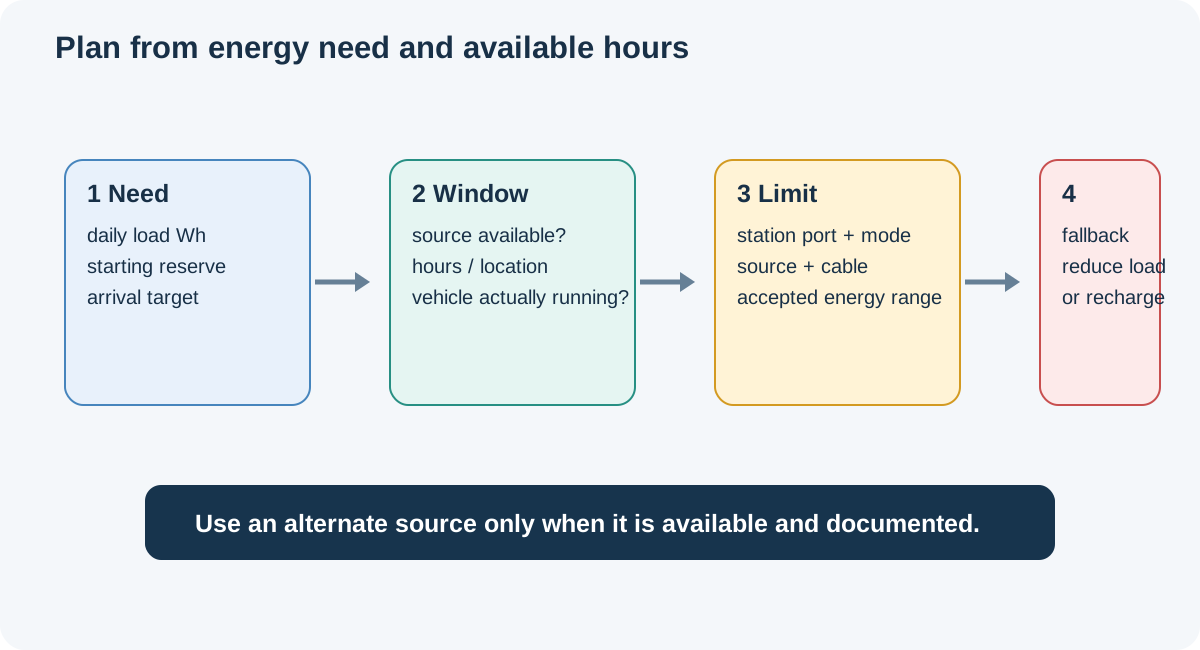
For an outage or remote trip, write down daily load energy, available recharge windows, and the station’s remaining reserve. If wall power is unavailable, identify whether the vehicle will actually run, whether the exact alternator setup is documented, or whether solar can be placed in good sun. When a source may be delayed or insufficient, reduce nonessential loads or arrange another verified source rather than using its maximum rating as a guarantee.
Do not wire directly into a vehicle alternator or modify a vehicle circuit from a generic guide. Installation, vehicle protection, cable routing, and fusing belong to the current instructions for the exact charger and vehicle and may require a qualified installer. A nominal 12 V label or a cable that fits is not a vehicle compatibility check.
Keep a fuel generator outdoors
A fuel-burning generator can produce carbon monoxide while it supplies AC to a battery station. Charging a station does not change the generator’s placement or refuelling precautions. Follow the generator manual and the current guidance for the place where it is used:
- In the United States, CPSC guidance says to use portable generators outdoors, at least 20 feet from the home, with exhaust directed away from nearby buildings.
- In Canada, Health Canada says to keep a generator at least 6 metres (20 feet) from buildings and direct exhaust away from open windows and doors.
- For Northern Ireland, HSENI says not to operate a generator indoors, in a partially enclosed space, or near open doors and windows. Its cited guidance gives no numeric setback; follow applicable local advice elsewhere in the UK.
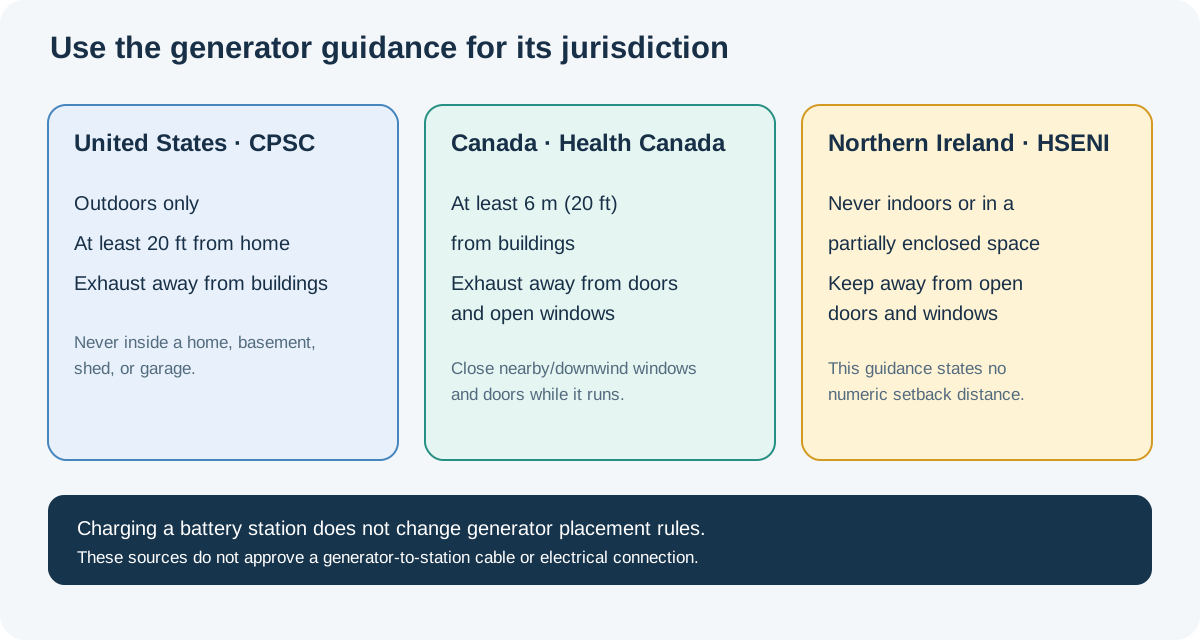
CPSC and HSENI also say to turn a generator off and let it cool before refuelling. Never use a generator indoors or in a garage or shed; a battery station and an open door do not make that safe. These placement instructions do not approve a generator-to-station electrical connection, cord, or charging rate—check both products’ manuals separately.
For a multi-day energy balance, use the solar recharge plan. For the two named DC-DC charger examples, see the EcoFlow Alternator Charger 600 guide and BLUETTI Charger 2 guide.
Key Points
- Choose a source by energy needed and available charging time, not its maximum-watt label.
- Confirm the exact station port, source, region, mode, and cable.
- Car sockets and dedicated alternator chargers are different charging paths.
- Vehicle wiring and installation are model-specific and are outside this comparison.