Build a Solar Recharge Plan for Multi-Day Power Station Use
Balance daily loads, stored solar energy, reserve, and fallback sources without treating panel watts as a multi-day guarantee.
A station can run overnight and still finish the next day with less energy than it started. Multi-day planning compares stored watt-hours at the beginning of each day with device use and energy actually recovered. Panel nameplate watts, a sunny-hour estimate, or an advertised charge time cannot guarantee that the station will recover a specific amount at a real site.
Start with a daily energy ledger
List each load, its expected watts, hours of use, and daily Wh. Use measured energy where possible, especially for cycling devices. Add starting battery energy and set a reserve you will not plan to spend. Keep AC output and surge limits separate from the Wh budget: a load may fit the daily energy total but exceed a port’s power or startup limit.
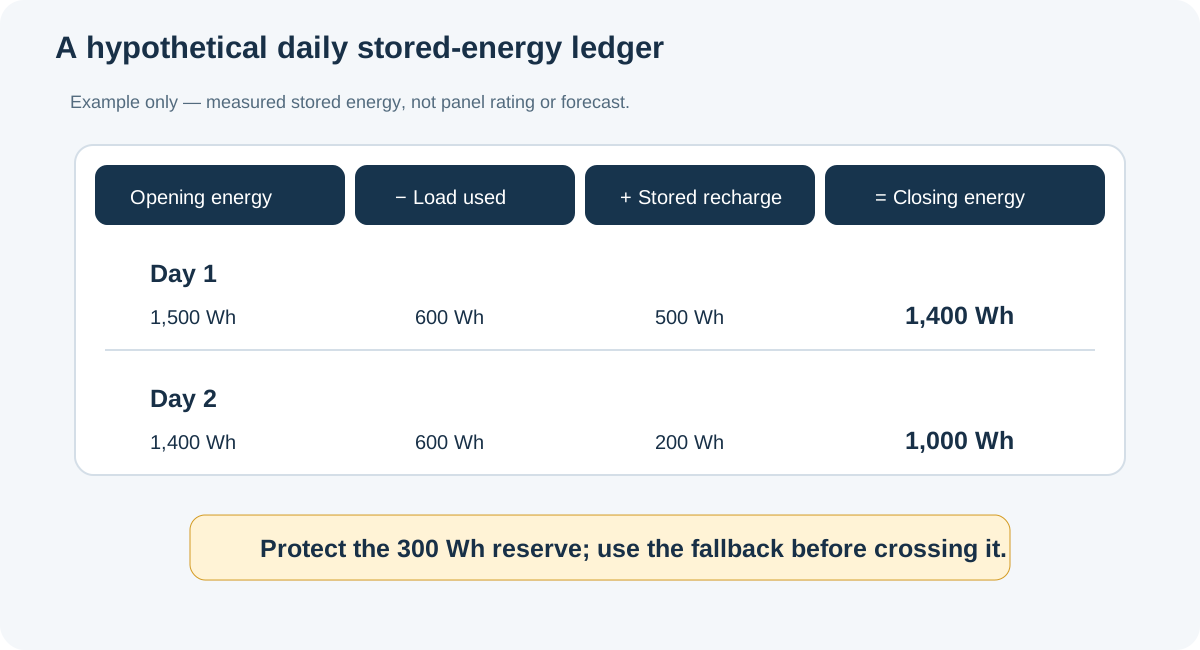
Use this simple balance for each day:
Closing stored energy = opening stored energy − energy used + energy added by charging.
For example, suppose a trip begins with 1,500 Wh available for planning and protects a 300 Wh reserve. A representative day uses 600 Wh and the station’s battery history shows 500 Wh added during solar charging. The next day begins with 1,400 Wh. If poor weather reduces stored recharge to 200 Wh, the next closing level becomes 1,000 Wh. Each following day at that same low recharge would reduce the balance by 400 Wh, crossing the reserve on the second such day. These figures are a hypothetical ledger, not a station or panel performance claim.
Estimate harvest for the place and season
Record location, dates, panel angle and direction, shade, weather range, and daily placement window. DOE’s PV design guidance describes general relationships between orientation, tilt, location, and system goals; DOE FEMP also distinguishes standard-test panel output from variable field performance. NREL’s PVWatts manual describes a simplified grid-connected PV estimate under typical-weather assumptions. These sources do not predict a portable station’s MPPT behavior, cable losses, input clipping, battery charge taper, or stored-Wh result.
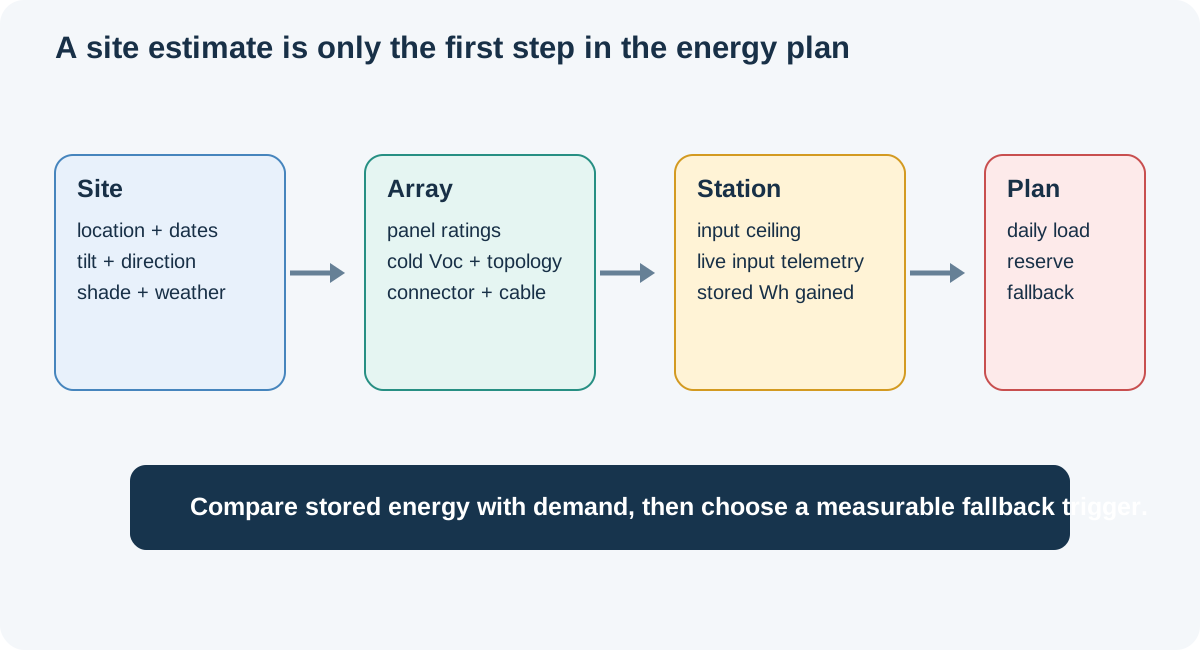
Use a location-specific estimate as a planning range, then refine it with station telemetry from comparable conditions. Track panel placement, input watts, stored Wh gained, and loads running while charging. The station’s solar input maximum is an upper boundary, not a daily yield. Check the exact panel Voc, current, connector, and arrangement against the station manual before relying on the array.
Build a fallback and a trigger
Choose what happens when harvest is below the day’s load: reduce nonessential use, change panel placement, use a documented wall or vehicle source, shorten the trip, or stop using loads before reserve is crossed. Write the trigger in a measurable form, such as “if stored energy is below 700 Wh by evening, stop the optional loads and use the verified alternate source.” Set the threshold for the actual station and use case.
Do not count a vehicle or wall source unless it will be available during the required window and the exact station cable and input are supported. If an extra battery is under consideration, compare it with the repeated energy deficit and its documented recharge path in the expansion guide. For panel rating versus measured recharge, use the real-world harvest guide.
Key Points
- Budget daily Wh and a protected reserve before choosing a panel set.
- Count stored energy gained, not panel wattage or solar hours alone.
- Use local estimates as ranges and refine them with station measurements.
- Decide when to shed load or use a verified fallback before the reserve is reached.