Solar Panel Nameplate Watts Versus Real-World Recharge Time
Separate panel rating from station input and stored energy, then plan solar recharge from site conditions and measured results.
A 200 W panel is not a 200 W source for every hour of daylight. Nameplate power is measured under defined test conditions; the energy a station accepts and stores changes with sunlight, placement, shade, temperature, wiring, input limits, battery state, and loads. A “full charge in” estimate is meaningful only with its model, start and end charge levels, panel setup, and test conditions.
Follow the energy through three readings
Keep three stages separate: panel rating in watts, live input power accepted by the station, and change in stored battery energy in watt-hours. The readings answer different questions. A panel label describes its rated output under test conditions. The station display shows what its controller accepts at that moment. The increase in stored Wh shows the result after conversion and any simultaneous device use.
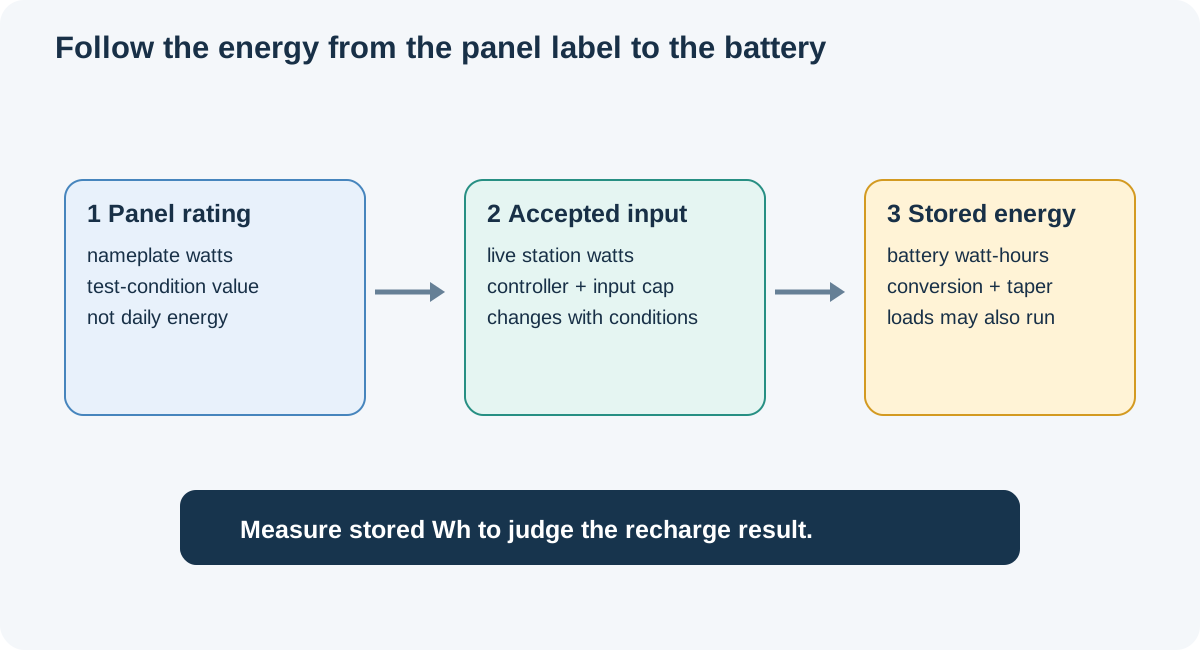
A simple arithmetic example shows why these stages matter. If a station reports an average 120 W solar input for three hours, that is 360 Wh entering the station during that interval. It does not prove that 360 Wh was added to the battery: conversion, charging behavior, battery state, and loads running at the same time can change the stored-energy result. Measure the battery’s Wh change or use the station’s energy history when available.
Estimate a range for the actual site
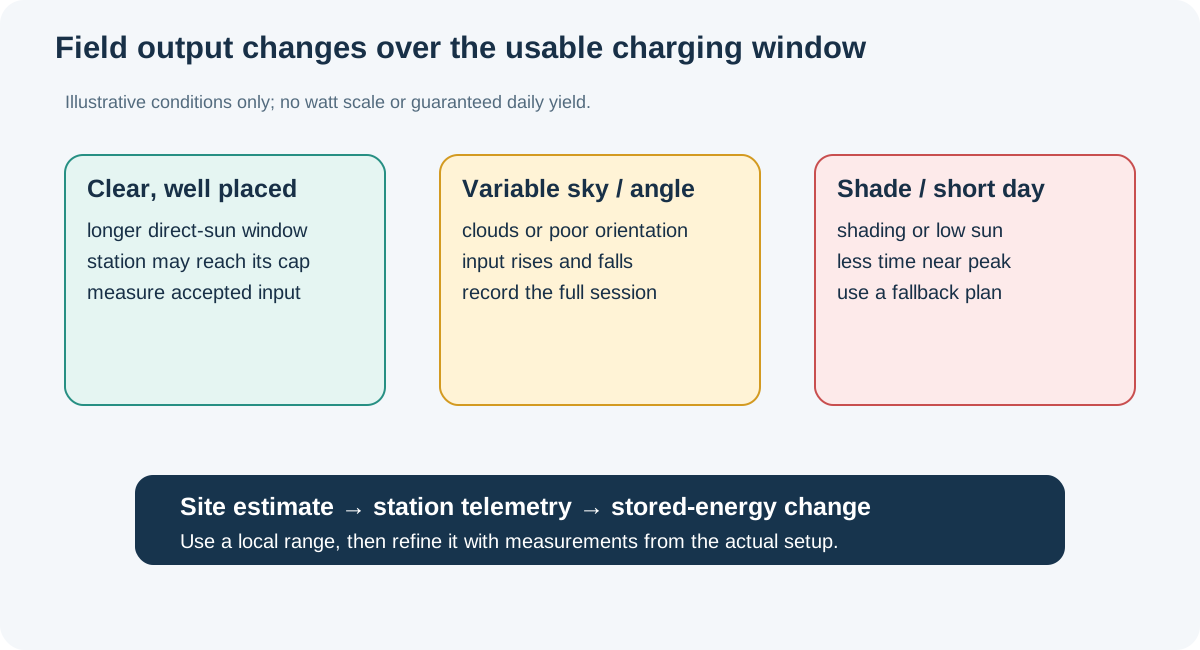
Record the location, season, panel direction and tilt, shading, expected weather, and usable charging window. The U.S. Department of Energy explains that orientation and tilt depend on location and system goals; those general design principles do not forecast a folding panel at a particular campsite. Cloud, partial shade, panel temperature, and cable length also change output through the day.
A location-based solar estimate can help compare seasons or choose a rough panel size, but it is not a battery recharge promise. NREL describes PVWatts as a simplified estimate for grid-connected PV under typical-weather assumptions. Its output does not model a portable station’s MPPT controller, input clipping, cable losses, battery charge taper, or stored-Wh conversion. Use it as one planning input, then compare it with the exact station manual and observed results.
When comparing manufacturer charging times, preserve the conditions the maker gives. Check whether the time ends at 80% or full, the starting state of charge, named panel models and count, temperature, and whether a live load was present. Treat a missing test setup as an uncertainty, not a value to fill from another product’s table.
Also separate input clipping from charge taper. Clipping happens when available panel output is above the station’s accepted input ceiling, so the controller limits what enters the station. Taper happens as the battery nears its charging limit and the station reduces accepted power. Both can lower a live input reading, but they have different causes. Compare peak input while the battery can still accept charge, then compare stored Wh gained over the full session.
Measure and improve the plan
For a real day, note panel arrangement and placement, station input watts over time, battery percentage or Wh at the start and finish, and any loads powered while charging. Repeat the same log after changing one factor, such as shade or orientation. This makes it easier to tell whether the panel, station input ceiling, weather, or charge taper is limiting the result.
If accepted input stays near the station’s documented maximum during bright conditions, adding panel nameplate watts may not increase station input. If output remains low, inspect shade, angle, connectors, and the manual’s electrical limits before changing the array. Do not infer compatibility from a recharge-time chart. Use the input sizing guide first, then use the multi-day solar plan to compare stored energy with daily demand and reserve.
Key Points
- Panel watts, station input watts, and stored watt-hours are different measurements.
- Location and weather tools estimate solar resource; they do not model every portable-station loss or behavior.
- Preserve each manufacturer estimate’s panel setup, charge endpoint, and test conditions.
- Base a multi-day plan on stored energy and a fallback, not a peak-watt headline.