How an Extra Battery Changes Power Station Runtime
Compare added stored energy with station output limits, and verify the exact battery model and connection rules before expansion.
An extra battery adds stored energy only when the station maker documents that exact pairing. It does not automatically increase inverter output, surge capability, port current, or solar input. Before buying an expansion pack, separate the energy question (“how long can the load run?”) from the power question (“can the station start and operate it?”).
Capacity and output answer different questions
Battery capacity is expressed in watt-hours (Wh); output power is expressed in watts (W). For a simplified comparison, a hypothetical load averaging 100 W would use 500 Wh over five hours. Doubling the available stored energy might extend runtime in an ideal calculation, but real usable time is lower because of inverter losses, reserve, temperature, changing load, and battery limits. The calculation says nothing about whether the station can deliver the appliance’s continuous or startup power.
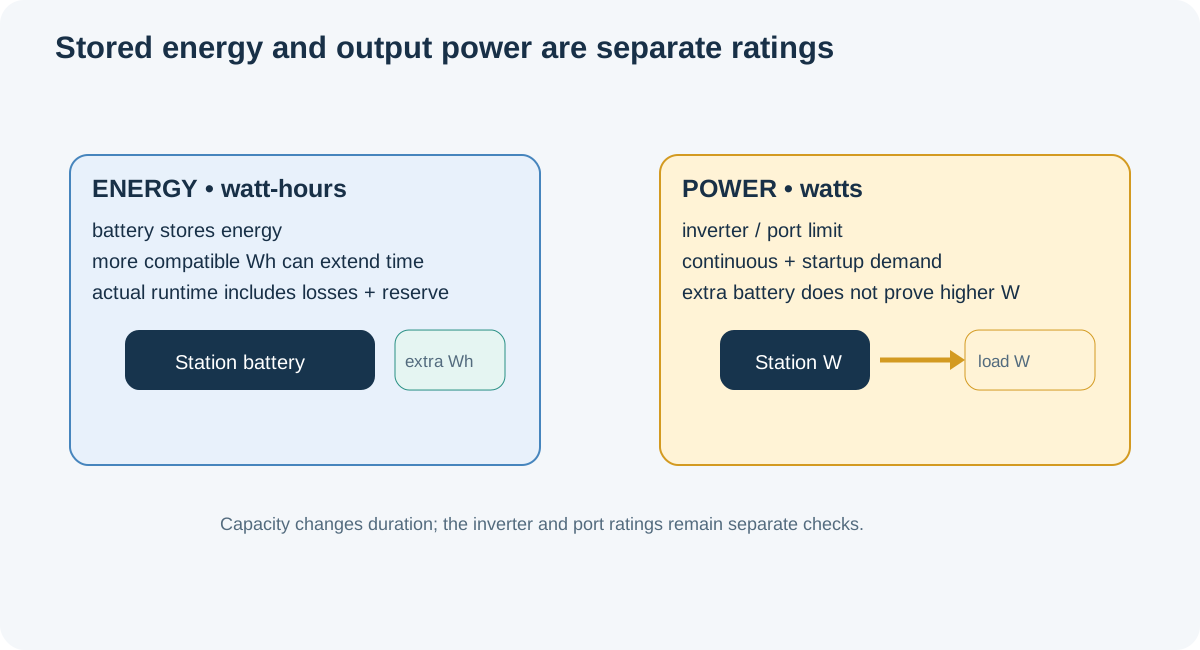
Check continuous AC output, surge rating, DC port limits, and load startup separately. A larger battery will not fix an overloaded outlet, an incompatible voltage, or a missing high-current port. If the load exceeds a port limit, choose a properly rated station or load rather than treating expansion as an output upgrade.
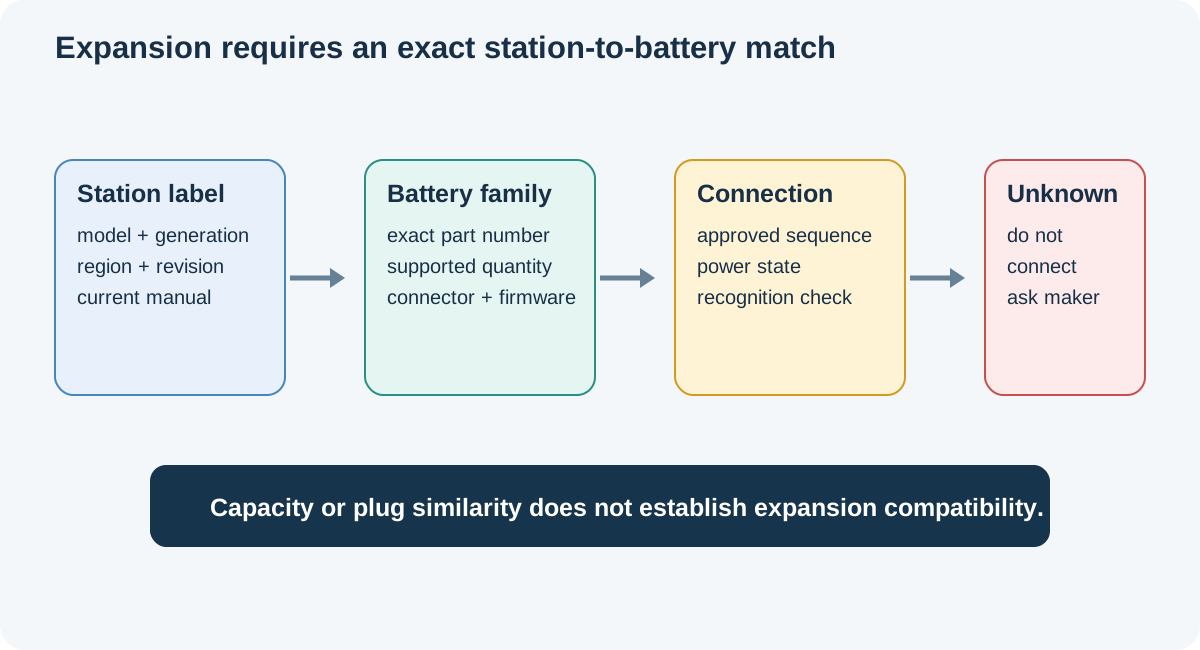
Verify the exact battery family
Use the station label and current compatibility table to identify an approved battery model, supported quantity, connector, firmware or revision, and connection sequence. Check whether both products must be powered off before connecting, how the station confirms recognition, which charging sources can charge the combined system, and any temperature or placement requirements. Do not connect packs because their voltage, capacity, or plug looks similar.
For example, EcoFlow’s US Smart Extra Battery overview lists one 1,024 Wh DELTA 2 Extra Battery for the DELTA 2. It distinguishes that battery from the DELTA Max Extra Battery, which is listed for other named station families. Jackery’s Europe Explorer 1000 V2 support page says that model has no extension function. These examples show that expansion is a model feature, not a general property of portable stations.
The current BLUETTI AC180P product page also contains conflicting expansion language: a marketing section describes B-series batteries as expansion, while its FAQ says B80, B230, and B300 do not support capacity expansion and describes Power Bank Mode instead. The page does not reconcile those statements. Do not count an AC180P battery as added capacity until BLUETTI confirms the exact battery, cable, and operating mode for the unit.
Expansion may also change transport weight, storage space, cost, and how quickly the system can be recharged. Compare the added Wh with the charging sources and time actually available. If the station cannot recharge between high-use days, extra capacity delays depletion but does not solve a repeated daily energy deficit.
Compare expansion with other options
Estimate the load’s daily Wh use and required reserve. Then compare reducing nonessential use, adding a documented recharge source, changing the charging window, or buying an approved battery. Choose based on the problem: expansion can support a longer interval between charging, while load reduction and recharge can address ongoing demand. Keep every option inside the station’s instructions.
If the exact battery model or system limit is not listed, pause and ask the manufacturer before connecting it. For the day-by-day stored-energy budget, see the multi-day recharge plan.
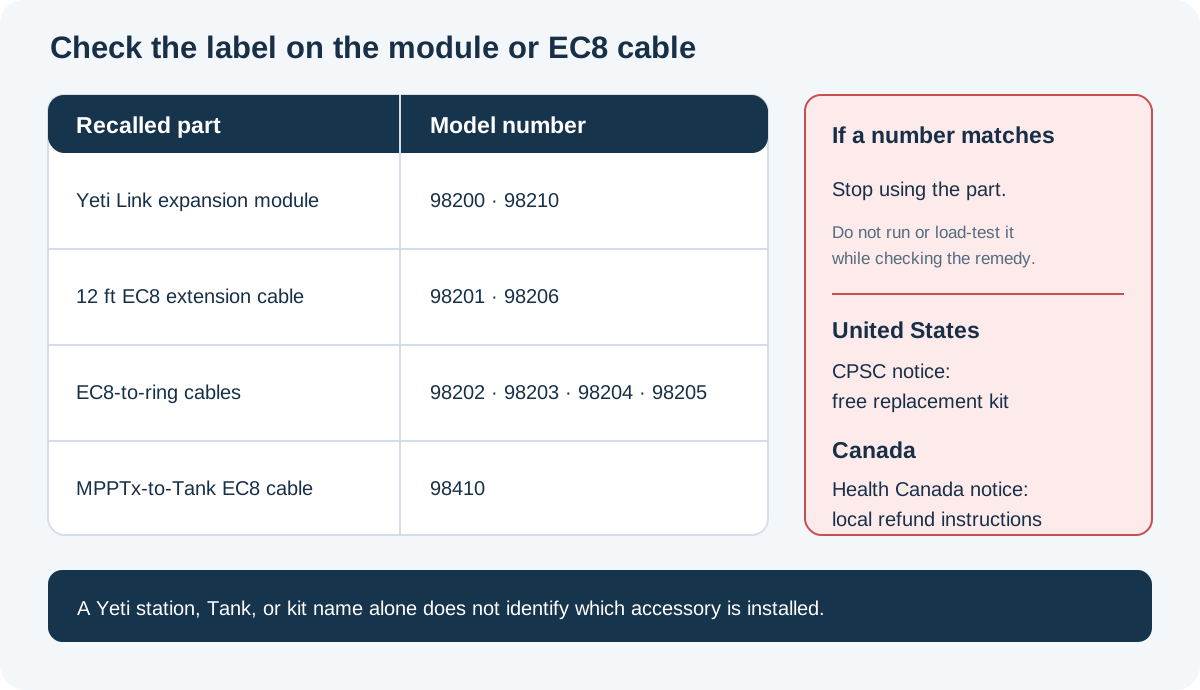
Screen recalled expansion parts by model number
Goal Zero Yeti Link modules 98200 and 98210 and specified EC8 cables—models 98201, 98202, 98203, 98204, 98205, 98206, and 98410—are covered by a fire and burn hazard recall. The U.S. CPSC notice lists the affected parts and says to stop using a matching module or cable immediately and contact Goal Zero for a free replacement kit. Health Canada’s notice covers the Canadian recall and gives its local refund instructions. Check the exact model label and follow the notice for the unit’s market; a Yeti station, Tank, or expansion kit name alone does not identify which cable is installed.
Key Points
- Added capacity can extend duration but does not itself raise the station’s output rating.
- Match the exact station and battery model, supported count, and connection sequence.
- Compare expansion with load reduction and recharge availability.
- Do not infer compatibility from connector shape or similar capacity labels.