EcoFlow Alternator Charger 600: Modes and Compatibility Checks
Understand the Alternator Charger 600's documented charging modes, receiving-station limits, and vehicle-side checks before planning a drive.
The EcoFlow Alternator Charger 600 is a dedicated vehicle charging system. Its 600 W figure is a maximum for one documented mode, not a promise that every vehicle or receiving station will deliver that rate. Output depends on the vehicle model and motion, and the receiving station and cable can impose a lower ceiling. Check the exact components and the current manual before building a route or energy estimate.
Understand the mode and output limits
The manual gives a maximum of 600 W for Charge Mode. It also says actual output is affected by vehicle motion and vehicle model, so a trip estimate should not assume a steady 600 W. The charger monitors the vehicle battery and stops charging when its voltage falls below a configured start threshold. That cutoff is a protection behavior, not a way to determine whether a vehicle can support the installation.
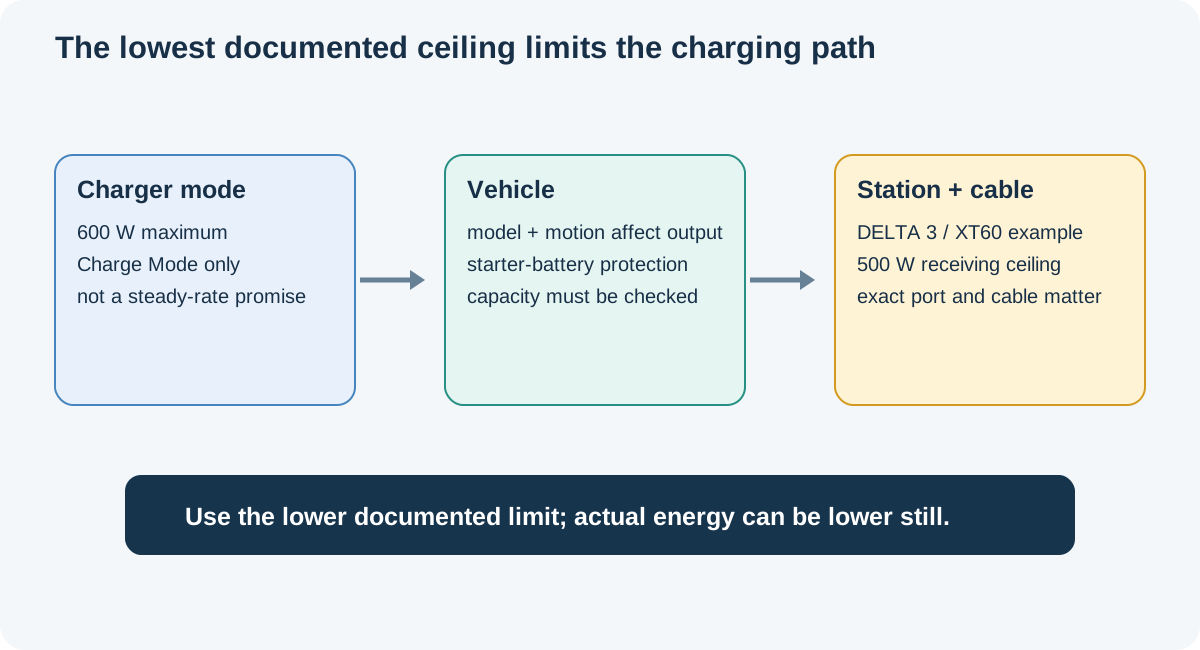
The receiving station path matters too. EcoFlow’s manual gives the DELTA 3 connected through XT60 as an example limited to 500 W by the station and cable. The example shows why the charger’s rating alone does not set the final rate. It does not establish that every DELTA 3 model or every XT60-connected station supports the Alternator Charger 600.
| Connection detail | What the manual supports | What still needs checking |
|---|---|---|
| Charge Mode | Up to 600 W maximum; vehicle model and motion affect output | Exact vehicle capacity, supported station, drive conditions, and current manual |
| DELTA 3 with XT60 | 500 W example ceiling at the receiving station/cable path | Exact model, cable part, port rating, regional version, and approved mode |
| XT150 | Additional charge, reverse-charge, and battery-maintenance modes are described | Compatible XT150 station port and the separately specified cable |
| Starter battery | The charger monitors voltage and stops below its configured threshold | Correct vehicle-side setup and all current manufacturer requirements |
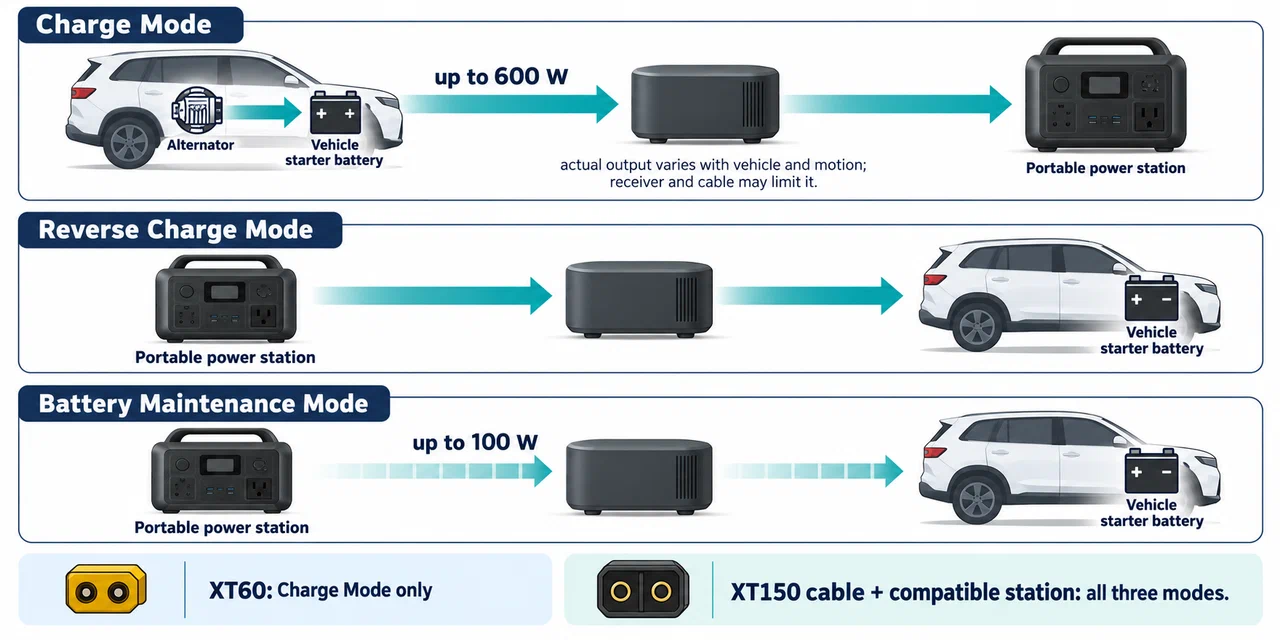
The XT150 detail is especially important: a matching connector is not enough. The manual ties additional modes to a compatible station port and a separate cable. Do not assume an adapter converts an unsupported port into an approved XT150 connection or that modes can be changed while driving.
Decide whether it fits the energy plan
Start with the energy needed after the drive, not the 600 W headline. Record the receiving station’s exact input limit and cable path, then use the lower documented ceiling when the charger, station, and cable specify different maxima. A 500 W ceiling sustained for one hour would equal 0.5 kWh before conversion losses; this is only arithmetic at that ceiling, not a forecast. The manual’s vehicle-motion qualifier means real delivered energy may be lower or vary during the trip.
Compare that bounded estimate with the loads expected on arrival and preserve reserve for idle use, weather, delays, and charging variation. If the drive window is too short, reduce planned consumption or arrange another compatible charging source. Do not rely on an unverified average output or convert a maximum charging mode into a promised charge time.
Treat vehicle compatibility as a separate check
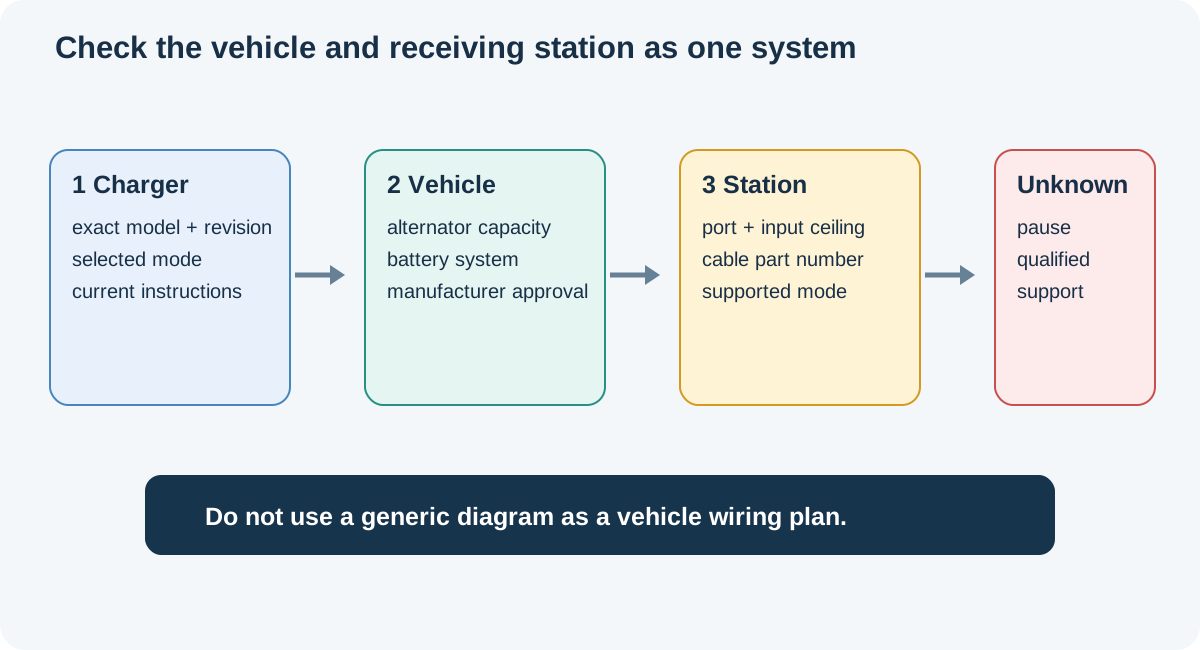
The available manual details do not provide a complete vehicle list, alternator-capacity table, universal wiring design, or supported-station matrix. Before purchase or operation, identify the exact Alternator Charger 600 version, vehicle and alternator, starter-battery system, receiving station and port, cable part numbers, and mode. Confirm each connection and limit in the current documents for those products.
EcoFlow recommends professional wiring and says to verify that alternator capacity can support the charger’s maximum draw. It also calls for personal protective equipment and warns about polarity reversal, loose or poorly routed wiring, and changing modes while driving. These instructions make installation a vehicle-specific task. This guide does not provide wiring, fuse selection, cable routing, or DIY installation steps; use the current manufacturer instructions and a qualified vehicle installer.
If the manual or product labels do not establish compatibility, pause and ask EcoFlow and the vehicle manufacturer with the exact model numbers. A plug that fits, a nominal 12 V label, or a compatible-looking port does not prove the charger is suitable for that vehicle and station.
Key Points
- 600 W is the Alternator Charger 600’s Charge Mode maximum; vehicle model and motion affect actual output.
- The DELTA 3/XT60 500 W figure is a manual example constrained by the receiving station and cable.
- XT150 modes require a compatible station port and the specified separate cable.
- Confirm the exact vehicle, charger, cable, station, port, and mode in current manufacturer documents.
- EcoFlow recommends professional wiring; this guide does not provide vehicle installation steps.