Series, Parallel, and Connector Compatibility for Solar Panels
Understand what series and parallel arrangements change, and verify panel matching, connector, polarity, and station approval.
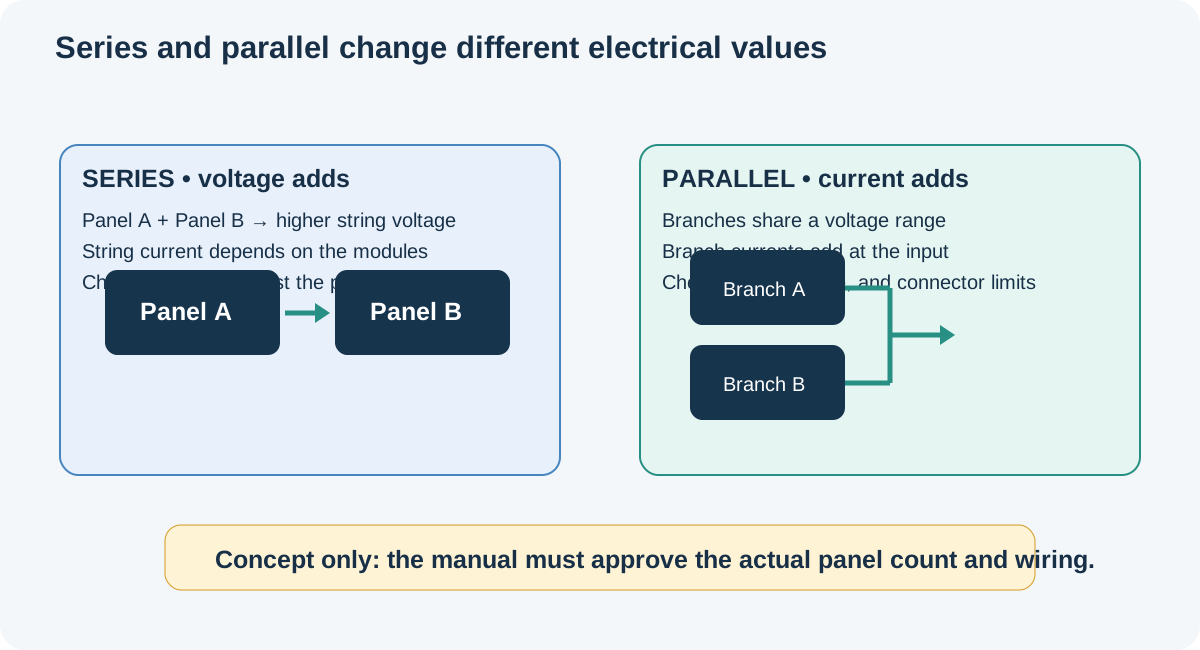
Series and parallel describe how panels are electrically grouped; neither arrangement is universally better. Series strings increase voltage, while parallel branches increase current. The station, panel, and connector manufacturers must all permit the exact configuration. A simple drawing or matching plug shape cannot substitute for those instructions.
Compare the electrical changes
| Arrangement | What adds | What stays important |
|---|---|---|
| Series string | Panel voltages add; string current is constrained by the modules and arrangement | Cold-weather Voc, operating-voltage window, current, power, and manual approval |
| Parallel branches | Branch currents add; voltage remains near the panel operating range | Input-current ceiling, branch matching, fuses or combiner rules, cable and connector ratings |
The total wattage is not a complete compatibility check. In either arrangement, compare the full array with the exact station’s input range, maximum current, power ceiling, connector, and panel-count rules. Calculate cold-weather Voc for each series string when the panel data and station manual call for it. Check operating voltage and current separately, and follow the panel maker’s matching guidance.
Follow the exact model example
Jackery’s Europe Explorer 1000 V2 support page says its two DC inputs are parallel and describes specific supported panel counts: one, two, or four, with three panels unsupported. It also gives matching conditions for certain multi-panel arrangements. This is a rule for that regional JE-1000D, not a panel-count recipe for other Jackery generations.
BLUETTI’s US AC180P manual allows series or parallel panels but requires MC4 connectors and says not to mix different panel types. That permission still does not specify a universal number of panels or approve every panel with an MC4-style connector. Use the manual for the exact station and the datasheet for the exact modules.
Jackery’s named Anderson accessories show why connector ratings also belong to a specific product: its listed series connector, parallel connector, and extension cable have separate current ratings, and the manufacturer rejects a stated SolarSaga panel mix. These details do not apply to an unbranded adapter or a similar-looking connector.
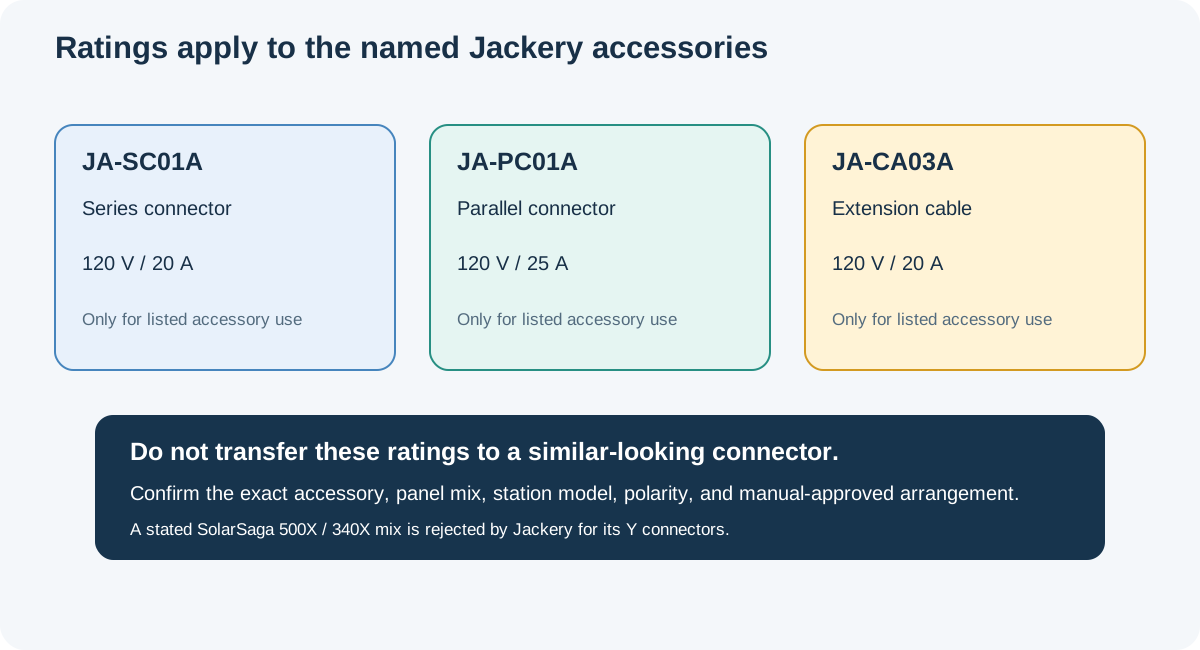
For the named Jackery parts, the JA-SC01A series connector is listed at 120 V / 20 A, the JA-PC01A parallel connector at 120 V / 25 A, and the JA-CA03A extension cable at 120 V / 20 A. The same page lists SolarSaga 100 Prime series arrangements for Explorer 600 Plus and 1000 V2, parallel for Explorer 1500, and series-parallel for Explorer 1000 Plus. It warns against joining SolarSaga 500X and 340X panels with its Y connectors. These ratings and arrangements apply to those listed parts and stations; they are not generic Anderson or panel rules.
Check the combiner label against current recalls
Goal Zero Solar Series Combiner model 98715 (4x HPP to 1x HPP+) is covered by a fire-hazard recall. The U.S. CPSC notice and Health Canada’s notice direct owners to stop using that exact combiner immediately and contact Goal Zero about the stated refund remedy. Match the number on the cable; a notice saying the combiner may have been bundled with a Nomad panel or Yeti PRO 4000 does not mean every such panel or station kit contains it. Check the current local notice for remedy instructions before using or discarding a matching unit.
Treat connectors as electrical components
Before using an adapter or extension, confirm connector family and manufacturer, mating part, voltage and current ratings, pin polarity, cable rating, and the station port’s input requirements. A connector changes physical fit; it does not regulate voltage, correct polarity, limit current, or make an unsupported array safe.
Some connector instructions are product-specific. For example, Stäubli’s MC4-Evo stor instructions require assembly by an electrician or electrically instructed person, approved PV cables and tools, de-energizing before mating or disconnecting, and never disconnecting under load. They also prohibit mating that connector half with another manufacturer’s half. Those requirements apply to the named connector product and must not be generalized to every MC4-style connector.
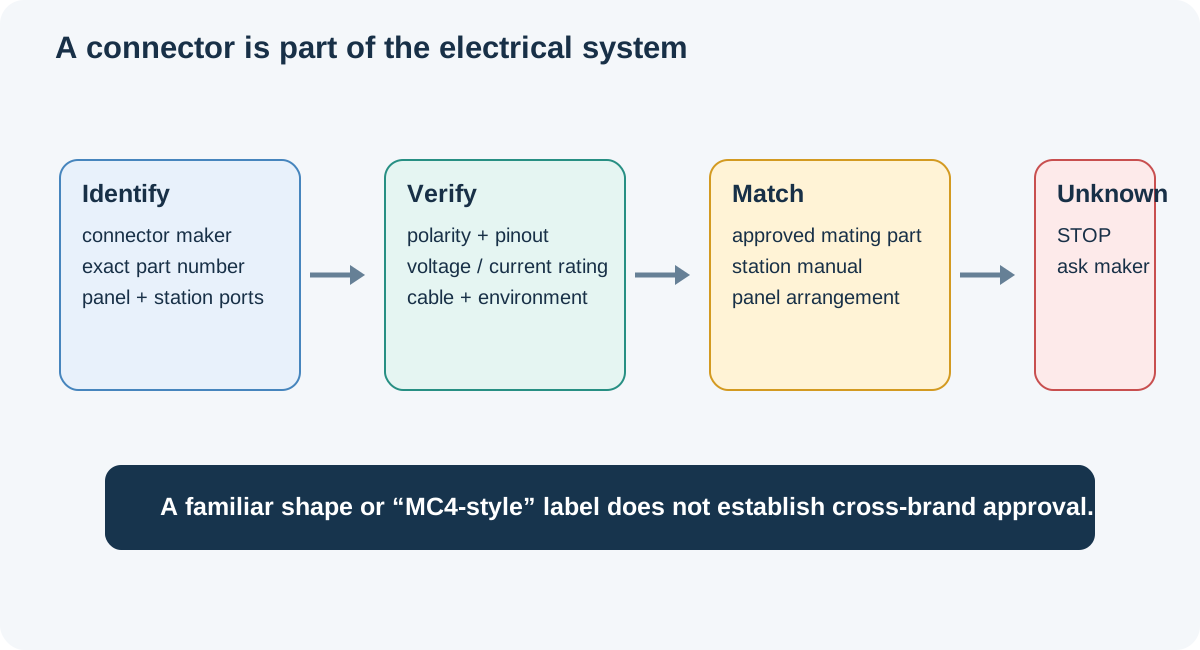
Do not assemble or disconnect a live solar circuit to experiment. If panel count, connector pairing, polarity, or cold-voltage margin is undocumented, pause and ask the relevant manufacturers with the exact part numbers and datasheets. For the broader voltage, current, and power worksheet, use the solar input sizing guide; for cable selection, see the direct-DC compatibility checklist.
Key Points
- Series adds voltage; parallel adds current.
- A permitted topology is model-specific and does not replace voltage, current, power, and temperature checks.
- Connector shape, family name, or adapter fit does not prove polarity or compatibility.
- Keep connector-specific handling instructions with the exact product they describe.