Check Solar-Panel Open-Circuit Voltage in Cold Weather
Use a panel’s own temperature coefficient and coldest expected module temperature to screen a series array’s maximum voltage.
Solar-panel open-circuit voltage (Voc) rises as the panel gets colder. A series string adds the Voc of its panels, so an array that appears below a station’s maximum voltage in mild weather may exceed that limit in cold conditions. Check the exact panel’s temperature coefficient and the power station’s maximum PV input before connecting a string. This is a screening calculation; it does not replace either manufacturer’s wiring instructions.
Find the data for the exact panel
Record the panel’s rated Voc, any stated Voc tolerance, the temperature coefficient for Voc, the coefficient’s reference condition, and the temperature range or calculation method specified in its manual. Use the coldest expected module-cell temperature relevant to the design, not a room temperature or an unexamined weather-app air temperature. The panel’s operating temperature can differ from ambient conditions; use the manufacturer’s guidance when converting a local design temperature to the value required by its method.
If the temperature coefficient is given as a negative percentage per degree and the manufacturer specifies a reference temperature, a first-order screen is:
Cold Voc ≈ rated Voc × [1 + (absolute Voc coefficient × degrees below reference)]
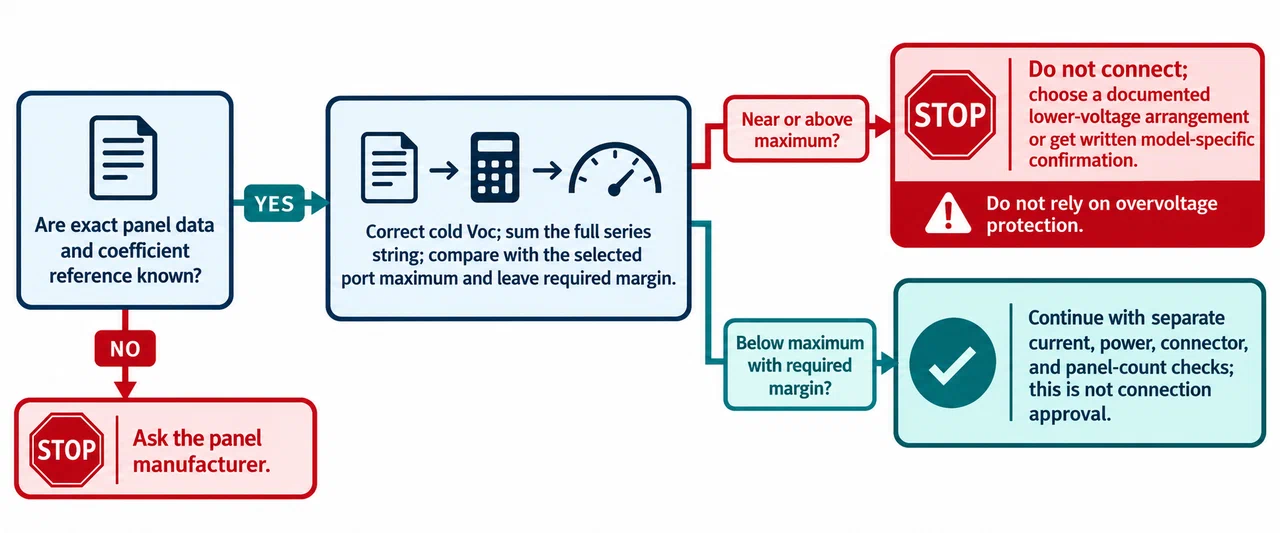
Convert the percent coefficient to a decimal before multiplying. Apply stated voltage tolerance and any additional manufacturer-required correction. For series panels, sum the resulting panel Voc values. Do not use this formula when the coefficient, units, reference condition, or required adjustments are unknown; ask the panel manufacturer instead.
A labeled example, not a connection approval
The European Jackery Flexible Solar Panel Set 200 W (4) information page lists Voc as 41.64 V with ±5% tolerance and a Voc temperature coefficient of −0.26%/°C. If the exact product documentation’s reference temperature is 25°C and a planning calculation uses a 5°C module temperature, the simple coefficient factor is 1 + 0.0026 × 20, or 1.052. Applied to nominal Voc, that gives approximately 43.8 V for one panel before applying the stated voltage tolerance or any other required correction.
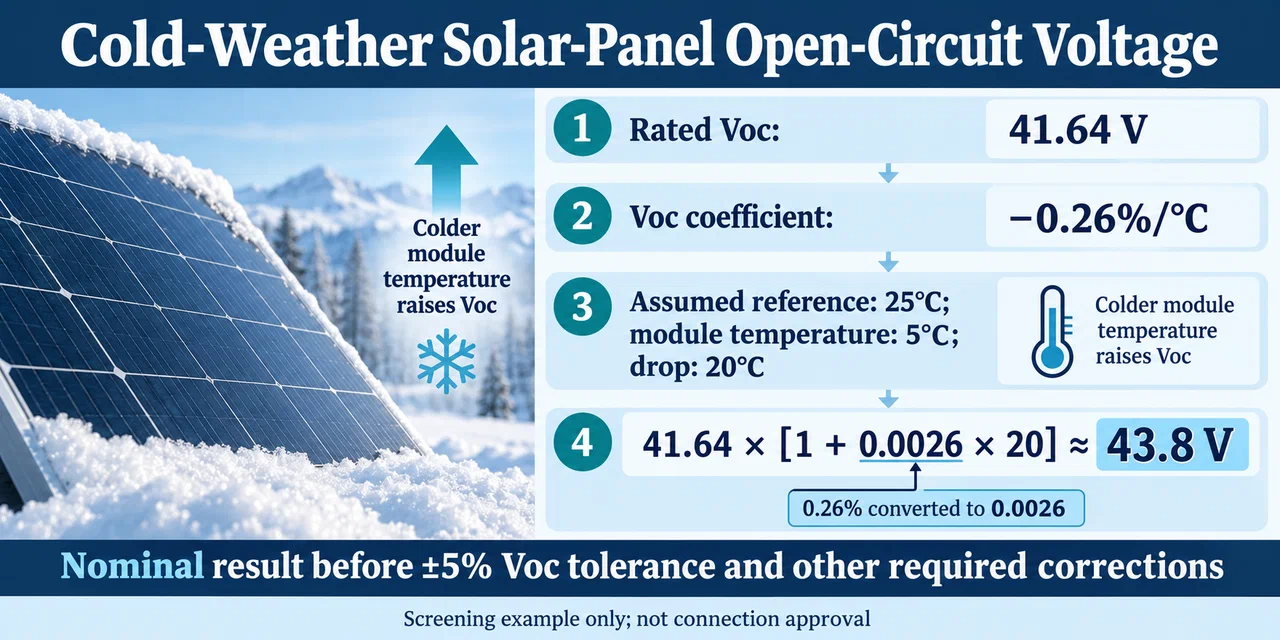
That figure is a worked screening example under stated assumptions, not permission to connect a panel. Use the current panel documentation to confirm its coefficient reference and tolerance treatment, then compare the corrected value with the exact power-station input limit. For multiple panels in series, apply the check to the full string. A different panel with a higher Voc or a larger temperature coefficient needs its own calculation.
Compare with the right station limit
Use the station’s maximum PV input voltage for the chosen port and model. For example, the EcoFlow DELTA Pro 3 manual specifies distinct high- and low-PV input ranges and warns that series Voc adds and must remain within the selected input’s limit. The EcoFlow DELTA Pro Ultra specification sheet also lists separate low- and high-voltage PV ranges. These are model-specific examples, not interchangeable limits.
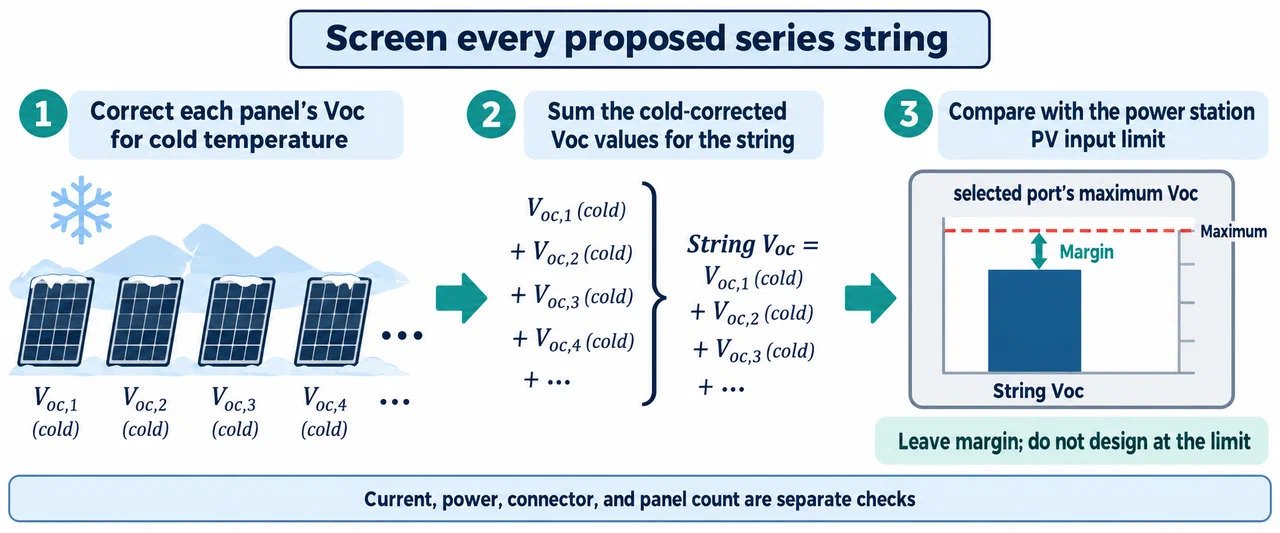
Keep cold Voc separate from Vmp, input current, and maximum power. Voc is measured with the circuit open; it is used to assess maximum voltage, while operating values serve other compatibility checks. Check every proposed series string, then evaluate array current, wattage, port choice, connector, polarity, and supported panel count on their own. A correct voltage calculation does not authorize an unlisted connection method.
Keep margin and stop at uncertainty
Do not design exactly at the station’s maximum or rely on an overvoltage protection trip. Coefficients, tolerances, temperature assumptions, and product revisions can affect the result. Use margin below the station limit consistent with both manufacturers’ instructions. If the corrected worst-case value approaches the maximum, choose a documented lower-voltage arrangement or get written model-specific confirmation before connecting the panels.
Never solve a cold-voltage mismatch by routing an array to a different port or adding an adapter. A connector changes physical fit, not array Voc. Do not use a field measurement taken in warm weather as proof that the string will remain within limits on a cold morning.
Key Points
- Cold temperatures raise panel Voc; series panels add their open-circuit voltage.
- Use the exact panel’s coefficient, reference condition, tolerance, and manufacturer calculation method.
- Compare corrected string Voc with the exact station port’s maximum, with margin.
- Voltage screening is separate from current, power, connector, and panel-count checks.
- Stop and request manufacturer guidance when an input or coefficient detail is unclear.