Jackery Explorer 2000 Plus Solar Charge Times by Panel Count
Compare Jackery’s conditional charge-time estimates for selected SolarSaga panel counts on the US Explorer 2000 Plus (JE-2000C).
Jackery’s US support page for the Explorer 2000 Plus, model JE-2000C, lists approximate charging times for several SolarSaga panel counts. The table is useful for comparing the manufacturer’s examples for this named system. It is not a field test, a guarantee for a particular trip, or permission to connect any panel combination.
Jackery’s listed examples
| SolarSaga panel | Panel count listed | Approximate time on the US support page |
|---|---|---|
| SolarSaga 40 | — | No verified time listed |
| SolarSaga 80 | 1 / 2 / 4 / 6 | Around 35 / 18 / 9 / 6 hours |
| SolarSaga 100 | 1 / 2 / 4 / 6 | Around 23 / 13 / 7 / 5.5 hours |
| SolarSaga 200 | 1 / 2 / 4 / 6 | Around 14 / 7 / 3.8 / 2 hours |
| SolarSaga 500 X | 1 / 2 | Around 7 / 3.5 hours |
“Around” matters: the page presents product charging-time estimates, not a promise that every setup will match those times. It does not give a complete set of test conditions alongside this table. Sunlight, panel angle, shading, temperature, cable arrangement, battery state, loads running during charge, and the station’s acceptance limits can all affect real charging. A larger panel count also does not produce a simple guaranteed multiplier; compare the listed estimates only within the manufacturer’s stated examples.
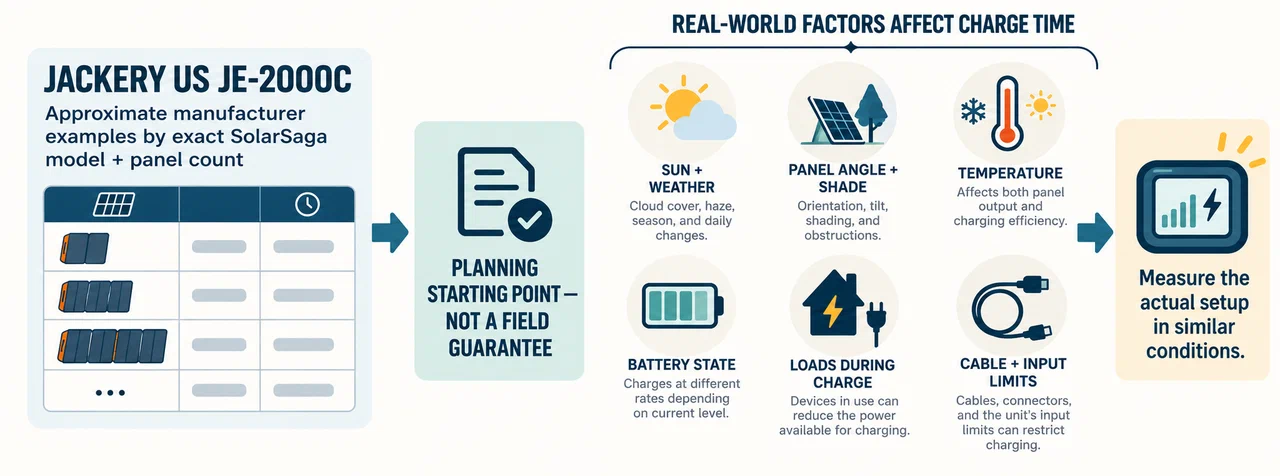
The missing SolarSaga 40 estimate means Jackery lists no verified time for that panel in this table. It does not establish that the panel is incompatible. The SolarSaga 500 X row gives examples for one and two panels only; do not infer times for larger sets from those entries.
Keep the estimate separate from compatibility
The support entry identifies JE-2000C and gives panel-count and adapter guidance for its two DC inputs. For example, its listed four- and six-panel arrangements use equal panel counts on the two inputs. Panel models must follow the page’s compatibility conditions; if model types are mixed, it requires matching maximum output, open-circuit voltage, and operating voltage. Those instructions are specific to the named station and accessory path. Check the current manual and the labels on the exact station and panels before choosing a setup. Voltage, current, open-circuit voltage in cold conditions, connectors, polarity, panel count, and total input power remain separate checks.
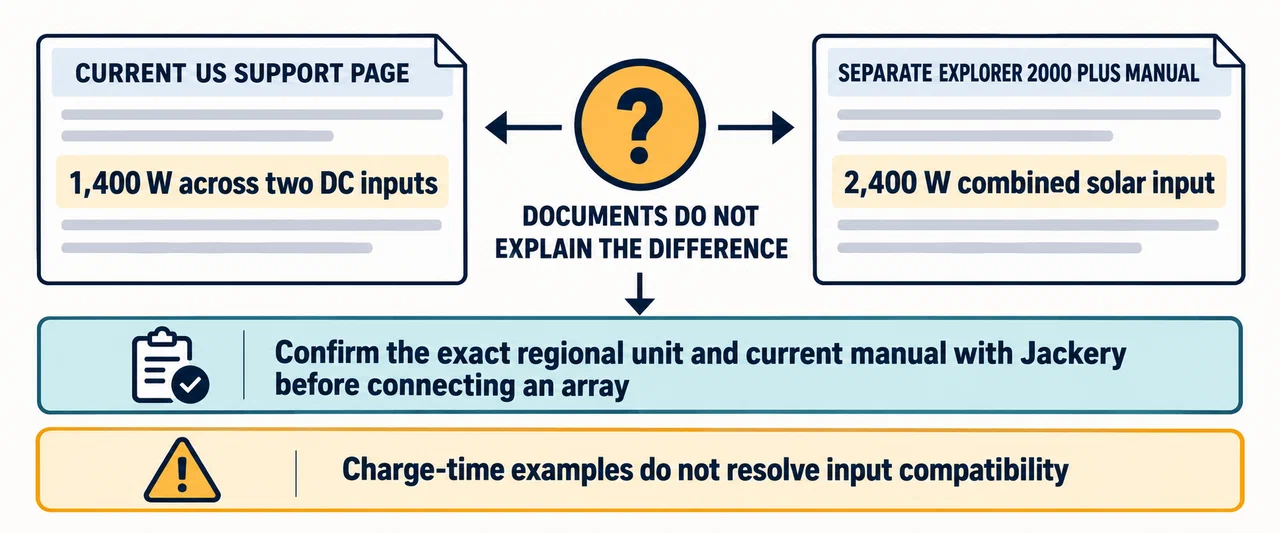
Jackery’s product documentation also reports different combined solar-input limits for the JE-2000C in different source surfaces: its current US support page lists 1,400 W across two inputs, while a separate Explorer 2000 Plus manual lists 2,400 W combined. The available documents do not explain the difference. Do not use the charging-time table to settle that specification conflict or to approve an array. Confirm the exact regional unit and its current manual with Jackery before connection.
Use the numbers as a planning prompt
Start with the model and panel combination you actually have, then compare the relevant manufacturer estimate with a measured charging session in similar conditions. Record the starting and ending state of charge, weather, panel position, active loads, and any station input reading. A momentary input-watt value is not the same as stored watt-hours over a day.
For a broader estimate, account for location, season, shade, orientation, conversion losses, battery reserve, and the station’s input ceiling. Keep a fallback source or a load-reduction plan when stored energy matters over several days. The real-world solar recharge guide explains how to distinguish panel rating, live station input, and energy gained. Before connecting panels, use the input-sizing guide and series and parallel guide to check the exact electrical arrangement.
Key Points
- These are approximate manufacturer examples for the US Explorer 2000 Plus, model JE-2000C.
- SolarSaga 40 has no verified time listed; the 500 X examples cover only one and two panels.
- Charge-time estimates do not replace a model-specific voltage, current, connector, and panel-arrangement check.
- Jackery documentation lists different combined solar-input limits in separate source surfaces; verify the exact unit before connecting an array.
- Use actual station readings and a reserve or fallback plan for real-world, multi-day use.