Goal Zero Yeti 3000X Solar Charge Times by Panel Rating
Compare Goal Zero's conditional Yeti 3000X sunlight-hour examples from 100 W to 1,200 W rated panel sets and the separate 600 W actual-input cap.
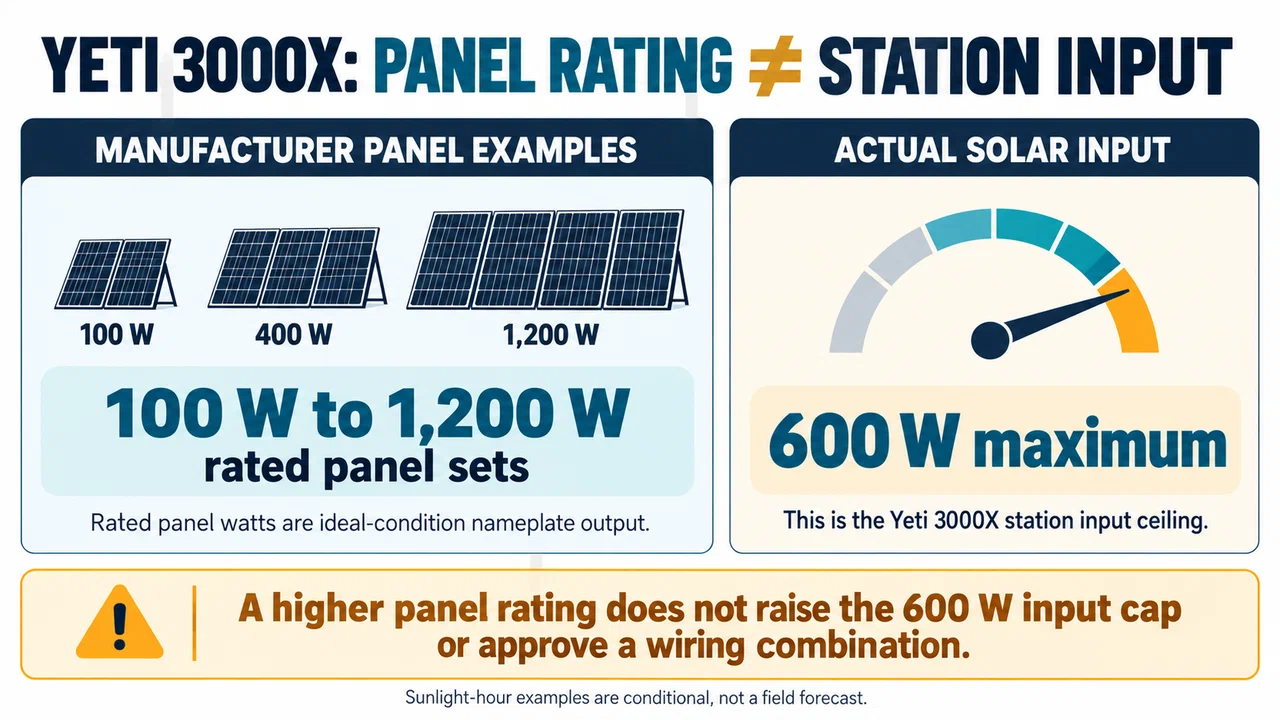
Goal Zero lists solar recharge examples for the Yeti 3000X, a 3,032 Wh station. The current product page spans 100 W to 1,200 W rated panel sets, with sunlight-hour examples from 36–72 hours at 100 W to 6 hours at 1,200 W. They are manufacturer examples for comparing panel ratings and are not measured field results, a universal charging promise, or approval for every array.
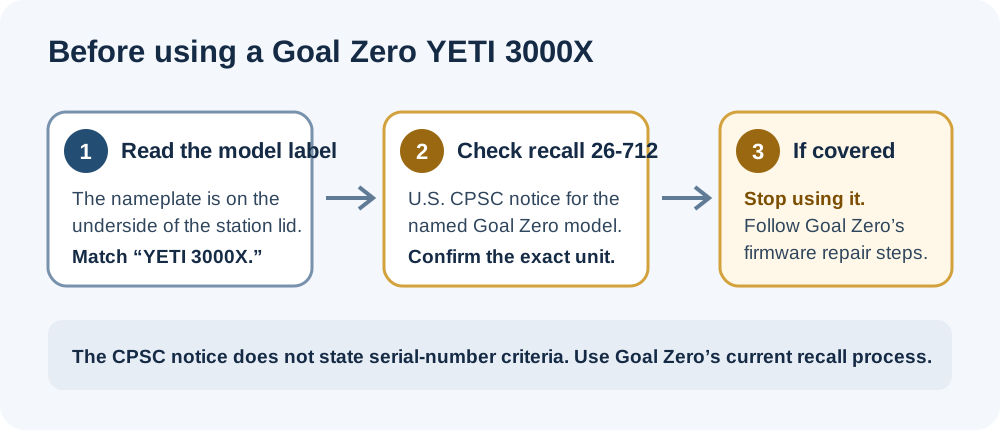
Check the U.S. and Canadian recalls before using a YETI 3000X
U.S. CPSC recall 26-712 and Health Canada’s Canadian recall RA-82608 identify Goal Zero YETI 3000X power stations and describe the same circuit-board overheating, fire, and burn hazard. Both direct owners of a covered station to stop using it immediately and obtain the free firmware repair through the Goal Zero app or by contacting Goal Zero. Check the current CPSC notice or Health Canada notice for the station’s market. The charge-time examples below do not override the stop-use instruction. See the dedicated recall guide for model-identification and repair details.
Manufacturer solar examples
| Rated panel set in Goal Zero’s table | Named example on the page | Listed sunlight hours to full |
|---|---|---|
| 100 W | Boulder 100 BC or Nomad 100 | 36–72 |
| 200 W | Boulder 200 BC or Nomad 200 | 18–36 |
| 400 W | Two Boulder BC or Nomad 200 panels | 9–18 |
| 600 W | Two Ranger 300 panels or three Boulder/Nomad 200 panels | 6–12 |
| 800 W* | Four Nomad 200 panels, etc. | 6–9 |
| 1,200 W* | Four Ranger 300 panels, etc. | 6 |
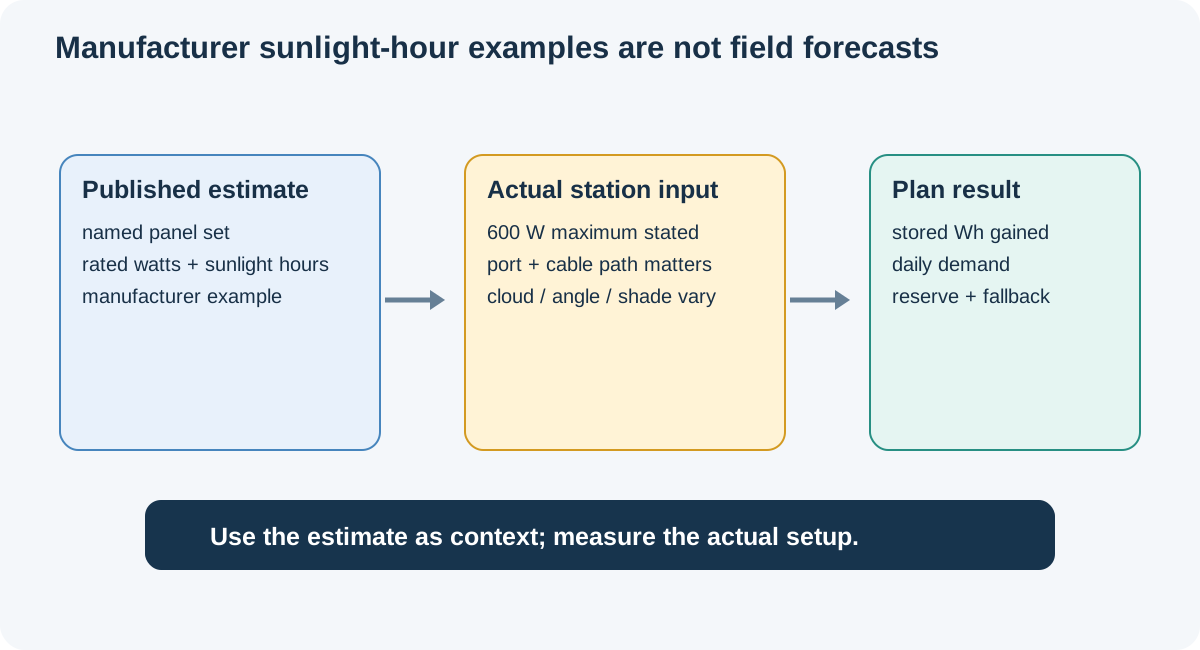
Goal Zero says rated panel watts describe output under ideal temperature, orientation, angle, and full-sun conditions, before cable losses. “Hours of sunlight” should not be read as elapsed clock time from sunrise to sunset. Actual input changes with cloud, shade, panel angle, temperature, season, cable losses, battery state, and charging behavior.
Separate panel rating from the station’s input
The same page states a 600 W maximum for actual solar input. Its current input specifications list one High Power Charging port rated up to 600 W at 14–50 V and up to 50 A, plus two 8 mm charging ports rated up to 150 W each at 14–50 V and up to 10 A. These are port specifications; the page does not explain every combination of inputs or identify the exact wiring path behind each higher-rated panel example.
The 800 W and 1,200 W rows describe panel nameplate totals, not power the Yeti 3000X accepts above 600 W. The page’s named examples do not establish that an arbitrary set with the same total wattage is electrically equivalent, that the ports may be combined in any way, or that a third-party panel arrangement is approved. Check the exact port, panel Voc and current, cable, polarity, and permitted arrangement against current product instructions before connection.
Put the estimate in a recharge plan
The Yeti 3000X page lists a 3,032 Wh capacity and separate AC estimates: 14 hours with the 230 W supply and 6 hours with an optional 600 W supply. Those are product-page examples for the named equipment. Do not infer a fixed solar conversion rate by dividing capacity by a charge time, and do not use an AC estimate as a solar result.
For an off-grid plan, estimate the energy your devices need per day, then compare that with likely solar harvest for the site and season. Leave reserve for poor weather and define an alternate charging source or reduced-load plan. The manufacturer’s table can frame a range, but it does not forecast a particular campsite or guarantee a full charge on a given day. The solar harvest guide separates rated panel power from station input and stored energy; the multi-day plan helps build a reserve and fallback.
Keep other model details attached to the Yeti 3000X
Goal Zero names its Yeti Lithium 12 V Car Charging Cable for vehicle charging and warns against using an ordinary charging cable from a 12 V source. The expansion port is listed for Goal Zero expansion modules only. Those are product-specific accessory boundaries; they do not make a generic 12 V lead or a third-party battery suitable. Check the exact cable and module instructions before use.
The station is described with an MPPT charge controller and an NMC battery. Neither fact changes the 600 W actual solar-input maximum or fills the remaining questions about a proposed panel, cable, connector, or combined-port arrangement. Do not extend this page’s estimates or accessory information to a different Yeti generation.
Key Points
- Goal Zero lists 36–72, 18–36, 9–18, 6–12, 6–9, and 6 sunlight hours for its 100 W, 200 W, 400 W, 600 W, 800 W, and 1,200 W examples.
- The Yeti 3000X page states a 600 W maximum for actual solar input; higher panel-nameplate examples do not raise that station limit.
- The page lists voltage and current ceilings for its charging ports but does not provide a complete panel, cable, polarity, and combined-input compatibility matrix.
- Panel rating, station input, stored energy, and real-world harvest are different quantities.
- Verify the exact station input path and panel arrangement in current product instructions before connecting.