EcoFlow DELTA 3 Plus Solar Input Limits
Read the DELTA 3 Plus EF-DL-H10-4 solar and car input limits, including per-port and total PV ceilings.
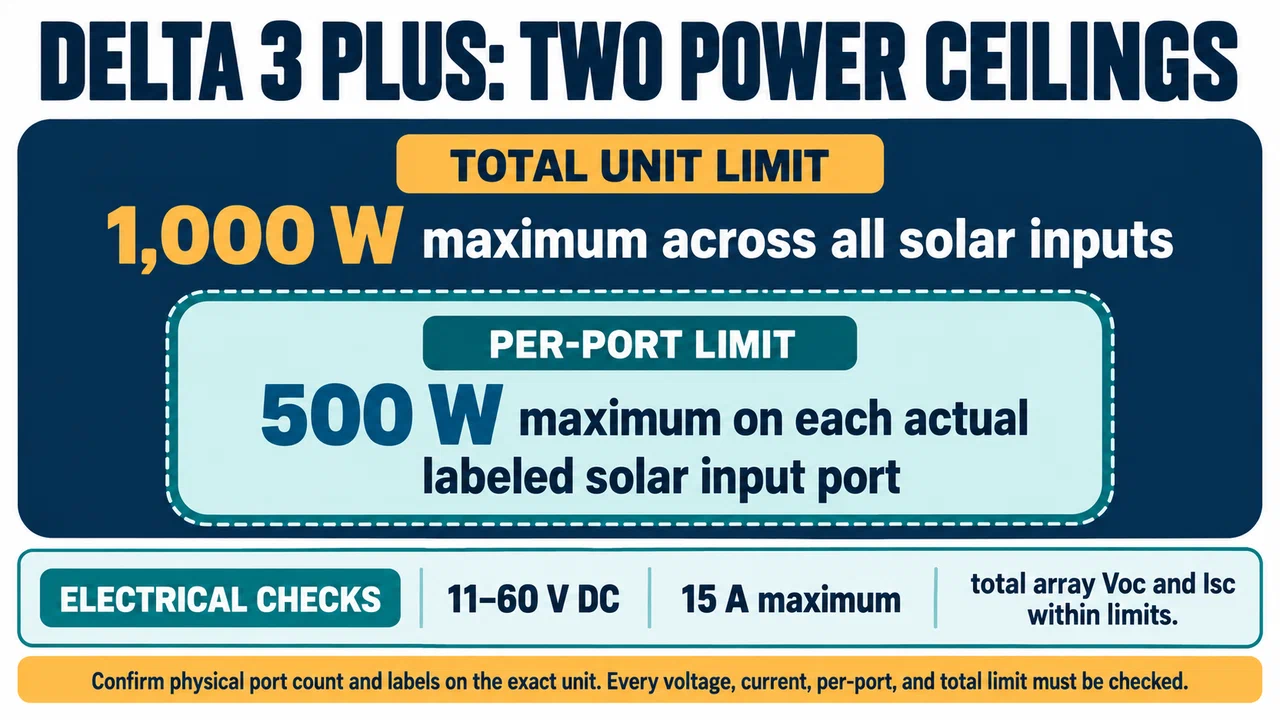
EcoFlow’s DELTA 3 Plus manual identifies model EF-DL-H10-4 and gives a solar input range of 11–60 V DC at up to 15 A, with a maximum of 500 W per port and 1,000 W total. It also lists a separate 12 V, 8 A maximum car input. Keep these values with the DELTA 3 Plus profile; they do not describe the DELTA 3, DELTA 3 Classic, or DELTA 3 Max Plus.
Check every solar ceiling
| DELTA 3 Plus solar check | Manual value |
|---|---|
| Input voltage | 11–60 V DC |
| Maximum input current | 15 A |
| Maximum power per port | 500 W |
| Maximum total solar power | 1,000 W |
| Total array open-circuit voltage | Within 60 V |
| Total array short-circuit current | Within 15 A |
Treat the per-port and total values as separate limits. Do not assume that the total 1,000 W can be placed on one port; the manual also states 500 W maximum per port. The physical port count and port labels should be checked on the exact unit rather than inferred from the power figures. Each proposed path must stay within its own limits, and the total must remain within the aggregate ceiling.
Collect each panel’s operating voltage and current, open-circuit voltage, short-circuit current, power rating, temperature coefficient, and connector details. Apply only series or parallel arrangements described by the panel and station documentation. Series strings raise voltage; parallel branches raise current. Check cold-weather Voc before comparing the array to the 60 V ceiling. Panel nameplate watts alone cannot establish electrical compatibility, and remaining under 1,000 W does not demonstrate that voltage, current, or polarity is acceptable.
The manual lists a solar-to-XT60i cable for solar charging and a separate car charging cable. An adapter that fits an XT60-style port does not make a panel compatible. Verify connector variant, polarity, conductor rating, and station instructions for the exact accessory. The manual does not provide a universal third-party panel approval list or temperature correction for arbitrary panels.
Keep car charging separate
The manual lists car charging at 12 V DC and up to 8 A for this exact model. It says to start the vehicle before connecting and to use the specified car cable. That information does not establish an alternator installation method or vehicle wiring requirement. The car input is not the same thing as a 12 V car output port. Check the vehicle, cable, and station manual rather than transferring values from another EcoFlow model.
Understand input priority and operating temperature
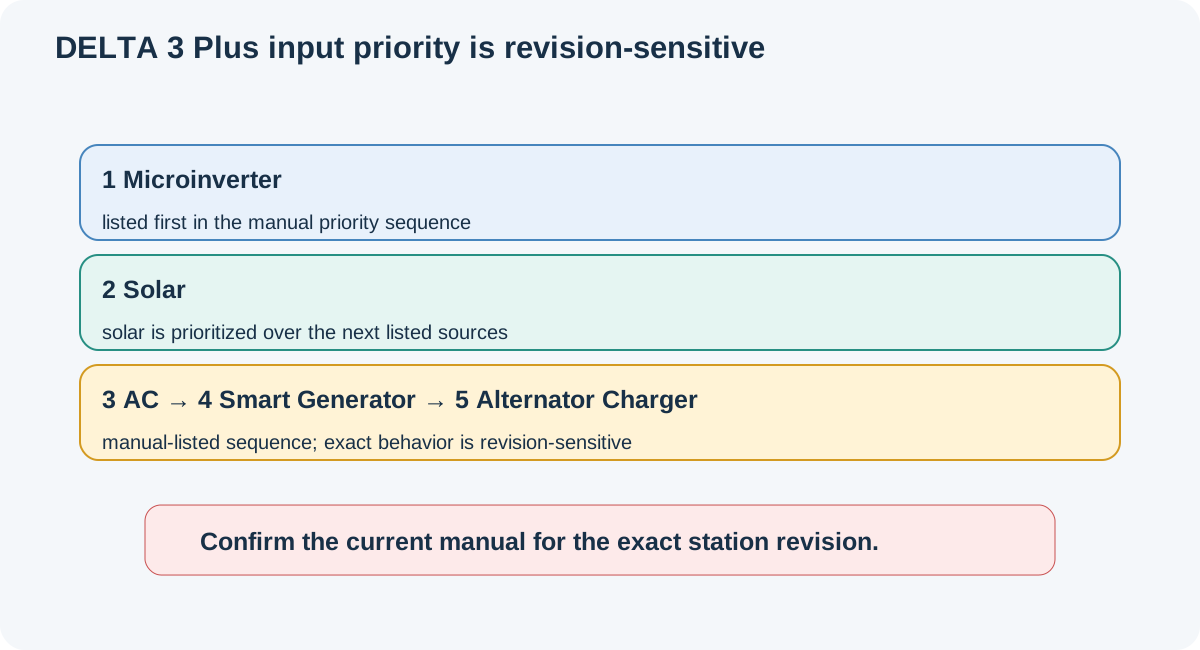
The manual says that when AC and solar are connected, solar is prioritized by default and AC supplements insufficient solar input. It also lists input priority for several charging sources and warns that priority logic may change with product revisions. Treat that as documented behavior for this product revision, not a permanent rule across EcoFlow stations. The manual gives a charging temperature range of 0–45 °C; this is a station charging limit and does not replace the panel’s cold-weather Voc calculation.
The station’s 1,024 Wh capacity is stored-energy information, while 1,000 W describes a maximum PV input. Neither figure predicts daily harvest or recharge time. Sun conditions, orientation, shading, cable losses, and charging behavior affect energy stored. Use the multi-day solar planning guide to budget energy instead of treating the input rating as a daily yield.
If a panel value, cable detail, regional specification, or product revision is unclear, pause before connection and ask EcoFlow using the station label and panel datasheet. For a general compatibility workflow, see the solar sizing guide and the series and parallel guide.
Key points
- The EF-DL-H10-4 manual states 11–60 V, 15 A maximum, 500 W per port, and 1,000 W total.
- Check both per-port and aggregate power limits, plus array Voc and Isc.
- The listed car input is 12 V at 8 A maximum and uses a separate cable path.
- Recheck the exact unit and manual revision before using input-priority or accessory details.