EcoFlow DELTA 3 Max Plus Solar Input Limits
Check the US DELTA 3 Max Plus manual's solar voltage and current limits alongside current US and Canada listings for its PV power ceiling.
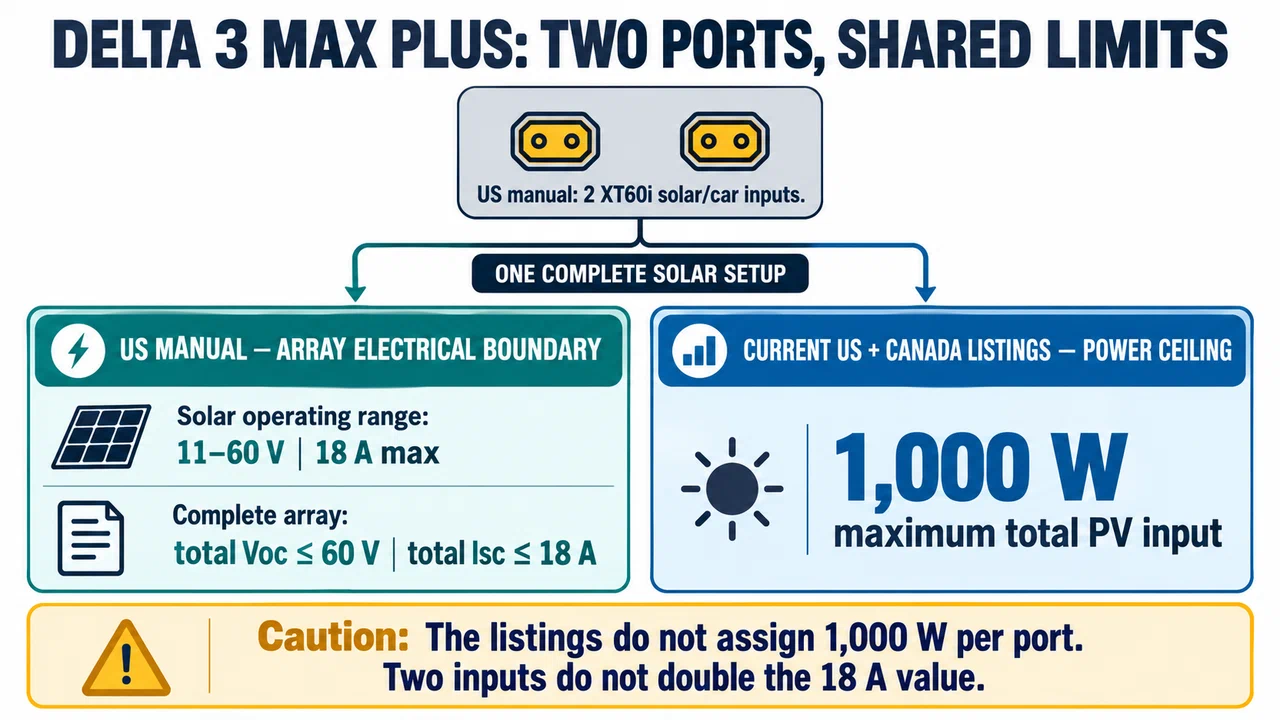
The US EcoFlow DELTA 3 Max Plus manual describes two XT60i input ports for solar or car charging and gives a solar operating range of 11–60 V, with an 18 A maximum. It also requires the complete solar array to remain within 60 V open-circuit voltage and 18 A short-circuit current. Current official US and Canadian product listings each state a 1,000 W maximum PV input. Keep the manual’s electrical limits and listing’s aggregate power ceiling together; neither source makes a third-party panel array automatically compatible.
Input limits stated by the sources
| Check | DELTA 3 Max Plus value | Source scope |
|---|---|---|
| Solar operating voltage | 11–60 V | US manual |
| Maximum solar input current | 18 A | US manual |
| Maximum total array open-circuit voltage | 60 V | US manual |
| Maximum total array short-circuit current | 18 A | US manual |
| Maximum PV input power | 1,000 W | Current US and Canada product listings |
| Input ports | Two XT60i ports for solar/car input | US manual |
Treat 1,000 W as a total PV ceiling from the product listings. The manual does not assign a 1,000 W limit to each port, and its 18 A figure must not be doubled just because there are two ports. Do not combine separate port labels into a higher total without a manual statement that authorizes it. Check the exact port, array, cable, and product revision.
Check the array, not only its wattage
For each panel, obtain the datasheet values for operating voltage and current, open-circuit voltage, short-circuit current, wattage, temperature coefficient, connector, and polarity. Then calculate the complete array using only an arrangement allowed by the panel and station documentation. Series strings add voltage; parallel branches add current. Use the panel’s cold-weather Voc where required, and check the manual’s total Voc and Isc boundaries independently. The 1,000 W power ceiling does not override voltage, current, connector, or polarity limits.
EcoFlow’s manual points readers to the panel documentation for series or parallel details; it does not give a universal wiring recipe or approve every third-party panel. If an array’s cold-weather voltage, current, or connector path is not established, ask EcoFlow with the full station model and panel datasheet before connection. Physical connector fit alone does not demonstrate electrical compatibility.
Preserve the model and regional boundary
The manual is the US version and lists the two XT60i ports as solar/car paths. The product pages cited here are the current US and Canada listings, and both state 1,000 W maximum PV input. These sources support that listing figure for their named product pages; they do not establish identical AC outlets, accessory availability, warranty, or behavior for every regional configuration. Confirm the unit’s label and current regional manual.
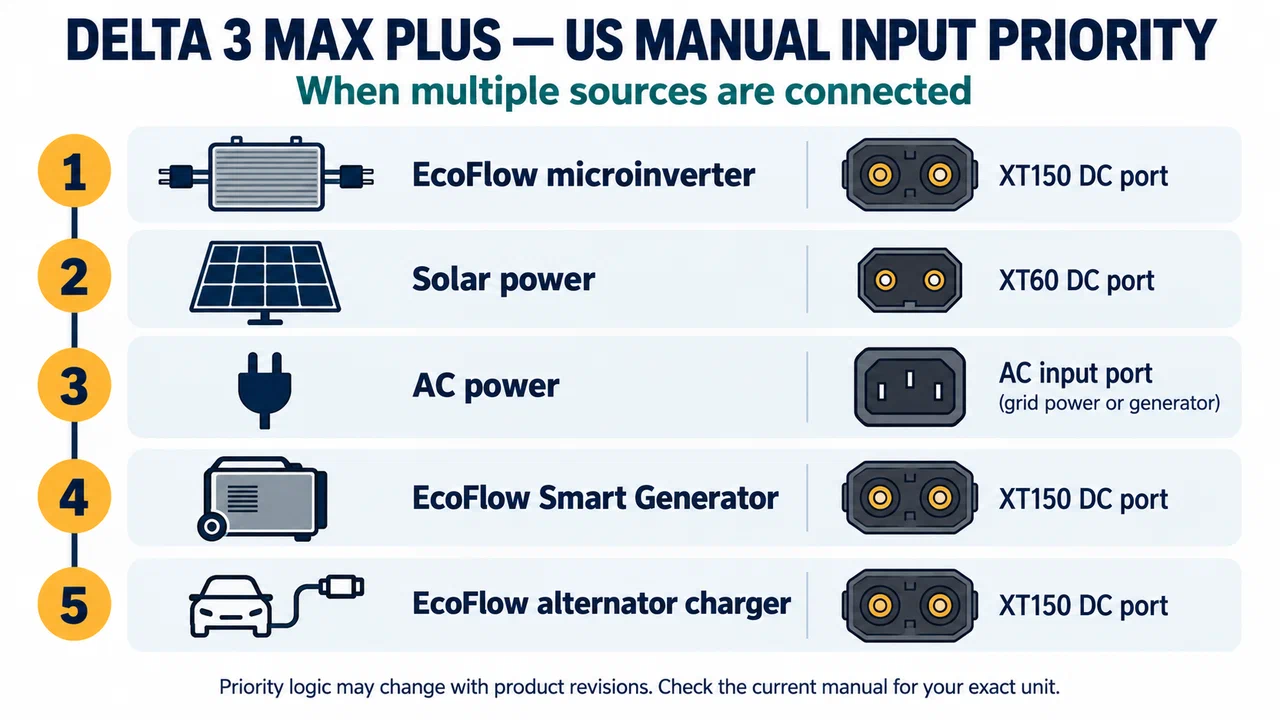
The manual also lists a 0–45 °C charging temperature range. This is the station’s charging boundary, not a panel temperature correction. Its simultaneous-input priority is EcoFlow microinverter, solar, AC, Smart Generator, then alternator charger; EcoFlow warns that product revisions may change priority. Treat that order as revision-sensitive manufacturer guidance rather than a rule shared with other EcoFlow stations.
Keep charging and energy estimates separate
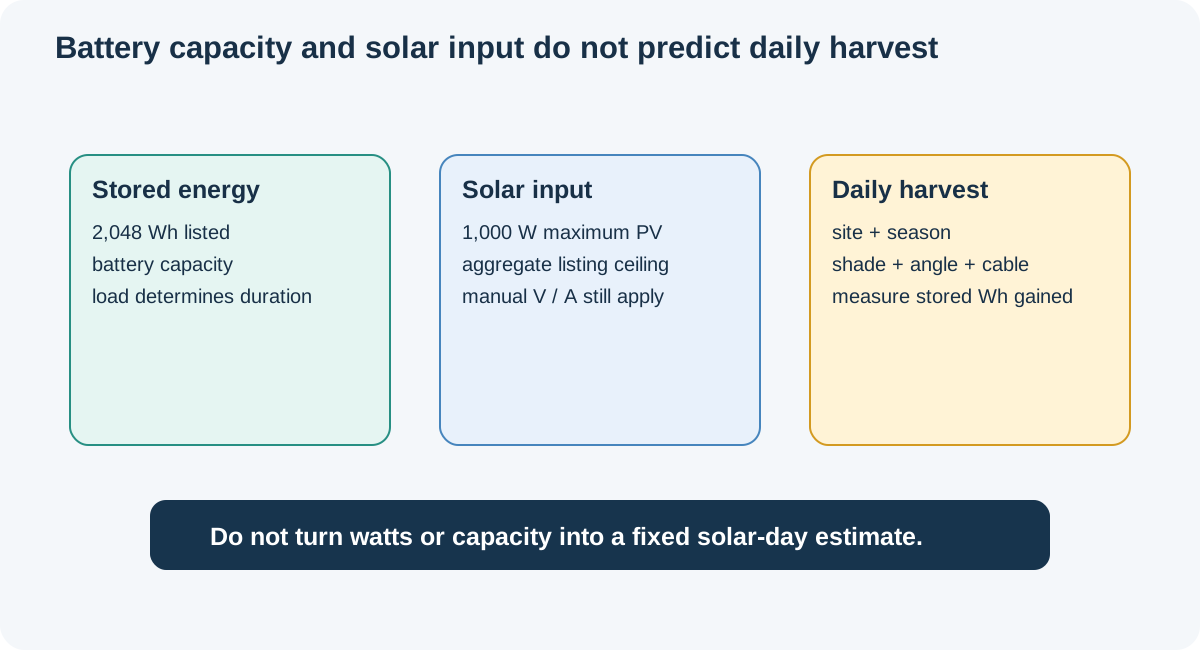
The DELTA 3 Max Plus has a listed 2,048 Wh battery capacity, while 1,000 W is a maximum solar input power. Neither number promises a fixed amount of energy harvested during the day. Weather, shade, angle, temperature, cable losses, charge state, and conversion behavior all affect stored energy. Use a site-specific energy budget with reserve and fallback rather than equating a 1,000 W input rating with 1,000 W sustained production.
The manual supports multiple input sources and specific extra-battery accessories, but the XT150 accessory path has separate compatibility rules. Do not infer solar compatibility from an accessory plug, or an output increase from battery expansion. For a broader method, use the solar input sizing guide, the series and parallel guide, and the DELTA 3 Plus profile for the distinct EF-DL-H10-4 model.
Key points
- The US manual states 11–60 V, 18 A maximum, total Voc within 60 V, and total Isc within 18 A.
- Current official US and Canada product listings state 1,000 W maximum PV input.
- The power ceiling is aggregate; do not read it as a per-port rating.
- Confirm exact regional unit, manual revision, panel data, cable, connector, and polarity.