EcoFlow DELTA 2 Max UK Solar Input and Expansion Limits
Check the UK/AU DELTA 2 Max EFD350 manual's two solar-port limits, car charging, and Smart Extra Battery boundary.
The UK/AU EcoFlow DELTA 2 Max manual V1.0 identifies model EFD350. It lists two solar input ports, each accepting 11–60 V at up to 15 A and 500 W maximum; using both ports raises the stated total maximum to 1,000 W. The manual also describes a separate 12/24 V car charging path and support for up to two Smart Extra Batteries. These details belong to the UK/AU EFD350 documentation and should not be transferred to a US DELTA 2 Max.
Solar input limits
| Solar input check | Per port | Both ports |
|---|---|---|
| Voltage | 11–60 V | 11–60 V per input |
| Maximum current | 15 A | 15 A per input |
| Maximum solar power | 500 W | 1,000 W total |
| Cable path | MC4-to-XT60 adapter | Separate input/cable check for each array |
The manual warns that panel output voltage must be within 60 V before connection. Compare each proposed panel arrangement against voltage, current, and power limits; do not treat the combined 1,000 W figure as a per-port rating. The manual does not approve every third-party panel or give a full matrix of series and parallel configurations. The MC4-XT60 cable description identifies an interface, not approval of a particular panel, polarity, or array.
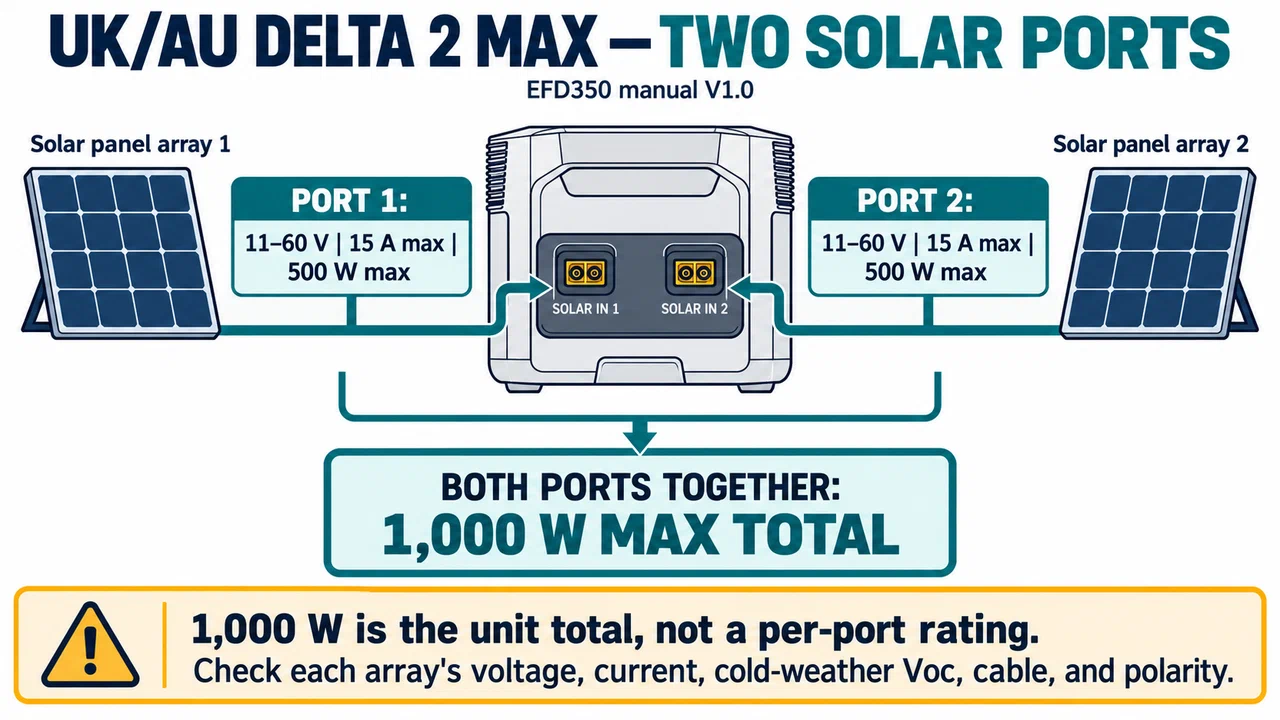
For each panel, check the datasheet for Voc, Vmp, Isc, Imp, rated power, tolerance, and temperature coefficient. Calculate each array using a topology supported by the panel and station documentation. Series panels add voltage, while parallel branches add current. Compare the cold-weather series Voc against the manual’s voltage limit and verify current independently. A watt sum below 500 W on a port does not demonstrate that its voltage and current are safe.
The base manual lists the solar cable and panels separately, so confirm the correct cable and connectors for the actual station. If the label, regional manual, cable, or array details differ from this guide, use the current manual for the unit and ask EcoFlow to verify any unresolved combination.
Car charging and outlet ratings are different
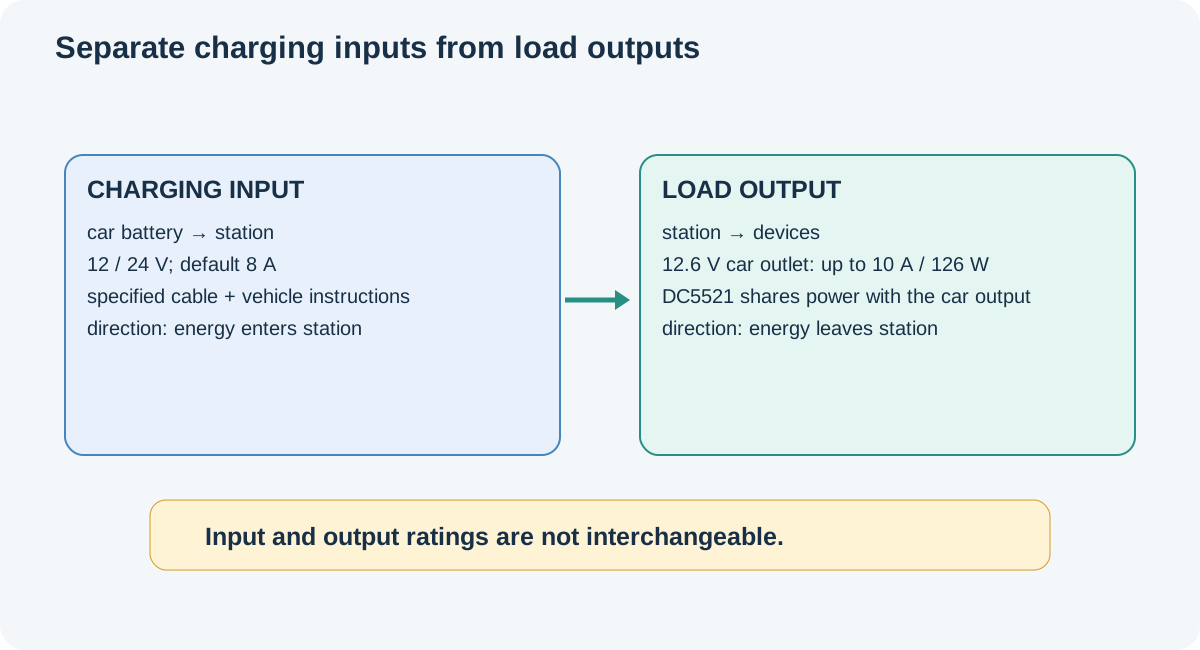
The manual says the car charger can use a 12 V or 24 V battery, with the default current set to 8 A; it directs users to start the vehicle before charging. This is a charging input description, not permission to wire into an alternator or vehicle electrical system. Vehicle charging depends on the specified cable and conditions in the manual.
The same manual separately rates the station’s 12.6 V car output at up to 10 A / 126 W and notes that it shares power with the DC5521 output. A charging input and a load output serve different directions and should not be confused. The two DC5521 outputs have their own current limits; connector shape alone does not establish compatibility with a device.
Expansion does not redefine the PV input
The UK/AU EFD350 manual supports up to two Smart Extra Batteries. It directs users to turn the station and extra battery off before connecting or removing them, avoid touching metal terminals, and confirm the extra-battery icon appears on both displays. Follow the exact battery and station instructions. Additional capacity does not change the documented PV limits or prove that inverter output rises.
The manual also lists a 30 ms EPS transfer figure. That is not a zero-interruption guarantee for a load. Test ordinary equipment only as its manufacturer permits, and seek suitable backup guidance for sensitive or critical equipment. The AC profile is regional as well: this manual gives 230 V output. Check the exact unit before relying on AC, EPS, or accessory information.
For general array calculations, see the solar input sizing guide. The expansion guide separates battery capacity from output capability.
Key points
- UK/AU EFD350: 11–60 V, 15 A, and 500 W per solar input; 1,000 W maximum total.
- The manual names an MC4-XT60 cable path but does not provide universal third-party panel approval.
- Keep car input, 12.6 V car output, and DC5521 outputs separate.
- Confirm regional model and exact accessory before connecting panels or batteries.