EcoFlow DELTA 2 Canada Solar and Car Charging Profile
Review the selected EcoFlow Canada DELTA 2 listing's solar and vehicle-charging figures and the limits of its regional applicability.
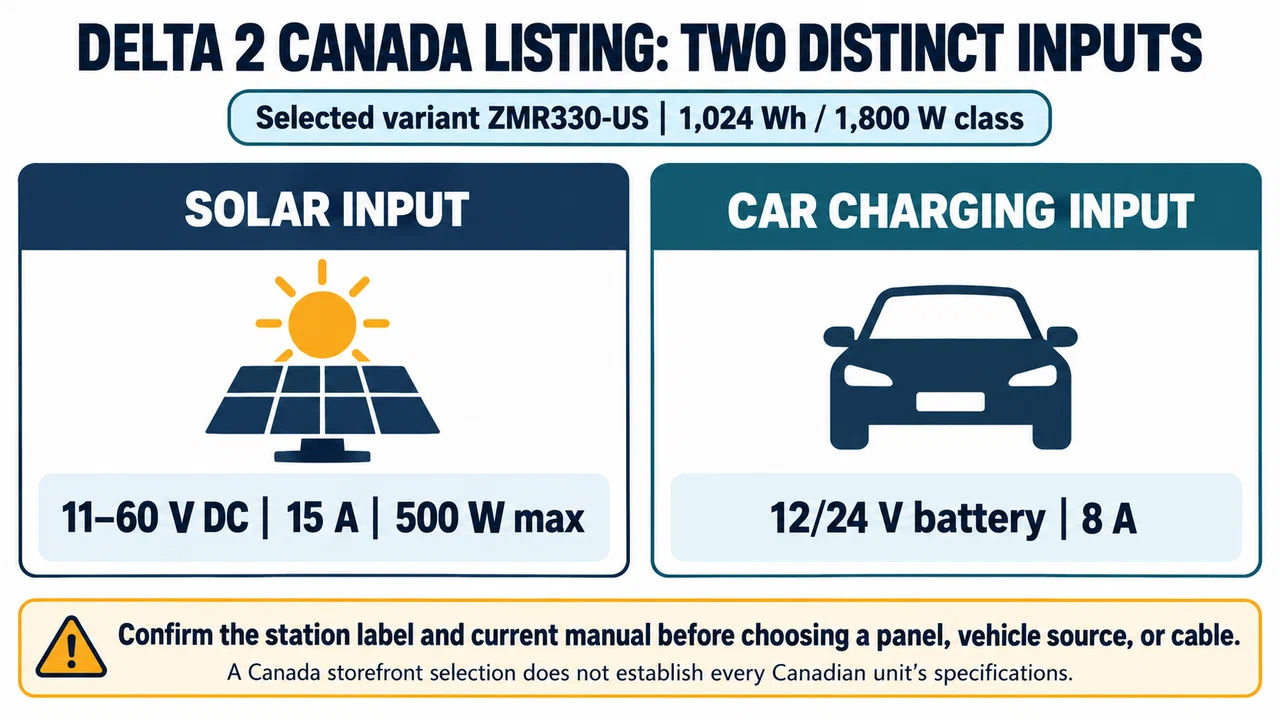
The selected English/CAD EcoFlow Canada DELTA 2 listing identifies variant ZMR330-US and states 11–60 V, 15 A, and 500 W maximum solar input. It also lists charging from a 12 V or 24 V battery at 8 A. The listing describes a 1,024 Wh / 1,800 W product class. These are storefront claims tied to the selected Canadian variant; they do not establish that every DELTA 2 sold in Canada has identical hardware, firmware, cables, or warranty conditions.
Values listed for the selected variant
| Listing detail | Published value | Limit of the source |
|---|---|---|
| Solar input voltage | 11–60 V | A storefront figure; verify the exact unit manual |
| Maximum solar current | 15 A | Does not replace array and cable checks |
| Maximum solar power | 500 W | Input ceiling, not a daily harvest figure |
| Car charging | 12/24 V battery at 8 A | Vehicle and cable requirements need the manual |
| Product class | 1,024 Wh / 1,800 W | Listing-level capacity and output values |
| Selected SKU | ZMR330-US | US-suffixed SKU on the Canadian English/CAD page |
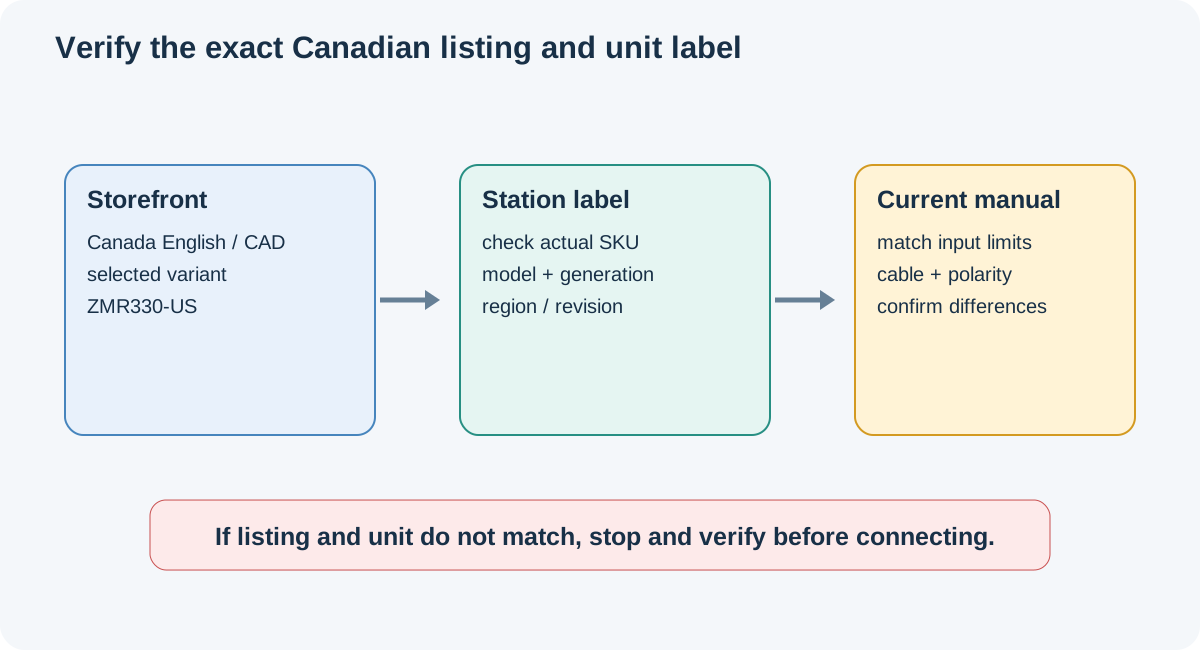
The SKU matters. The listing explicitly selects a US-suffixed variant on a Canadian storefront. Treat the page as evidence for that selection, not as proof that every Canadian DELTA 2 configuration is interchangeable. Confirm the label on your station and obtain its current manual before choosing a panel, vehicle source, or cable.
Solar checks before connection
The 500 W figure is only one solar limit. Check the proposed array’s operating voltage and current, open-circuit voltage, short-circuit current, total power, connector, and polarity against the exact station manual. Cold weather can raise panel open-circuit voltage, so use the panel’s temperature coefficient and the site’s minimum expected module temperature where the manufacturer requires it. A panel set below 500 W can still be unsuitable if its voltage, current, or connector is wrong.
The storefront does not provide a complete third-party panel matrix, a station-side polarity diagram, or a detailed cable and vehicle-accessory list for every Canadian configuration. Do not treat matching plug shape as proof of compatibility. If the manual cannot confirm the panel or cable path, ask EcoFlow with the station SKU and panel datasheet before connection.
Car input is not an installation recipe
The Canada listing states 12/24 V battery charging at 8 A. That value identifies a charging path; it does not tell you how to wire an alternator, size a vehicle circuit, choose a fuse, or install a DC-to-DC charger. Use the specified EcoFlow cable and the exact manual’s vehicle instructions. Do not substitute a generic lead based only on voltage or connector fit.
Vehicle charging input is also distinct from the station’s 12 V output ports, if present on your unit. One supplies energy to the station; the other supplies energy to a connected load. Check direction, current, connector, and polarity for each path. Stop if the current manual for the station label differs from the storefront or leaves a needed vehicle condition unresolved.
Plan around uncertainty
The listed 1,024 Wh capacity is stored energy and the 500 W solar value is a maximum input rating. Neither tells you how much a panel will harvest in a day. Weather, orientation, shading, panel temperature, conversion losses, and battery state affect real charging. Build a reserve and alternate plan instead of treating the maximum input as guaranteed daily energy.
This page is intentionally limited to the selected EcoFlow Canada listing. It does not establish regional equivalence with US product pages or every Canadian SKU. For general panel calculations, use the solar input sizing guide; for vehicle-source planning, see the wall, car, and alternator guide.
Key points
- The selected Canada page lists 11–60 V, 15 A, 500 W solar input and 12/24 V, 8 A car charging.
- The selected SKU is ZMR330-US; confirm the exact station label and current manual.
- The listing does not establish a full panel, cable, polarity, or vehicle-installation matrix.
- Do not infer daily harvest or alternator installation requirements from these headline figures.