BLUETTI Elite 200 V2 Solar Input and Panel Matching
Check the Elite 200 V2 manual's solar voltage, current, and power limits and its rule for matching dual solar panel sets.
The BLUETTI Elite 200 V2 EU English manual V4.0 gives three separate solar limits: 12–60 V, 20 A maximum, and 1,000 W maximum. It permits series or parallel panel arrangements and adds a matching requirement when using dual solar charging: both cable sets must use panels of the same type and power rating. These are Elite 200 V2 manual limits, not general rules for BLUETTI stations.
Read the limits as one boundary
| Check | Manual value | What to compare |
|---|---|---|
| Solar input voltage | 12–60 V | Array operating voltage and the manual’s 60 V open-circuit ceiling |
| Maximum current | 20 A | Array current for the exact supported arrangement |
| Maximum solar power | 1,000 W | Total input power accepted by the station |
| Dual-input matching | Same panel type and power rating on both cable sets | Panel model, rating, and the separate arrays used |
The watt ceiling does not override voltage or current. An array rated below 1,000 W can still exceed 60 V open-circuit or 20 A. Likewise, an array within the voltage range is not automatically acceptable if its current or connector arrangement is outside the manual. Confirm the exact Elite 200 V2 variant and current manual before ordering an adapter or using an existing panel set.
Apply the panel-matching rule
The manual allows series or parallel arrangements, but that sentence is not a complete design for any panel. It also says that for dual solar charging the two cable sets must use panels of the same type and power rating. Its example uses two 200 W panels rated at 20 V and 10 A in series on each set. The example illustrates matching; it is not approval for other panel brands or a direction to use that arrangement.
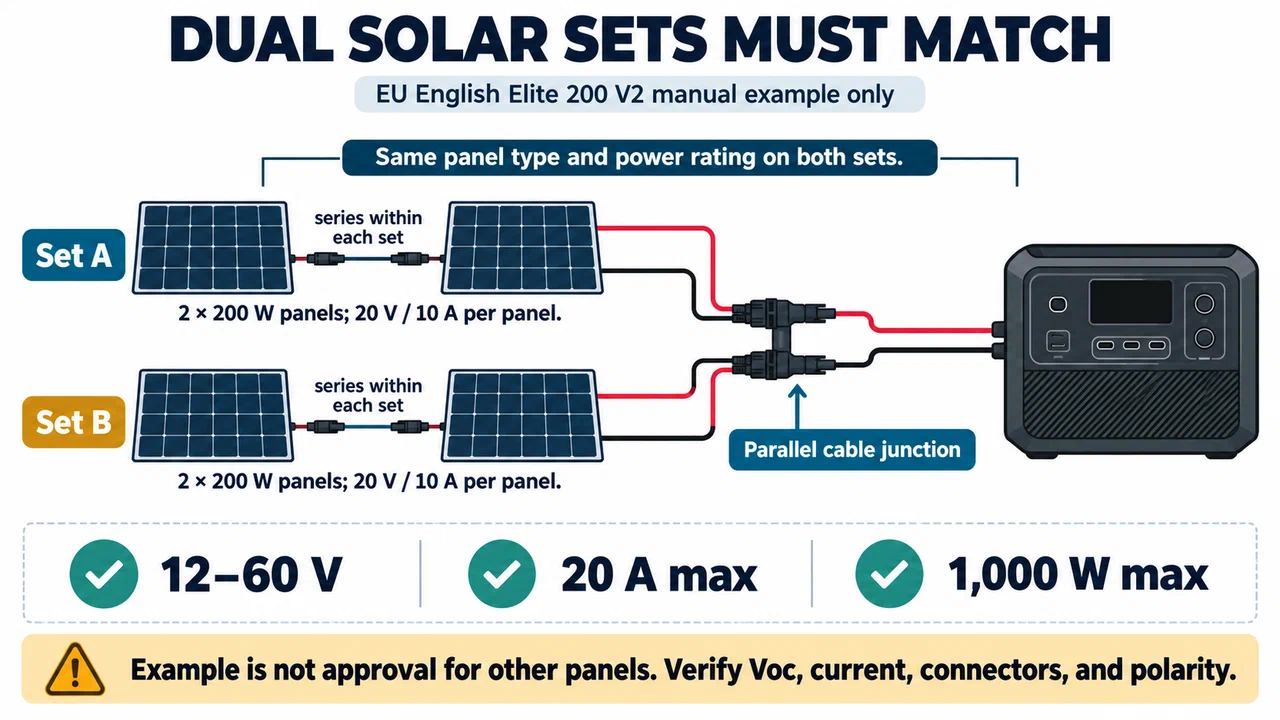
Write down the panel model, Voc, Vmp, Isc, Imp, rated power, temperature coefficient, connector, and polarity. Calculate the proposed string and branches using the array method supported by the manual and panel documentation. Series panels add voltage; parallel branches add current. Check cold-weather open-circuit voltage against 60 V, and check operating values and maximum current separately. Do not assume that two panels with the same watt rating are electrically interchangeable: their voltage, current, connector, and permitted wiring may differ.
If the station is being fed by two sets, compare their model and nameplate rating before connection. A mixed pair that merely totals less than 1,000 W does not meet the manual’s stated dual-set matching rule. When the manual does not explain whether a proposed combination meets that rule, ask BLUETTI with the panel datasheets rather than inferring approval.
Keep energy and output claims distinct
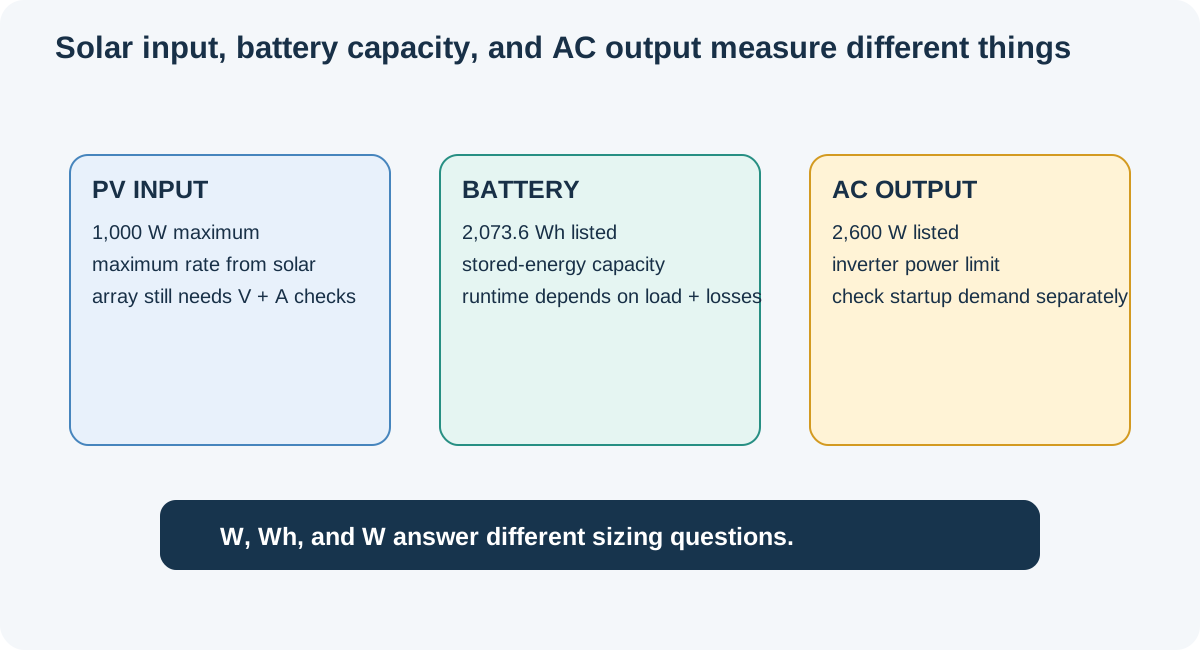
The same manual identifies a 2,073.6 Wh LiFePO4 battery and 2,600 W AC output. Battery capacity, inverter output, and solar input are different ratings. The 1,000 W PV ceiling does not say how much energy the panels will harvest over a day, and the battery capacity does not promise that all stored energy is available to a particular appliance. Shade, orientation, temperature, and conversion losses affect charging.
BLUETTI also lists different charging paths for AC, car, generator, and lead-acid sources. Their cables and operating requirements are separate. The manual specifies a pure sine-wave generator with matching voltage and frequency, and recommends Grid Self-Adaption mode. Verify the regional cable and accessory details in the correct manual. The station’s AC output must not be connected to the utility grid; this solar guide does not provide household wiring instructions.
Use a stop point when a value is missing
Do not connect a panel set until its total voltage, current, power, polarity, and cable path have been checked against the exact unit. If the panel’s temperature coefficient is absent, the manual revision is uncertain, or dual-set matching cannot be confirmed, pause and obtain the missing information. A connector adapter changes physical fit but cannot correct an electrical mismatch.
For the general calculation sequence, use the solar input sizing guide. The series and parallel guide explains the array arithmetic; the cold-weather Voc guide covers why panel voltage needs a temperature check.
Key points
- The EU English V4.0 manual lists 12–60 V, 20 A maximum, and 1,000 W maximum.
- Dual solar sets must use the same panel type and power rating under this manual.
- Check voltage, current, power, polarity, and the exact panel arrangement independently.
- The example configuration is not third-party panel approval or a universal BLUETTI rule.