Anker C1000 Solar Inputs: US Gen 2 vs UK C1000/C1000X
Compare the documented solar-input bands for the US Anker SOLIX C1000 Gen 2 and the separate UK C1000/C1000X models.
“C1000” names cover distinct products and regional specifications. Anker’s US C1000 Gen 2 page and its UK C1000/C1000X guide list different battery capacities, input bands, charging behavior, and expansion options. Use the table to identify the documented profile for the named model and market; it does not establish that the units are interchangeable.
Compare the documented profiles
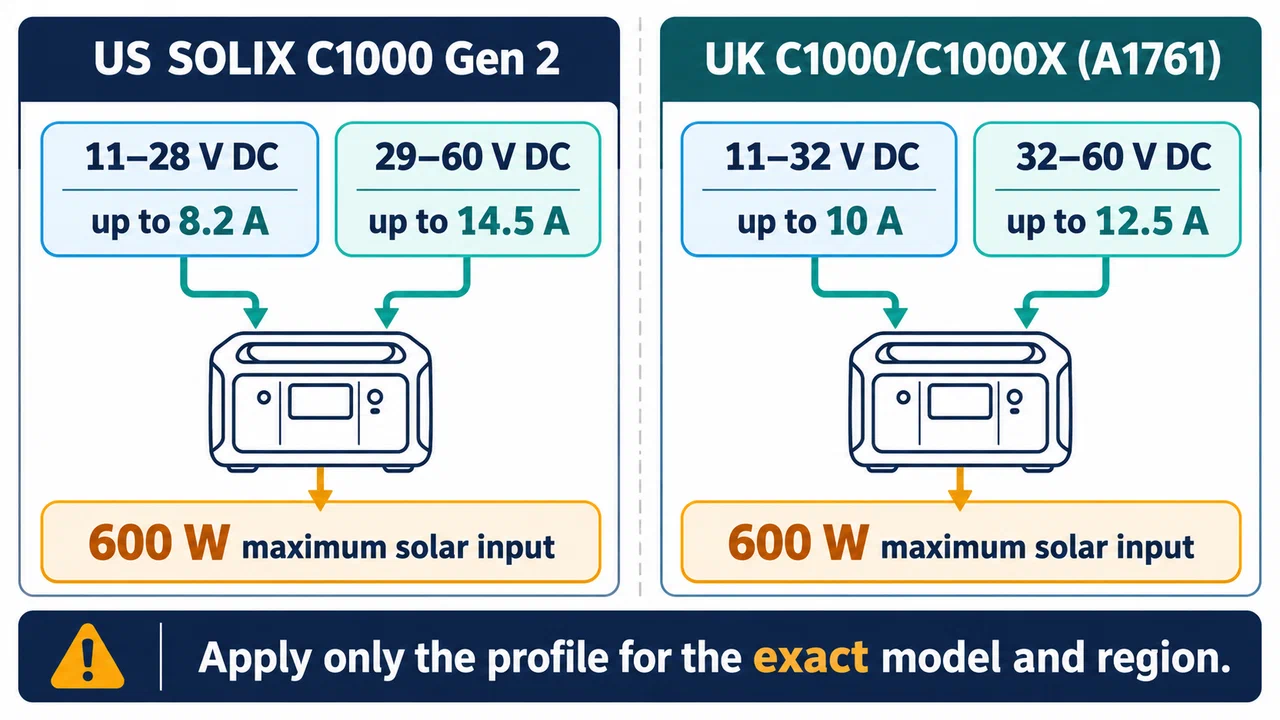
| Listing or guide | Solar input bands | Solar power ceiling | Other documented details |
|---|---|---|---|
| US SOLIX C1000 Gen 2 | 11–28 V DC at up to 8.2 A; 29–60 V DC at up to 14.5 A | 600 W | 1,024 Wh; no capacity expansion listed |
| UK C1000/C1000X guide A1761 | 11–32 V at up to 10 A; 32–60 V at up to 12.5 A | 600 W | 1,056 Wh; up to two panels; one BP1000 expansion is listed |
These are not one shared input specification. The lower and upper bands have different voltage and current ceilings within each profile, and the upper band does not cancel the 600 W total ceiling. A panel set can remain below 600 W and still fall outside the voltage or current limit. The Anker US page describes its specific Gen 2 product, while guide A1761 is explicitly a UK guide for C1000/C1000X.
Identify the unit before choosing panels
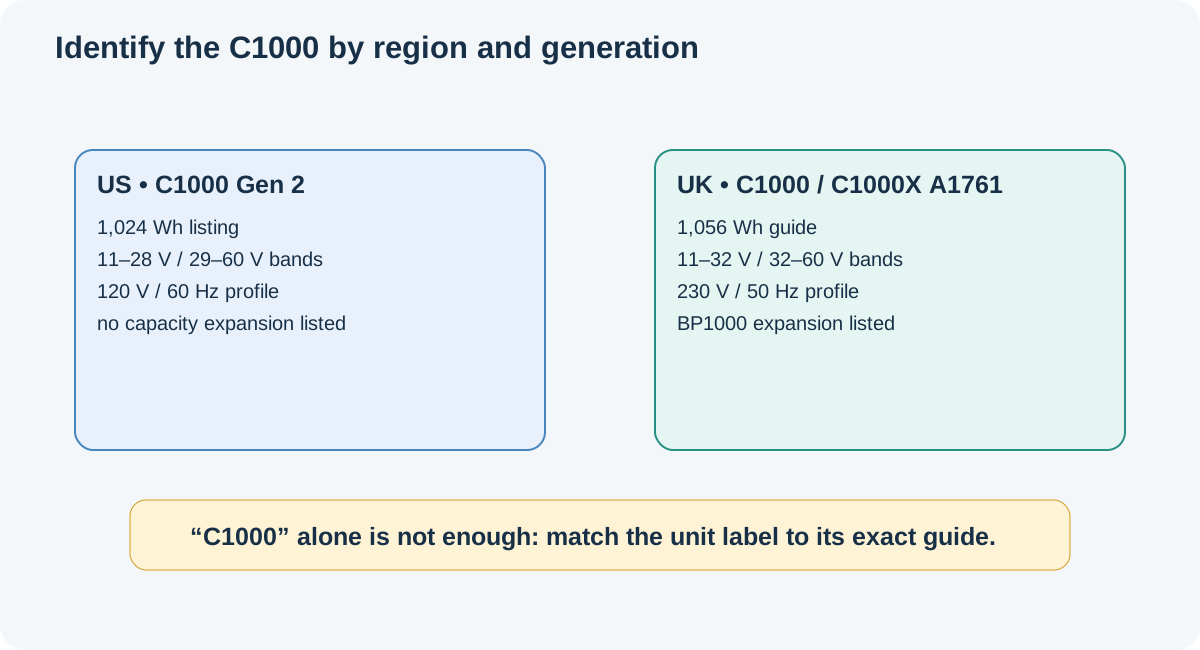
Check the full model name and regional label on the station, then open the corresponding current guide. “C1000” alone is not enough to choose a cable or interpret the MPPT bands. The US C1000 Gen 2 listing identifies a 1,024 Wh unit and says it has no expansion feature. The UK guide covers a 1,056 Wh C1000/C1000X, lists up to two panels, and describes one BP1000 expansion. Those differences are practical clues, but the nameplate and exact manual govern.
For each proposed array, collect panel operating voltage, open-circuit voltage, operating current, short-circuit current, panel count, connector, and polarity from the panel documentation. Compare the values to the correct station profile and the proposed series or parallel layout. Series wiring raises string voltage; parallel branches raise current. The product specifications do not provide a complete third-party panel matrix or cold-weather correction for every panel. If an array’s cold open-circuit voltage, current, or polarity cannot be verified, stop and ask Anker or the panel maker.
The UK guide recommends Anker 200 W or 400 W panels, but that recommendation is not a blanket approval for every third-party panel. Similarly, a connector that physically fits does not prove that the electrical limits or polarity match. Use only the cable and connection arrangement specified for the exact unit.
Keep regional charging details separate
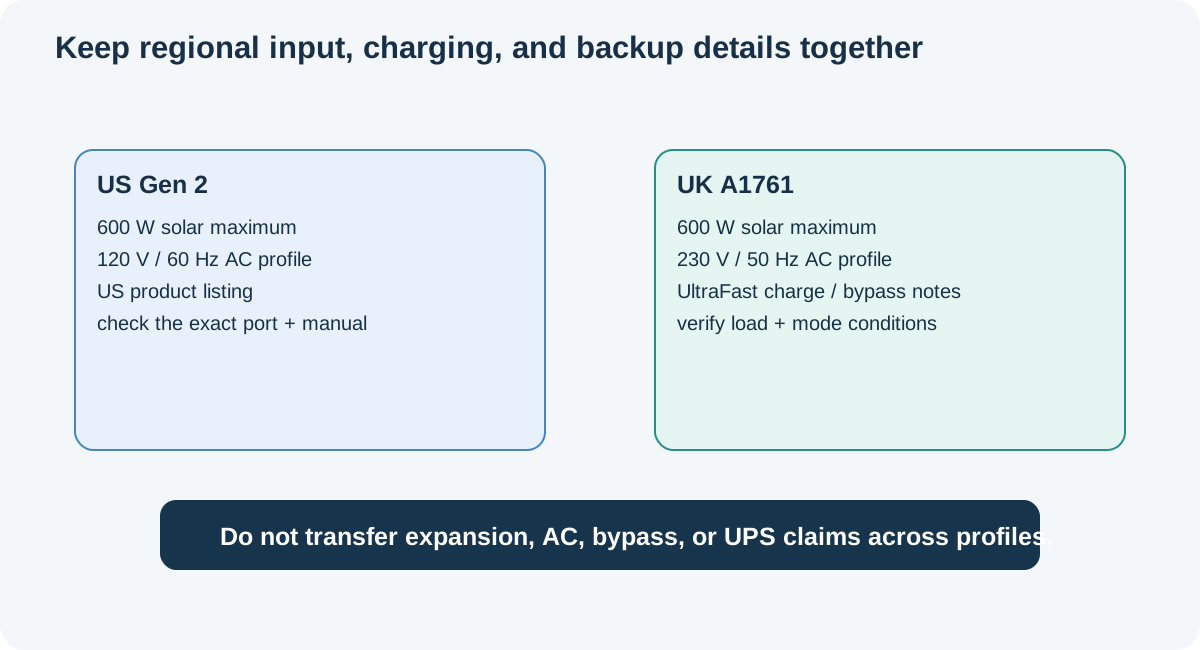
The UK guide describes a 230 V / 50 Hz inverter profile, up to 1,000 W normal AC charging, and up to 1,300 W app-controlled UltraFast charging. Its 20 ms UPS figure is a manufacturer specification, not a no-break guarantee for a particular device. The US Gen 2 listing has a 120 V / 60 Hz profile and different AC charging figures. Do not use AC outlet, charger, or accessory details from one page as a substitute for the other model’s documentation.
The UK guide also says SurgePad is unavailable in bypass mode and is not intended for precision instruments or loads with strict voltage requirements. That qualification belongs to the UK C1000/C1000X guide. If bypass or backup behavior matters, verify the exact unit, operating mode, load requirements, and current guide. A product’s UPS label or transfer figure does not establish that a sensitive appliance will remain on.
Make a bounded compatibility check
Before buying or connecting panels, record the model and market, input band, array voltage and current, total panel power, and the exact cable path. Check each limit independently. Do not add panel nameplate wattages and treat that sum as the station’s solar input, and do not infer real-world harvest from the 600 W ceiling. Sun angle, temperature, shading, and cable losses affect production.
If a value sits at a limit or the current documentation does not state a needed boundary, preserve margin and contact the manufacturer with the station label and panel datasheet. For broader array arithmetic, see the solar input sizing guide and the series and parallel guide.
Key points
- The US C1000 Gen 2 and UK C1000/C1000X have separate documented input bands.
- Both cited profiles state 600 W maximum solar input, but their voltage and current bands differ.
- Confirm region, generation, model label, panel electrical data, cable, and polarity before connection.
- Regional AC, expansion, bypass, and UPS details must stay with the exact guide that states them.