Lion Energy Safari LT: Identity and Regional Output Limits
Read the Safari LT manual's 450 Wh and 500 W profile while keeping its unmapped 120 V and 230 V alternatives and unusual input fields visible.
The Lion Safari LT manual identifies a 450 Wh / 500 W power unit and lists two AC electrical profiles: 120 V at 60 Hz and 230 V at 50 Hz. It does not map those profiles to a country, plug type, or model/SKU number. Treat this as a model-specific manual with unresolved regional identity, not evidence that one physical Safari LT switches between both voltages.
Confirm the unit before applying an AC profile
The manual names the Safari LT and shows the 450 Wh / 500 W headline on its cover. It does not identify a printed SKU or say whether 450 Wh is rated or usable energy. A unit label and matching regional instructions are therefore important before using the output row.
| Manual field | Published value | What the manual does not establish |
|---|---|---|
| Capacity and inverter | 450 Wh / 500 W | Whether capacity is rated or usable; no surge rating is given. |
| AC output alternatives | 120 V / 60 Hz or 230 V / 50 Hz | Which market, plug, SKU, or physical unit corresponds to each alternative. |
| AC waveform | Pure sine wave; THD below 3% under full resistive load | Performance with a specific electronic or motor load. |
| DC output | 9–12.6 V; 5 A per load, 15 A maximum | A complete simultaneous AC/DC/USB budget. |
| Cigarette-lighter output | 12 V, 10 A maximum | Whether other outputs can each reach their maximum at the same time. |
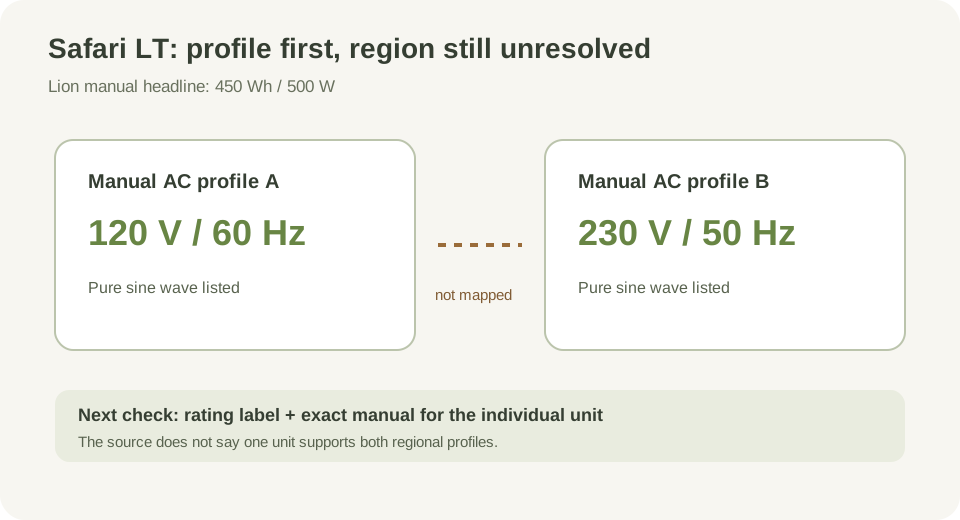
Do not infer a regional version from the retailer, the box’s shipping country, or a matching family name. The model identity guide explains how to pair a nameplate with a market-matched source. Until the exact AC profile is established, do not compare this unit’s output as though its voltage and frequency were known.
Keep the charging paths separate
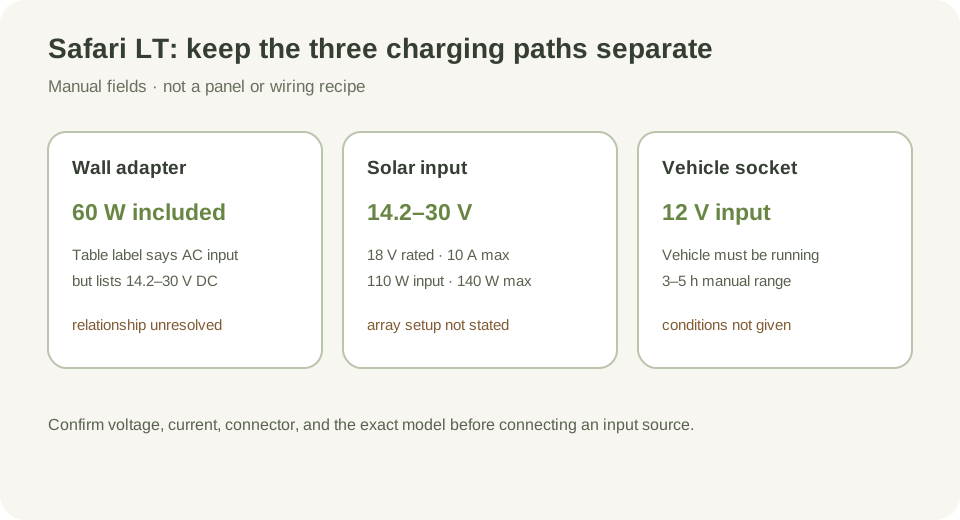
The manual lists wall, solar, and 12 V vehicle charging. Its wall-charging row is labeled “AC Charging Input Voltage,” but the listed input range is 14.2–30 V and the rated row is 20 V / 3 A. The included wall adapter is listed as 60 W, while the manual does not fully reconcile the adapter output with the table’s “AC charging input” label. Preserve that source wording rather than treating the values as a mains-voltage range.
Solar charging is listed at 14.2–30 V, rated 18 V, 10 A maximum, 110 W input power, and 140 W maximum. Those are separate table fields; the manual does not provide a full array-configuration matrix or establish panel compatibility from wattage alone. Vehicle input is through a 12 V cigarette-lighter connection. The manual says the vehicle must be running while charging from that socket and gives a broad 3–5 hour charging range without test conditions.
Read output and operating limits as manufacturer statements
The manual says multiple devices may be used only when their combined requirements remain within 500 W. It lists four DC outputs with 8 A overcurrent-protection fields, a 12 V / 10 A cigarette-lighter output, three USB outputs at up to 5 V / 2.4 A each, and one Type-C QC3.0/PD row with voltage and current combinations. It does not state a complete aggregate allocation across AC, DC, and USB or independently tested output performance.
The manual gives operating temperatures of 32–104 °F, storage of 14–115 °F, and charging of 32–115 °F. It says not to expose or store the unit above 115 °F, not to let the battery freeze, and not to charge a frozen battery. For infrequent storage, it says to avoid full discharge, charge fully before storage, and recharge at least every three to six months. These are manual instructions, not independent safety or certification results.
What remains unknown
The reviewed manual does not establish battery chemistry, usable energy, surge power, exact regional SKU mapping, a complete outlet map, grounding, pass-through or UPS behavior, or named-device runtime. Charge-time ranges lack a stated test protocol. Use the 450 Wh / 500 W description as a manual headline, then resolve the exact AC profile and accessory limits for the individual unit. The specification decoder shows how to keep source labels and missing values visible when comparing this model with another station.