Enphase IQ PowerPack 1500 U.S.: Output, Input, and Pass-Through Limits
Read the Enphase IQ PowerPack 1500 U.S. data sheet without mixing VA-rated battery output, timed pass-through, and separate charging inputs.
The Enphase IQ PowerPack 1500 data sheet identifies model PES-1515-BL-US and describes a 120 V, 60 Hz, single-phase unit. Its four AC receptacles, battery output, pass-through path, and charging inputs have separate ratings. Read the exact data-sheet rows rather than treating the product’s 1,500 name as a watt rating for every operating mode.
Start with the identity and output units
The data sheet lists an integrated lithium iron phosphate battery and Enphase IQ8 microinverter. It gives 1,532 Wh rated battery capacity and 1,500 Wh usable capacity. Those are manufacturer-published energy values, not a measured runtime for a particular appliance. The listed model is PES-1515-BL-US; the data sheet does not establish an equivalent non-U.S. electrical profile.
| Data-sheet field | Published value | Keep in view |
|---|---|---|
| AC battery output | 1,500 VA maximum continuous | The source uses VA; retain that unit rather than silently rewriting it as watts. |
| AC overload | 3,000 VA for two seconds | A duration-qualified overload field is not a continuous output rating. |
| AC receptacles | Four, 120 V | The sheet does not give a full concurrent AC, USB, and DC allocation. |
| AC pass-through | 1,800 VA, 15 A maximum | This is a separate path from battery inverter output. |
| Battery energy | 1,532 Wh rated; 1,500 Wh usable | Neither figure is an appliance runtime guarantee. |
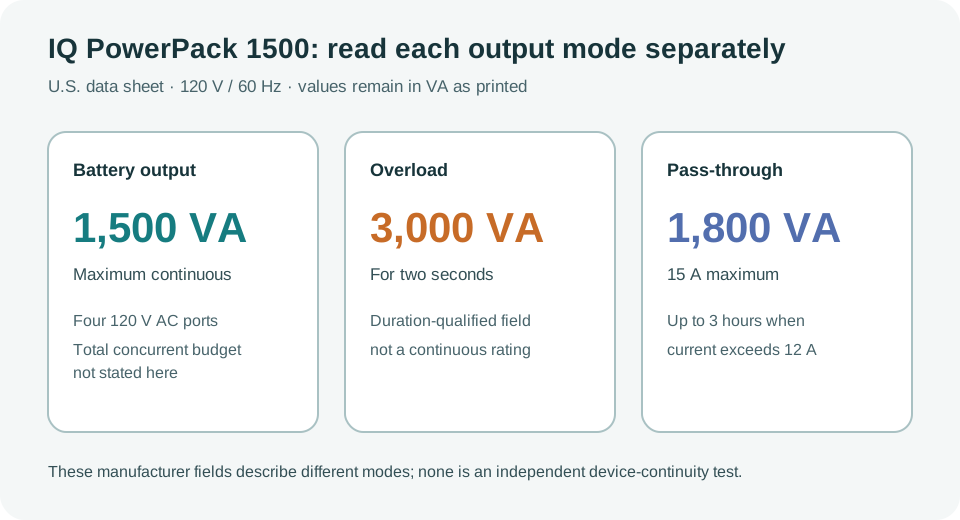
The difference between VA and W matters when comparing sources. The data sheet preserves VA in its AC output and pass-through rows and does not state a general power factor for converting those values. Keep its printed units, voltage, and operating mode beside each number. Do not add individual outlet labels or assume that several ports can each deliver their maximum simultaneously.
Treat pass-through as its own operating condition
Enphase lists up to 1,800 VA and 15 A for AC pass-through. The same row states that this is available for up to three hours when current exceeds 12 A. That time condition belongs to the pass-through row; it does not describe battery-only inverter operation, a transfer-time test, or the duration a connected device will remain powered through a grid event.
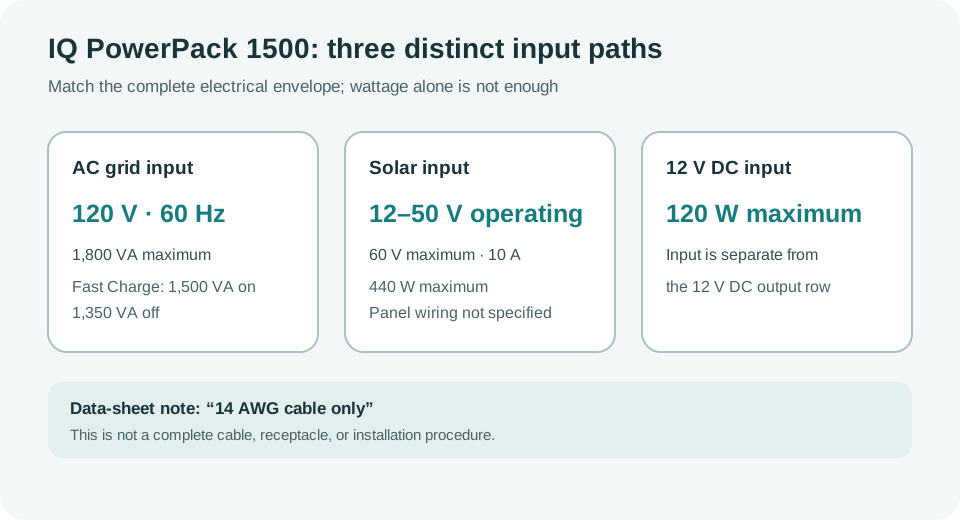
The sheet also lists AC grid input at 120 V line-to-neutral, 15 A, 60 Hz, and 1,800 VA maximum. It gives 1,500 VA with Fast Charge on and 1,350 VA with Fast Charge off. These input fields should not be merged with the 1,500 VA continuous battery-output rating. The data sheet does not provide a complete bypass sequence or independent continuity results for named devices.
Check the input envelope, not just a panel label
The solar input is listed for 12–50 V operating, 60 V maximum, 10 A, and 440 W maximum. All of those limits apply together. The data sheet does not provide a complete panel-wiring procedure or establish compatibility for a particular panel just because its label is below 440 W. The separate 12 V DC input is listed at up to 120 W; do not confuse that input with the 12 V DC output, which is listed at up to 10 A and 120 W.
The AC input row includes the manufacturer’s note “14 AWG cable only.” That note is a source constraint, not a complete cable-selection or installation procedure. The data sheet alone does not establish receptacle, extension-cord, grounding, protection, or installation requirements. Follow the matching current instructions for the exact unit.
Keep runtime and device-fit claims bounded
The sheet lists AC round-trip efficiency above 80 percent and a claim of 2,500 cycles to 65 percent capacity. It does not provide the test procedure or conditions in the selected material. Those are manufacturer statements, not independent measurements. The stated 1,500 Wh usable capacity can help identify the model’s published energy basis, but actual duration depends on the connected load, conversion losses, operating mode, reserve behavior, and conditions the data sheet does not fully specify.
The source also does not establish a total simultaneous allocation across AC, USB, and DC outputs, solar-panel wiring, transfer behavior with a named device, or the exact duration and behavior after the pass-through condition ends. For a shortlist, record PES-1515-BL-US, 120 V / 60 Hz, the source version, the relevant VA-rated field, and any unknown needed for the intended load. The specification decoder explains why mode and unit labels must stay attached; the transfer-time guide explains what these data-sheet fields do not establish about continuity.