EcoFlow RIVER 2 (240) U.S.: Capacity, Ports, and EPS Claim
Separate the RIVER 2 (240) U.S. page's 240 Wh name from its 243 Wh table field, and keep output, charging, X-Boost, and EPS claims scoped.
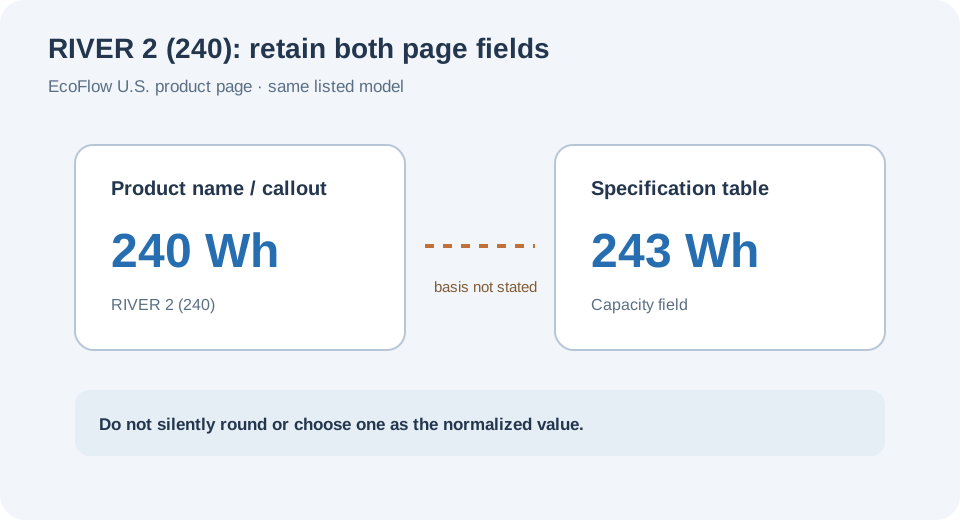
EcoFlow’s U.S. listing calls this model RIVER 2 (240) and describes a 240 Wh / 300 W portable station. Its specification table lists 243 Wh capacity, a 300 W AC output, and several separate input and output rows. Keep the model label, marketing callout, and table value together; the page does not explain the basis for the three-watt-hour difference.
Read the identity and AC fields from the same page
The exact page names RIVER 2 (240) and shows a 120 V, 50–60 Hz profile. It lists LFP chemistry, 300 W AC output, and 600 W surge. The table does not give surge duration. Do not merge this page with the RIVER 2 Pro or RIVER 2 Max, or infer a model number from a related product family.
| Field | U.S. page value | Boundary |
|---|---|---|
| Model name / capacity callout | RIVER 2 (240); 240 Wh | Marketing name and callout. |
| Specification-table capacity | 243 Wh | The capacity basis is not stated; retain the distinction. |
| Battery chemistry | LFP | Manufacturer-listed chemistry; the page does not give independent cycle testing. |
| AC output | 120 V, 50–60 Hz, 300 W | Manufacturer rating; waveform and outlet count are not established in the table. |
| Surge | 600 W | Duration and test conditions are not given. |
| DC output | 12.6 V, 8 A, 100 W maximum | A port rating does not define aggregate concurrent output. |
The page also advertises X-Boost up to 600 W. That feature claim is separate from the 600 W surge field. The page does not provide enough test conditions to treat either figure as evidence that a named appliance will start or run. Compare a device’s normal requirement with the rated output first, then check any relevant startup, waveform, voltage, and feature limits in the matching instructions.
Keep charging inputs separate
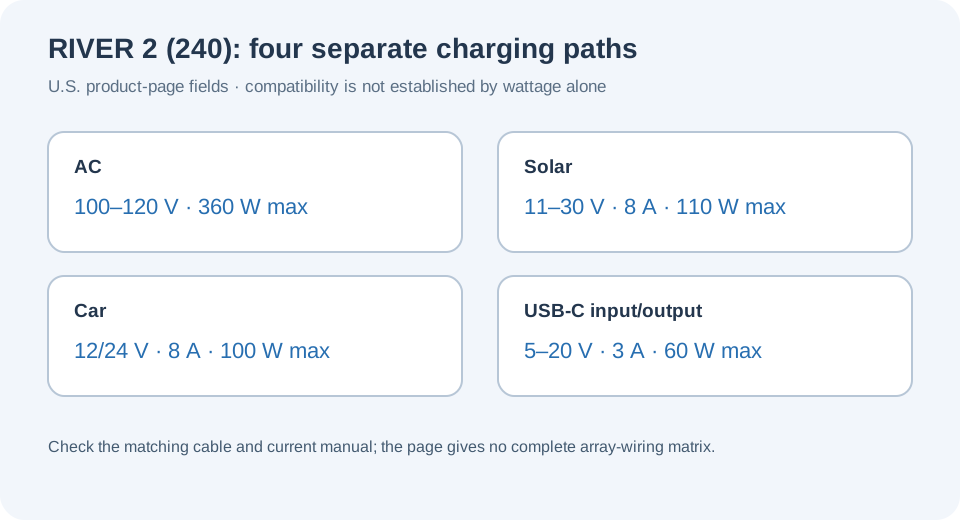
The specification table lists AC input at 100–120 V, 50/60 Hz, and up to 360 W. Solar input is 11–30 V, 8 A, and up to 110 W. Car input is 12/24 V, 8 A, and up to 100 W. USB-C input/output is listed at 5/9/12/15/20 V, 3 A, and up to 60 W. Those are separate source rows; a matching wattage does not prove that a panel, cable, or vehicle path is compatible.
The page’s DC5521 output field is a dash. Preserve that displayed source field instead of turning it into a broader claim about every hardware revision. It lists one 12.6 V / 8 A DC row, USB-A at up to 12 W, and Wi-Fi/Bluetooth control, but does not state a complete simultaneous-output budget. Check current instructions for the exact unit and keep charge input separate from output ports.
Treat EPS as a manufacturer claim, not a continuity result
EcoFlow’s page claims an EPS auto-switch under 30 ms for essential devices. The page does not identify the test setup, applicable outlets, firmware, allowed load, or a named-device continuity result. The claim is not the same as a verified no-break transfer. Determine whether the connected device can tolerate the interruption and consult the exact instructions before relying on the function.
The listing does not establish usable capacity, AC conversion efficiency, runtime for a named load, a surge duration, expansion support, or current availability over time. Its capture-time sale status can change and is not a capability field. For comparison, record the exact U.S. model label, the 240 Wh callout, the 243 Wh table value, and the mode attached to each output figure. The transfer-time guide explains the gap between a manufacturer switching-time claim and device-specific behavior.