EcoFlow DELTA 2 Capability and Runtime Inputs
Check the DELTA 2 manual's model-specific output, charging, expansion, timeout, and medical-equipment limits before estimating runtime.
Use the DELTA 2 manual for the exact DELTA 2 unit, then check the rating label and market before applying regional output values. The V1.0 manual is a 230 V profile; current U.S. and Canada product pages are separate North American sources. The supplied U.S. product URL is currently labeled DELTA 2, so do not repeat the earlier claim that it currently resolves to a DELTA 3 page.
Start with the manual’s output limits
The DELTA 2 V1.0 manual lists a nominal 1,024 Wh battery, 1,800 W total pure-sine AC output, a 2,700 W surge, and maximum X-Boost output of 2,400 W for its 230 V profile. Current U.S. and Canada product pages state 1,800 W output with X-Boost up to 2,200 W. These numbers answer different questions and belong to different source profiles. Capacity is stored energy; 1,800 W is the stated AC output ceiling; surge is a short-duration peak; X-Boost is a separate mode. The manual says X-Boost is unsuitable for equipment with strict voltage requirements. It is not a higher continuous rating and does not establish compatibility with a motor, compressor, or sensitive device.
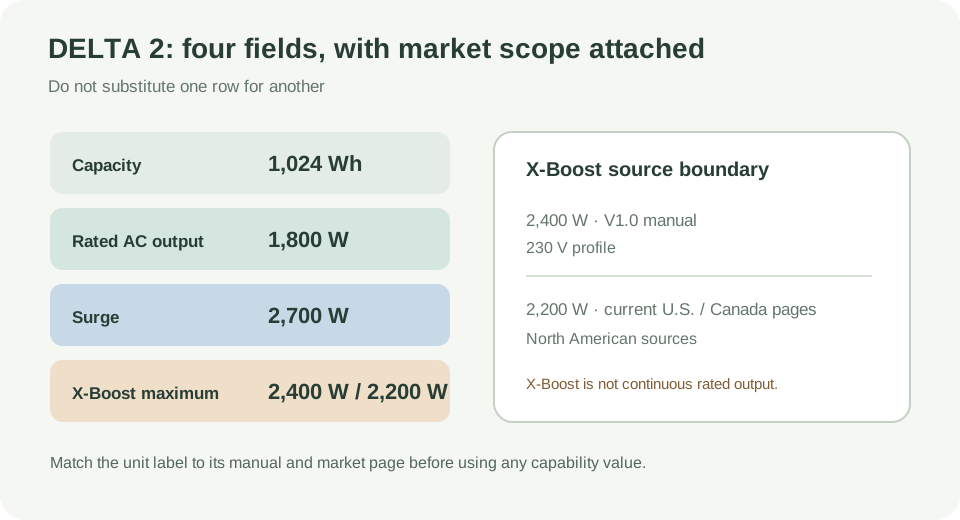
Check the specific AC variant on the manual and device label. The V1.0 manual used here is a 230 V profile. Do not apply North American values to a 230 V / 50 Hz unit, or transfer specifications from a DELTA 3 Classic because its name and capacity class look similar. The U.S. and Canada product pages each identify DELTA 2 and state up to 2,200 W with X-Boost; they do not make the manual’s 2,400 W field a North American rating.
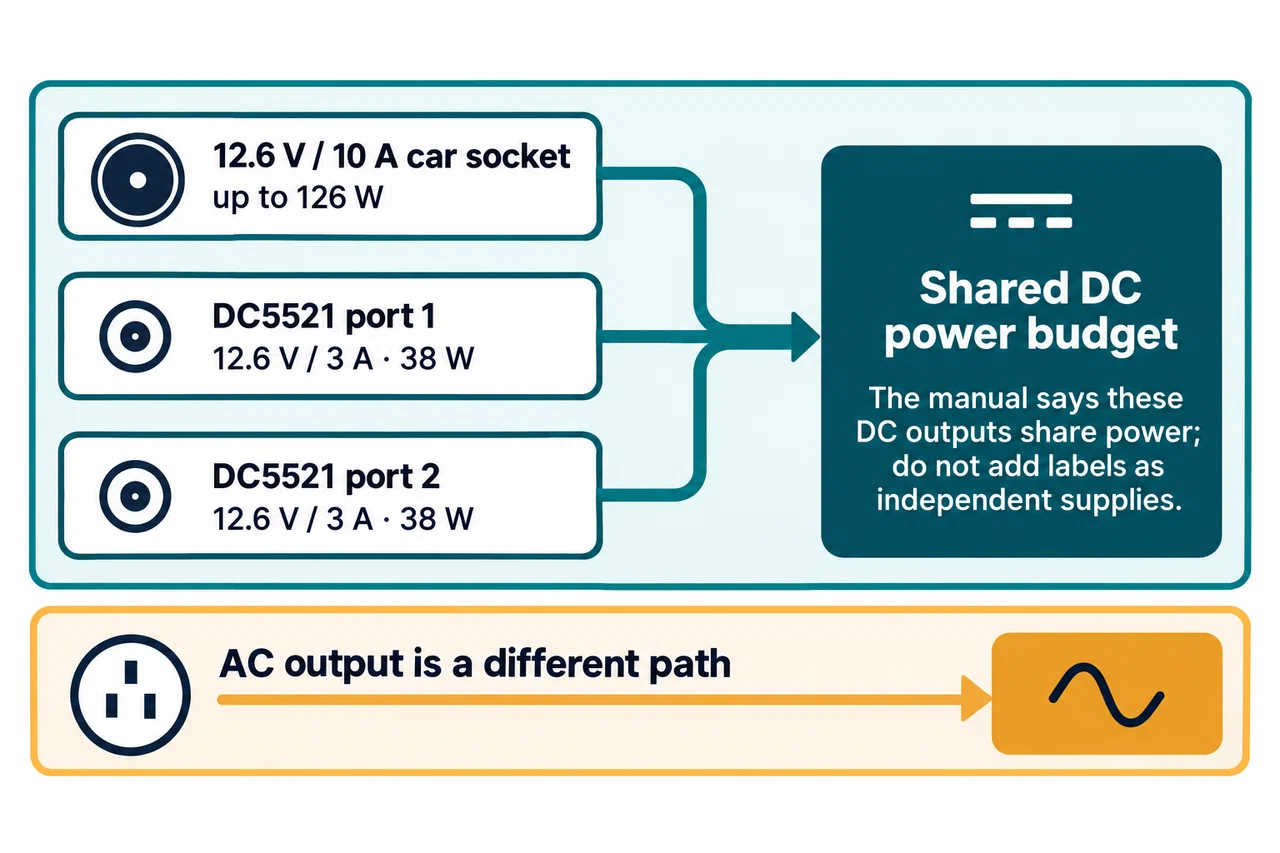
The 12.6 V/10 A car socket is rated up to 126 W. Two DC5521 ports are listed at 12.6 V/3 A and 38 W per port. The manual states that the car output shares power with the DC5521 outputs, so do not add every port’s label as if each had an independent supply budget. Confirm the combined limit in the manual for your exact setup.
Build a runtime estimate from actual load data
Start with the 1,024 Wh nominal capacity, but do not assume that all of it reaches an appliance. Usable energy depends on inverter losses, reserve behavior, temperature, output mode, and the connected load. Measure the load where practical, including compressor cycling or other intermittent demand, and treat a calculated result as an estimate rather than a guaranteed duration.
The station’s own consumption matters at low loads. If AC is enabled while little power is being drawn, the inverter may consume a substantial share of the energy that would otherwise reach the device. Include standby draw in a low-load estimate when a trustworthy exact-mode figure is available. Do not borrow an efficiency or self-consumption value from another EcoFlow model.
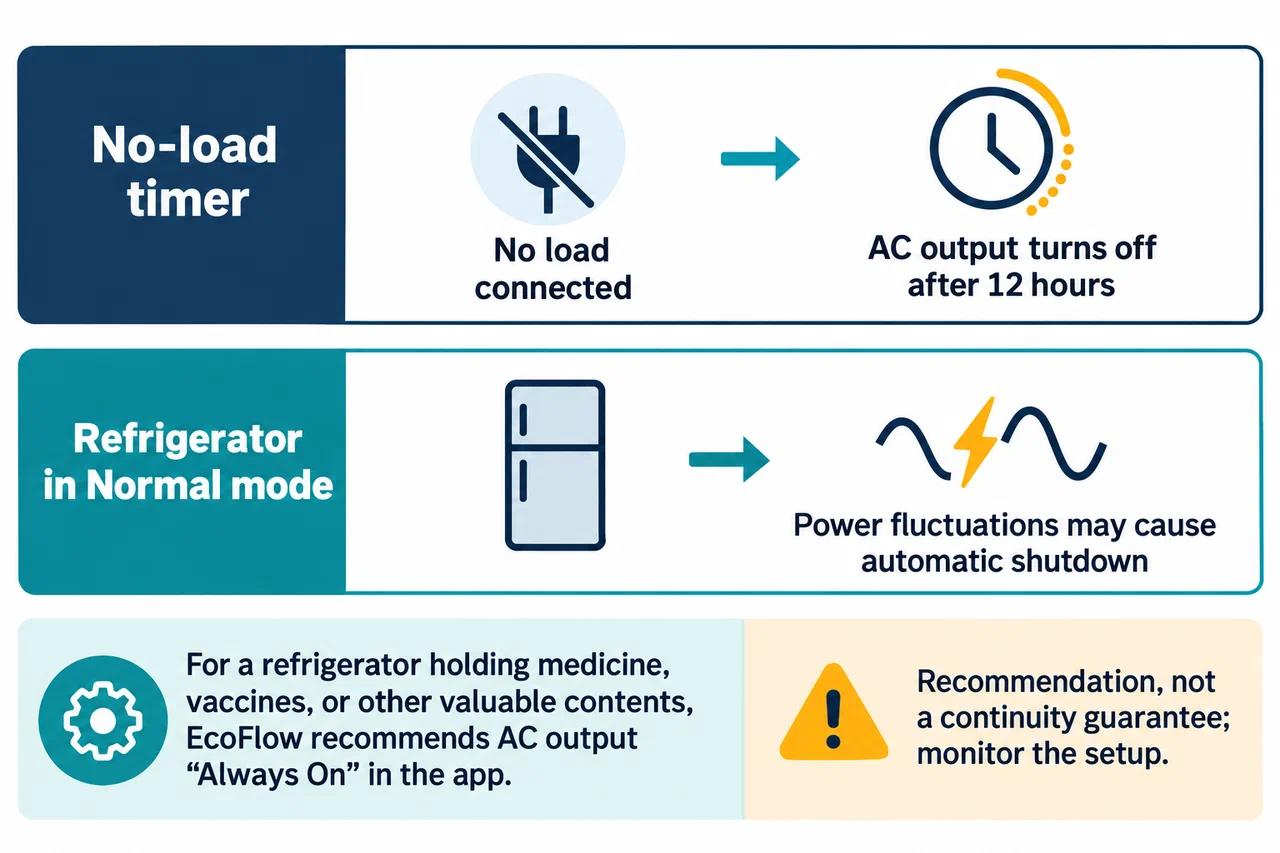
The manual describes two separate shutdown cases. First, AC output turns off after 12 hours when no load is connected. Separately, power fluctuations when a refrigerator is connected in Normal mode may cause an automatic shutdown. For a refrigerator holding medicine, vaccines, or other valuable contents, EcoFlow recommends setting AC output to Always On in the app. This setting is a manufacturer recommendation, not a guarantee of uninterrupted power; monitor the station and refrigerator and verify the manual for the exact unit.
Check inputs and expansion separately
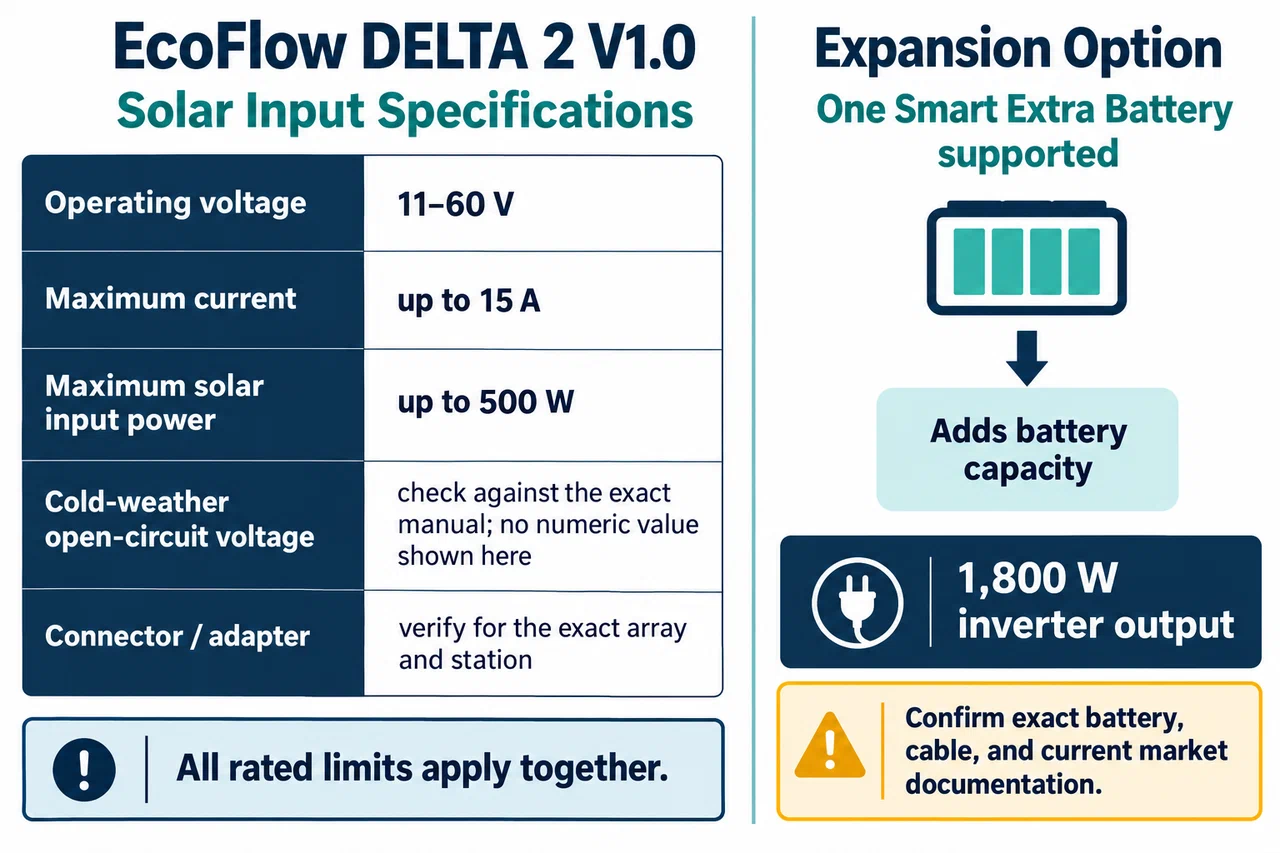
The manual lists solar input of 11–60 V, up to 15 A and 500 W. All limits apply together. Verify panel open-circuit voltage in the coldest expected conditions, operating voltage, current, connector and any adapter before connecting an array. A 500 W label does not make every 500 W panel configuration safe.
The DELTA 2 supports one Smart Extra Battery according to the manual. Expansion can add battery capacity, but it does not turn the 1,800 W inverter into a higher-output model. Confirm the exact battery and cable against the current market-specific documentation before purchase. Do not infer compatibility with a DELTA Max battery or a different generation from a separate regional product page.
Respect the medical-equipment warning
The manual says the DELTA 2 is not recommended for medical emergency equipment related to personal safety, including medical-grade ventilators and hospital CPAP. It directs users to follow a doctor’s instructions and consult the medical-equipment manufacturer. For general medical equipment, the manual calls for monitoring power status. A device appearing to fit within the wattage rating does not override that warning.
For outage coverage, also check the exact regional manual’s EPS wording and transition time. A transfer feature does not establish no-break operation or suitability for critical equipment. See the UPS and transfer-time guide for the questions to ask before relying on a station as backup.