Charge-While-Running, Pass-Through, and Solar-Generator Behavior
Separate simultaneous charging, bypass, and backup transfer claims, then check the exact station mode and load limits.
“Charge while running” can mean several different things: the station accepts energy while powering a load, an AC bypass path supplies a connected outlet, or a UPS/EPS mode transfers a load to battery after the grid fails. A “solar generator” bundle name says even less about those electrical behaviors. Check the exact station, source, output, and mode in its current manual.
Keep the terms distinct
| Term | What it may describe | What it does not prove |
|---|---|---|
| Simultaneous charge and discharge | An input and one or more outputs operate at the same time | A fixed net charge rate, uninterrupted output, or support on every port |
| Pass-through | A manufacturer-defined path for charging while powering a load | Zero interruption, grid-tie operation, or suitability for a critical appliance |
| Bypass | An AC input passes to an AC load under a documented mode | That the battery is fully charged or that the load rides through an outage |
| UPS/EPS | A model-specific switch to battery after input loss | A zero-millisecond transfer or compatibility with every electronic load |
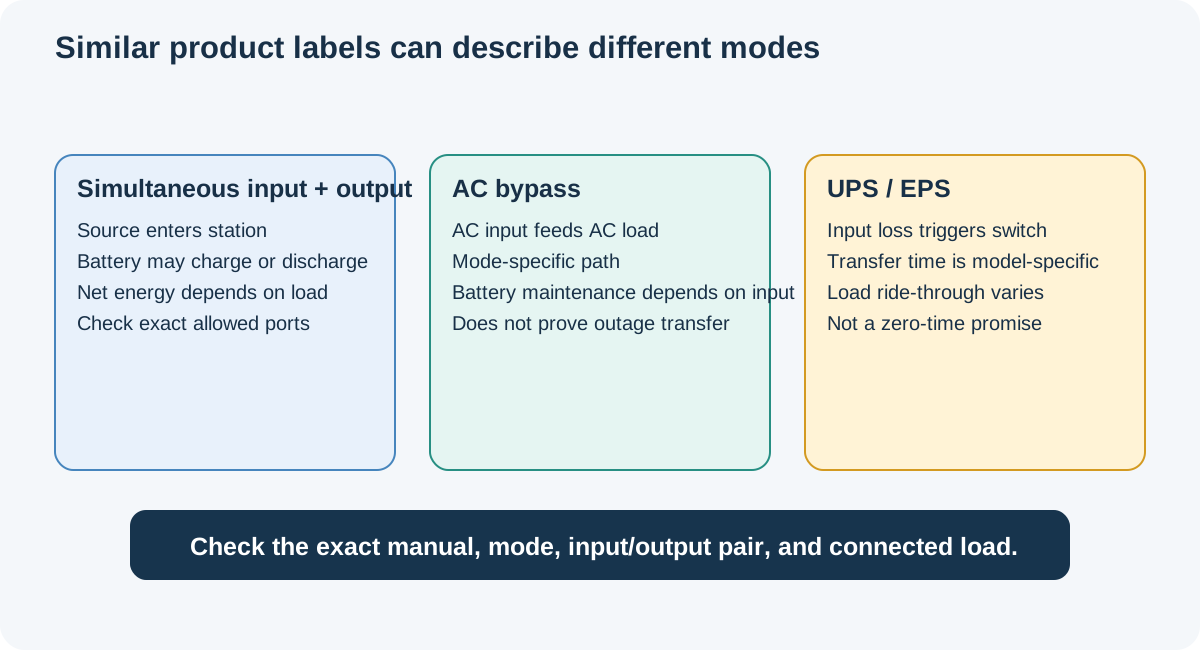
EcoFlow’s DELTA 3 Classic manual calls simultaneous AC input and AC output “bypass mode” and separately describes a standby UPS with a 10 ms transfer time. It also says grid input needs to exceed the connected load if the battery is to be maintained. BLUETTI’s AC180 manual describes simultaneous charging and discharging and a ≤20 ms UPS switch time. These are different manufacturer claims for different products and modes, not a ranking or a no-break guarantee.
The US AC180P manual says pass-through charging is supported, but that alone does not document a transfer time or establish that a sensitive load will stay on. Do not transfer AC180 behavior to AC180P. BLUETTI also warns that the AC180P is for off-grid use and must not connect its AC output to the grid.
Check the complete power balance
When input power is lower than the load and conversion losses, the battery may continue to discharge while the station reports that it is charging. When input exceeds the load, only the remaining accepted energy can replenish the battery, subject to the station’s charging limits and battery state. The AC output rating, source input rating, mode-specific ceiling, and battery reserve are separate constraints.
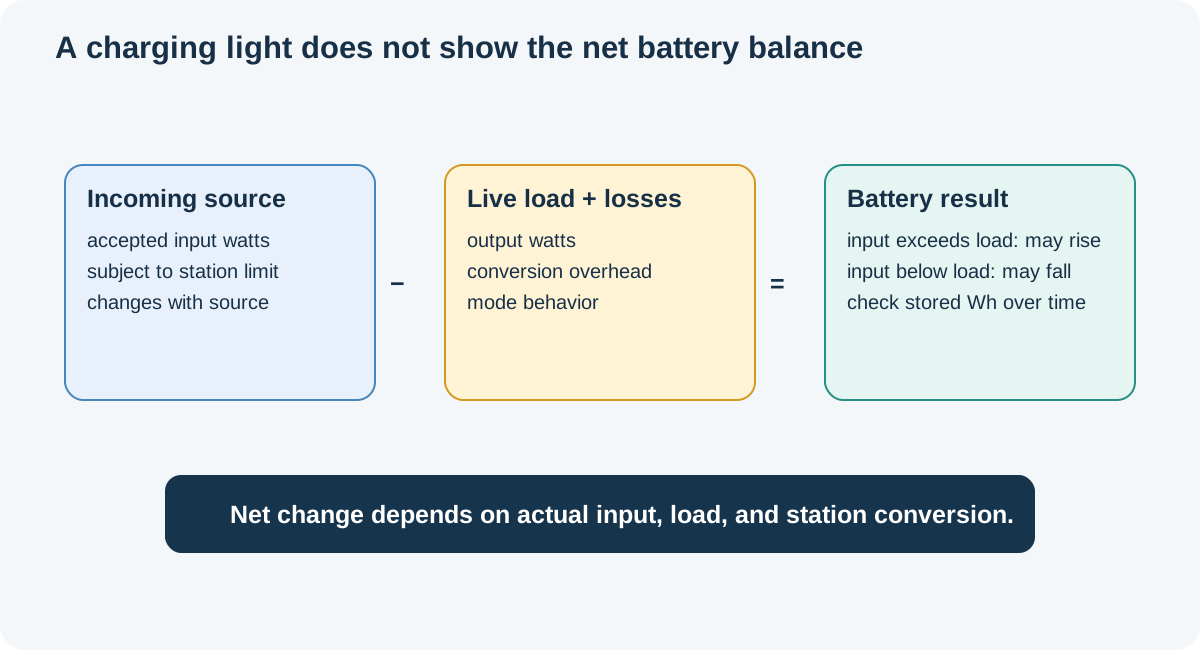
Before depending on the behavior, confirm that the manual permits the exact combination of source, input port, output port, and mode. Check continuous and surge output, battery reserve, thermal limits, and any low-load shutoff. For backup use, verify the connected device’s transfer tolerance with its manufacturer. A documented transfer time is not evidence that a device with a zero-interruption requirement will tolerate it.
Do not connect a station output to utility wiring or use it as a grid interconnection. Test only ordinary, noncritical loads and follow the product’s current manual. If the intended load is medical, life-safety, or otherwise interruption-sensitive, use an appropriate approved backup arrangement and obtain manufacturer guidance.
For vehicle or wall charging choices, read the charging-source comparison. For the difference between added stored energy and output power, see the expansion guide.
Key Points
- Simultaneous charging, bypass, pass-through, and UPS/EPS are not interchangeable terms.
- A charging indicator does not prove the battery is gaining energy.
- Transfer-time claims apply to the named model and mode and do not establish zero interruption.
- Check exact input/output combinations, load limits, and the intended device’s requirements.